




























0
Views
0
Downloads

0.0
0
Save
0 Likes
Share
Develop Empathy Skills Worksheet
0 Views
0 Downloads

Paste this activity's link or code into your existing LMS (Google Classroom, Canvas, Teams, Schoology, Moodle, etc.).
Students can open and work on the activity right away, with no student login required.
You'll still be able to track student progress and results from your teacher account.
Information
Description
What It Is:
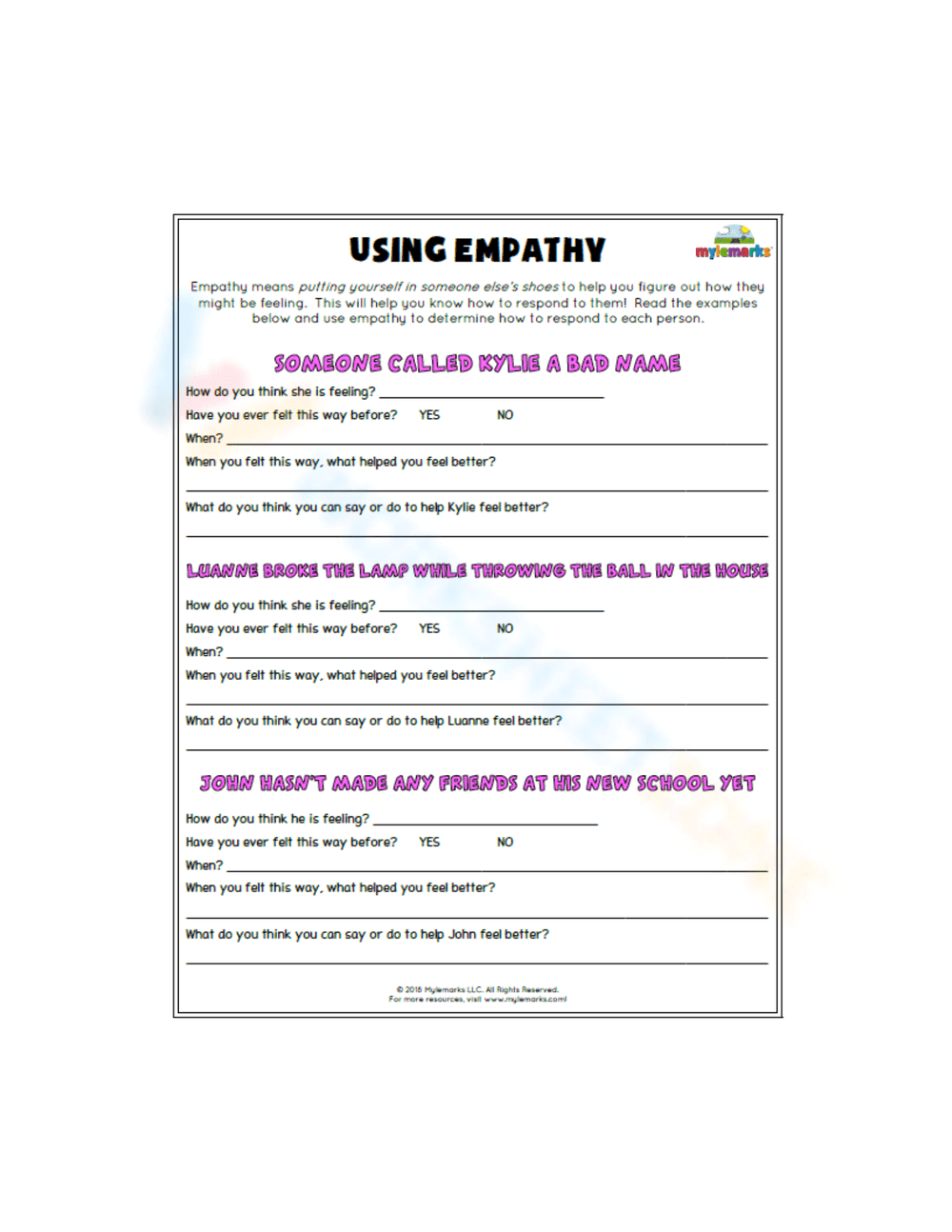
This is an educational worksheet titled 'Using Empathy.' It presents three different scenarios: 'Someone called Kylie a bad name,' 'Luann breaks the lamp while throwing the ball in the room,' and 'John hasn't made any friends at his new school yet.' For each scenario, the worksheet asks the student to consider how the person might be feeling, whether they've ever felt that way before, what helped them feel better when they felt that way, and what they think they can say or do to help the person in the scenario feel better.
Grade Level Suitability:
This worksheet is suitable for grades 2-5. The scenarios are relatable to this age group, and the questions encourage them to think about feelings and perspective-taking in a way that is developmentally appropriate.
Why Use It:
This worksheet promotes social-emotional learning by helping students develop empathy. It encourages them to consider different perspectives, understand emotions, and brainstorm ways to support others. It helps students build social skills and emotional intelligence.
How to Use It:
Students should read each scenario carefully. Then, they should answer the questions related to each scenario, reflecting on their own experiences and considering the feelings of the person described. The worksheet can be used individually, in small groups, or as a class discussion prompt.
Target Users:
This worksheet is ideal for elementary school students, counselors, teachers, and parents who want to foster empathy and social skills in children. It is also useful for children who struggle with understanding the feelings of others.
This is an educational worksheet titled 'Using Empathy.' It presents three different scenarios: 'Someone called Kylie a bad name,' 'Luann breaks the lamp while throwing the ball in the room,' and 'John hasn't made any friends at his new school yet.' For each scenario, the worksheet asks the student to consider how the person might be feeling, whether they've ever felt that way before, what helped them feel better when they felt that way, and what they think they can say or do to help the person in the scenario feel better.
Grade Level Suitability:
This worksheet is suitable for grades 2-5. The scenarios are relatable to this age group, and the questions encourage them to think about feelings and perspective-taking in a way that is developmentally appropriate.
Why Use It:
This worksheet promotes social-emotional learning by helping students develop empathy. It encourages them to consider different perspectives, understand emotions, and brainstorm ways to support others. It helps students build social skills and emotional intelligence.
How to Use It:
Students should read each scenario carefully. Then, they should answer the questions related to each scenario, reflecting on their own experiences and considering the feelings of the person described. The worksheet can be used individually, in small groups, or as a class discussion prompt.
Target Users:
This worksheet is ideal for elementary school students, counselors, teachers, and parents who want to foster empathy and social skills in children. It is also useful for children who struggle with understanding the feelings of others.


