


























1 / 2
0
Views
0
Downloads


0.0
0
Save
0 Likes
Share
Identify Variables in Scientific Experiments
0 Views
0 Downloads
Paste this activity's link or code into your existing LMS (Google Classroom, Canvas, Teams, Schoology, Moodle, etc.).
Students can open and work on the activity right away, with no student login required.
You'll still be able to track student progress and results from your teacher account.
Information
Description
What It Is:
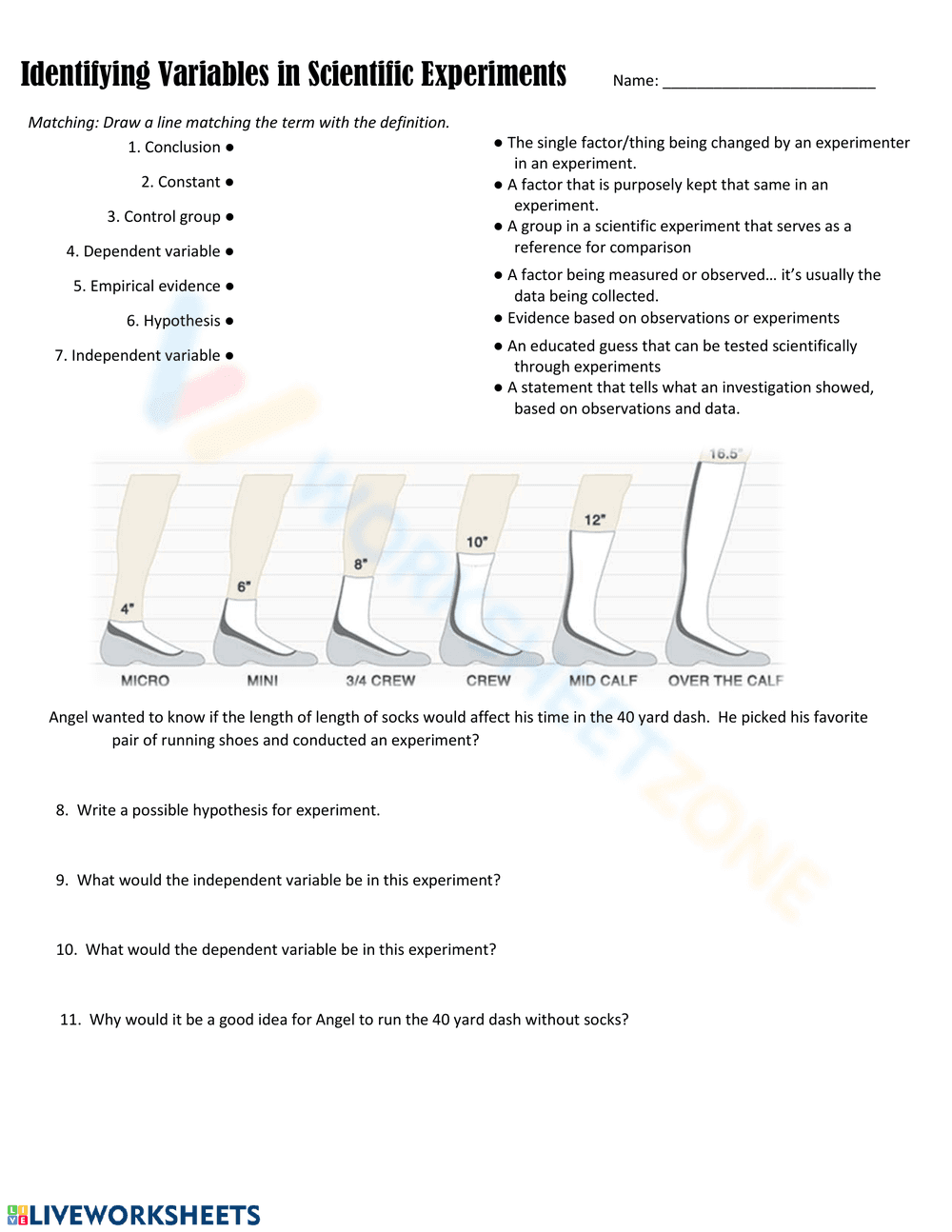
This is a science worksheet titled 'Identifying Variables in Scientific Experiments.' It includes a matching section where students must match scientific terms like 'Conclusion,' 'Constant,' 'Control group,' 'Dependent variable,' 'Empirical evidence,' 'Hypothesis,' and 'Independent variable' to their definitions. It also presents a scenario about a person named Angel testing the effect of sock length on 40-yard dash time, followed by questions that ask students to write a hypothesis, identify the independent and dependent variables, and provide a reason for running the dash without socks. There's also a visual showing different sock lengths.
Grade Level Suitability:
This worksheet is suitable for grades 6-8. The concepts of independent and dependent variables, hypothesis formation, and experimental design are typically introduced and reinforced at this level. The vocabulary and complexity of the questions are appropriate for middle school students.
Why Use It:
This worksheet reinforces understanding of key scientific method concepts, including identifying variables, forming hypotheses, and understanding experimental design. It encourages critical thinking and application of scientific principles to a real-world scenario. The matching section helps solidify definitions, while the scenario-based questions promote deeper understanding.
How to Use It:
Students should begin by reading the definitions provided and matching them to the correct scientific terms using lines. Then, they should carefully read the scenario about Angel and the sock experiment. Based on the scenario, they should answer the questions by writing a possible hypothesis, identifying the independent and dependent variables, and explaining the rationale for running the dash without socks.
Target Users:
This worksheet is designed for middle school students (grades 6-8) learning about the scientific method and experimental design. It is also suitable for teachers who need to assess student understanding of scientific variables and hypothesis formation.
This is a science worksheet titled 'Identifying Variables in Scientific Experiments.' It includes a matching section where students must match scientific terms like 'Conclusion,' 'Constant,' 'Control group,' 'Dependent variable,' 'Empirical evidence,' 'Hypothesis,' and 'Independent variable' to their definitions. It also presents a scenario about a person named Angel testing the effect of sock length on 40-yard dash time, followed by questions that ask students to write a hypothesis, identify the independent and dependent variables, and provide a reason for running the dash without socks. There's also a visual showing different sock lengths.
Grade Level Suitability:
This worksheet is suitable for grades 6-8. The concepts of independent and dependent variables, hypothesis formation, and experimental design are typically introduced and reinforced at this level. The vocabulary and complexity of the questions are appropriate for middle school students.
Why Use It:
This worksheet reinforces understanding of key scientific method concepts, including identifying variables, forming hypotheses, and understanding experimental design. It encourages critical thinking and application of scientific principles to a real-world scenario. The matching section helps solidify definitions, while the scenario-based questions promote deeper understanding.
How to Use It:
Students should begin by reading the definitions provided and matching them to the correct scientific terms using lines. Then, they should carefully read the scenario about Angel and the sock experiment. Based on the scenario, they should answer the questions by writing a possible hypothesis, identifying the independent and dependent variables, and explaining the rationale for running the dash without socks.
Target Users:
This worksheet is designed for middle school students (grades 6-8) learning about the scientific method and experimental design. It is also suitable for teachers who need to assess student understanding of scientific variables and hypothesis formation.


