


























Views
Downloads
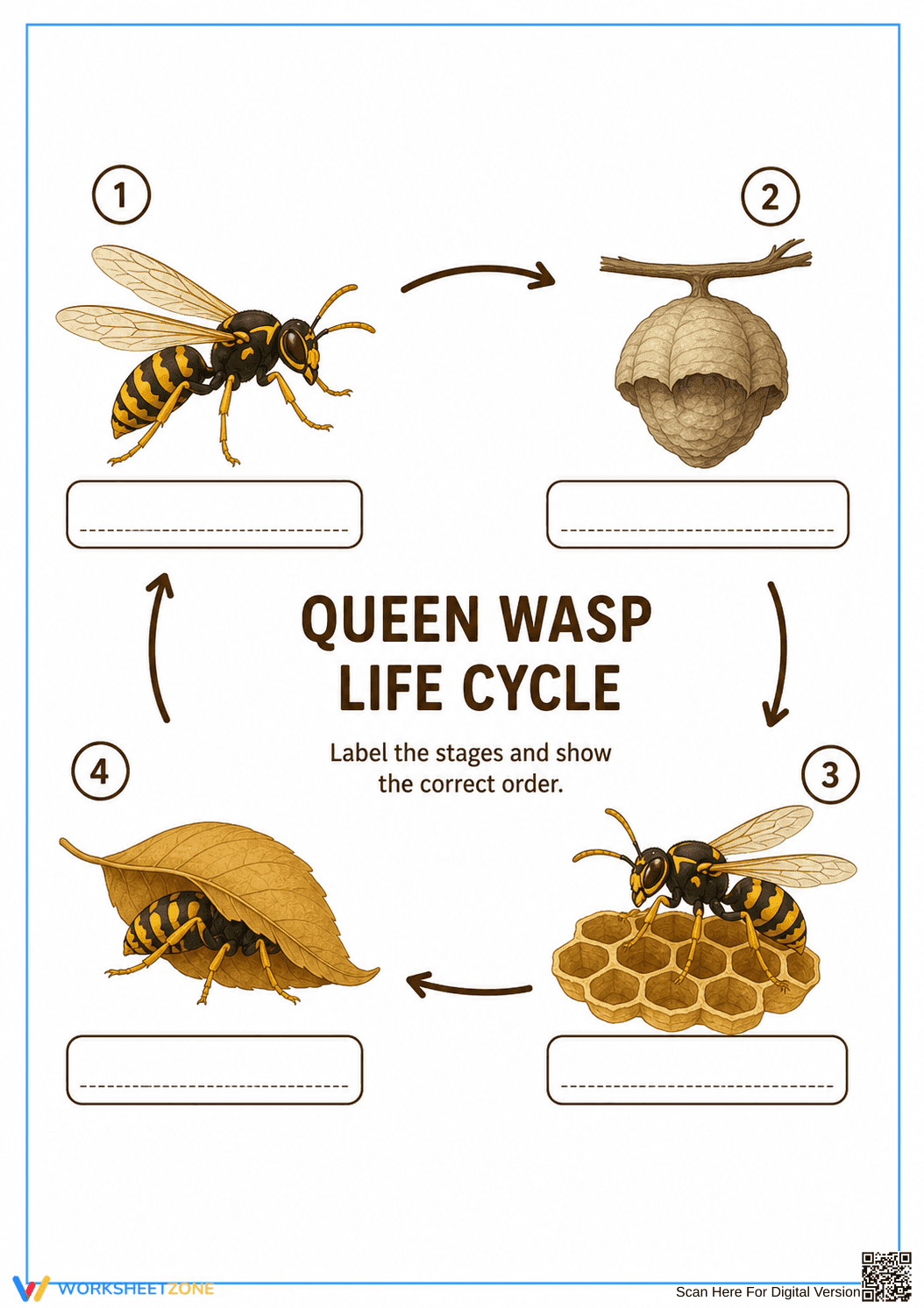

Grade 6 Wasp Life Cycle — Printable No-Prep Worksheet
Paste this activity's link or code into your existing LMS (Google Classroom, Canvas, Teams, Schoology, Moodle, etc.).
Students can open and work on the activity right away, with no student login required.
You'll still be able to track student progress and results from your teacher account.
This ready-to-use science worksheet helps students master the stages of the queen wasp life cycle by labeling and sequencing key developmental phases. Analyzing this insect life cycle builds a foundational understanding of animal survival strategies and ecosystem roles without requiring extensive teacher preparation.
At a Glance
- Grade: 6 · Subject: Science
- Standard:
MS-LS1-4— Explain how animal behaviors affect successful reproduction- Skill Focus: Labeling and sequencing life cycle stages
- Format: 1 page · 4 problems · Answer key included · PDF
- Best For: Independent practice and review
- Time: 10–15 minutes
This single-page resource features a clear diagram illustrating the four primary stages of a queen wasp's life. The worksheet features four distinct labeling tasks where students must identify each stage and indicate the correct chronological sequence using the provided blank boxes. A complete answer key is included to ensure accurate grading and provide immediate feedback to students.
Enjoy a streamlined zero-prep workflow:
- Print (1 minute): Simply download the PDF and print the required number of copies.
- Distribute (1 minute): Hand out the worksheet as a standalone activity, bell-ringer, or science station task. The instructions are completely self-explanatory.
- Review (3 minutes): Use the included answer key to quickly check student responses or project it on the board for self-correction.
With a total teacher preparation time of under two minutes, this worksheet is an excellent option for emergency sub plans or last-minute schedule changes.
This activity is aligned to the Next Generation Science Standard MS-LS1-4: Use argument based on empirical evidence and scientific reasoning to support an explanation for how characteristic animal behaviors and specialized plant structures affect the probability of successful reproduction of animals and plants respectively. Studying the queen wasp's life cycle highlights behaviors ensuring species survival. Both standard codes can be copied directly into lesson plans, IEP goals, or district curriculum mapping tools.
Deploy this worksheet during direct instruction as a guided note-taking tool. As you explain seasonal habits, students fill in the diagram, reinforcing concepts in real-time. Alternatively, use it as a formative assessment after an insect unit. Observation tip: watch whether students correctly sequence the hibernation phase, which often confuses learners. Expected completion time is 10 to 15 minutes.
This worksheet is primarily designed for middle school science students in grades 5 and 6. It serves as an excellent visual scaffold for English Language Learners (ELLs) or students who benefit from graphic organizers when processing complex biological sequences. For a comprehensive lesson, pair this diagram with a reading passage on ecosystem dynamics or a direct instruction lesson comparing solitary versus social insects.
Integrating visual diagrams into middle school science instruction significantly enhances student comprehension of cyclical biological processes. According to a ScienceDirect TpT Analysis (2024), students who engage with structured labeling tasks demonstrate higher retention rates when mapping complex systems compared to traditional text-only instruction. This worksheet directly supports MS-LS1-4 by requiring students to explain how animal behaviors affect successful reproduction through the specific lens of the queen wasp. By actively sequencing the stages from nest building to hibernation, learners connect physical adaptations to seasonal survival strategies. The clear, step-by-step format reduces cognitive load, allowing students to focus entirely on the scientific concepts rather than deciphering complicated instructions. This targeted approach ensures that foundational life science principles are firmly established, preparing students for more advanced ecological studies in subsequent grade levels.


