


























Views
Downloads

Essential Wasp Life Cycle Worksheet | Grade 6-7 Science
Paste this activity's link or code into your existing LMS (Google Classroom, Canvas, Teams, Schoology, Moodle, etc.).
Students can open and work on the activity right away, with no student login required.
You'll still be able to track student progress and results from your teacher account.
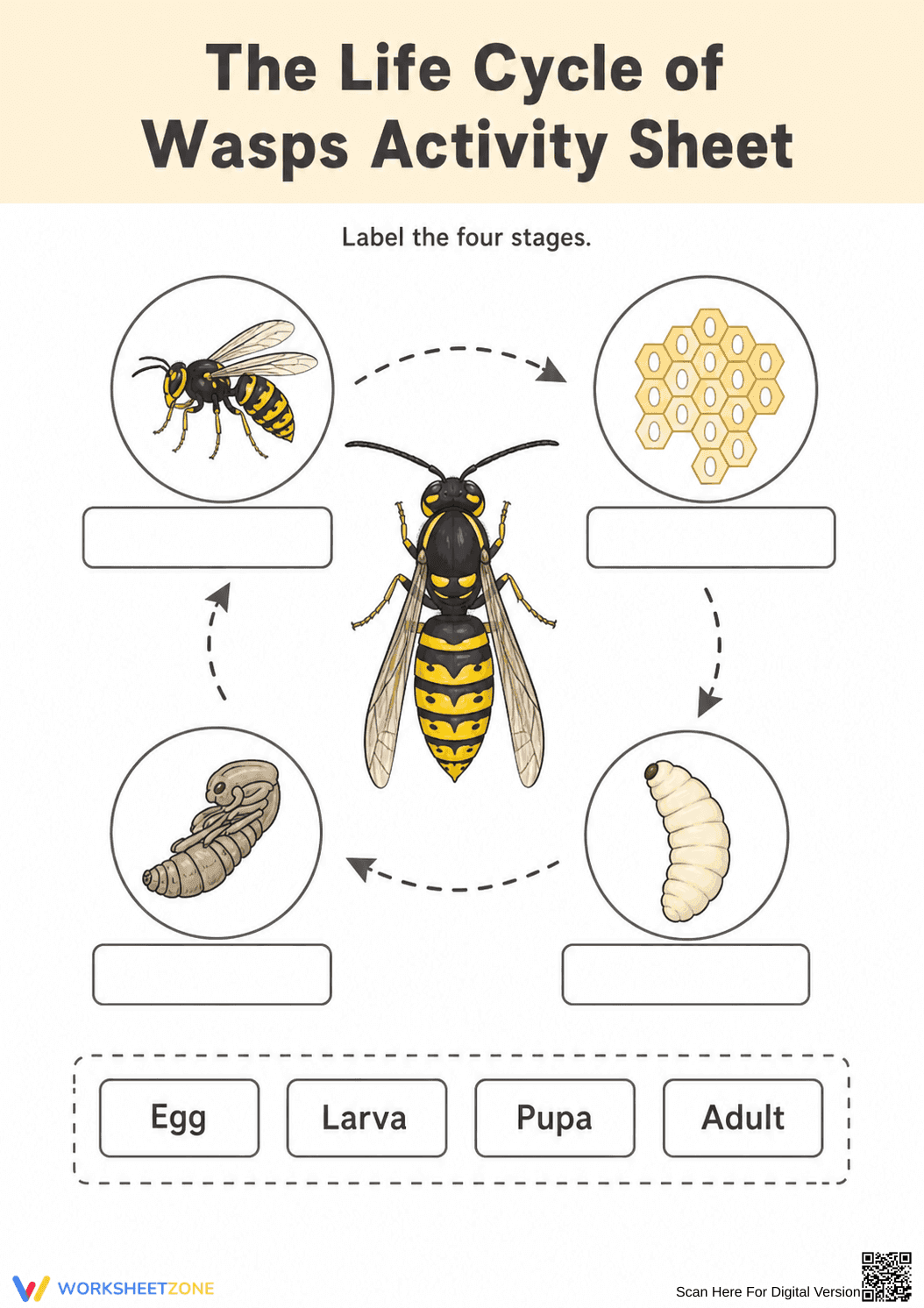
This Grade 6 and 7 science worksheet provides a clear, visual framework for students to identify and label the four distinct stages of wasp metamorphosis. By engaging with the diagram, learners solidify their understanding of biological growth cycles and the specific developmental transitions from egg to adult. It is an effective tool for reinforcing life science vocabulary.
At a Glance
- Grade: 6-7 · Subject: Life Science
- Standard:
MS-LS1-4— Explain how animal growth and development cycles support successful reproduction and survival- Skill Focus: Metamorphosis Stage Identification
- Format: 1 page · 4 problems · Answer key included · PDF
- Best For: Quick formative assessment or bell-ringer activity
- Time: 10–15 minutes
This single-page PDF features a high-quality anatomical diagram of a wasp surrounded by the four stages of its life cycle. The worksheet includes four dedicated labeling boxes and a convenient word bank containing the terms Egg, Larva, Pupa, and Adult. A comprehensive answer key is provided to facilitate rapid grading or student self-correction during independent study.
This resource is designed for immediate classroom implementation. Teachers can print the single-page PDF in less than 30 seconds. Distribution to a standard class takes approximately one minute. Finally, reviewing the four stages as a whole-group activity requires only three minutes of instructional time. This makes it an ideal emergency sub plan or a transition task between lessons.
This activity aligns with `MS-LS1-4`, which requires students to use empirical evidence to support explanations for how characteristic animal behaviors and specialized structures affect the probability of successful reproduction. By identifying the pupa and larva stages, students recognize the specialized developmental phases necessary for insect survival. Both standard codes can be copied directly into lesson plans, IEP goals, or district curriculum mapping tools.
Use this worksheet as a "Do Now" activity at the start of a unit on invertebrates to gauge prior knowledge of metamorphosis. Alternatively, assign it as a formative exit ticket after a lecture on Hymenoptera to verify that students can distinguish between the larval and pupal stages. Expect students to complete the labeling and brief discussion in 12 minutes.
This resource is tailored for middle school science students, particularly those in general biology or life science tracks. It provides excellent support for English Language Learners (ELLs) through visual cues and a word bank. It pairs naturally with a digital presentation on insect anatomy or a physical specimen observation lab.
The wasp life cycle activity is anchored in the MS-LS1-4 standard, focusing on the plain-English skill of identifying developmental stages in animal life cycles. According to the RAND AIRS 2024 report on science literacy, visual scaffolding in biological diagrams significantly improves retention of complex terminology among middle school learners. By utilizing a structured labeling task, this worksheet reduces cognitive load while reinforcing the sequence of complete metamorphosis. Research from Fisher & Frey (2014) suggests that "word-to-image" association tasks are critical for developing scientific literacy in the middle grades. This worksheet provides the necessary repetition for students to master the distinction between holometabolous stages. It serves as a foundational component for broader ecological studies, ensuring students possess the prerequisite vocabulary to discuss reproductive success and environmental adaptation. The inclusion of a word bank further supports diverse learners in achieving mastery of core biological concepts.


