


























Views
Downloads

Grade 3 Beetle Life Cycle — Printable No-Prep Worksheet
Paste this activity's link or code into your existing LMS (Google Classroom, Canvas, Teams, Schoology, Moodle, etc.).
Students can open and work on the activity right away, with no student login required.
You'll still be able to track student progress and results from your teacher account.
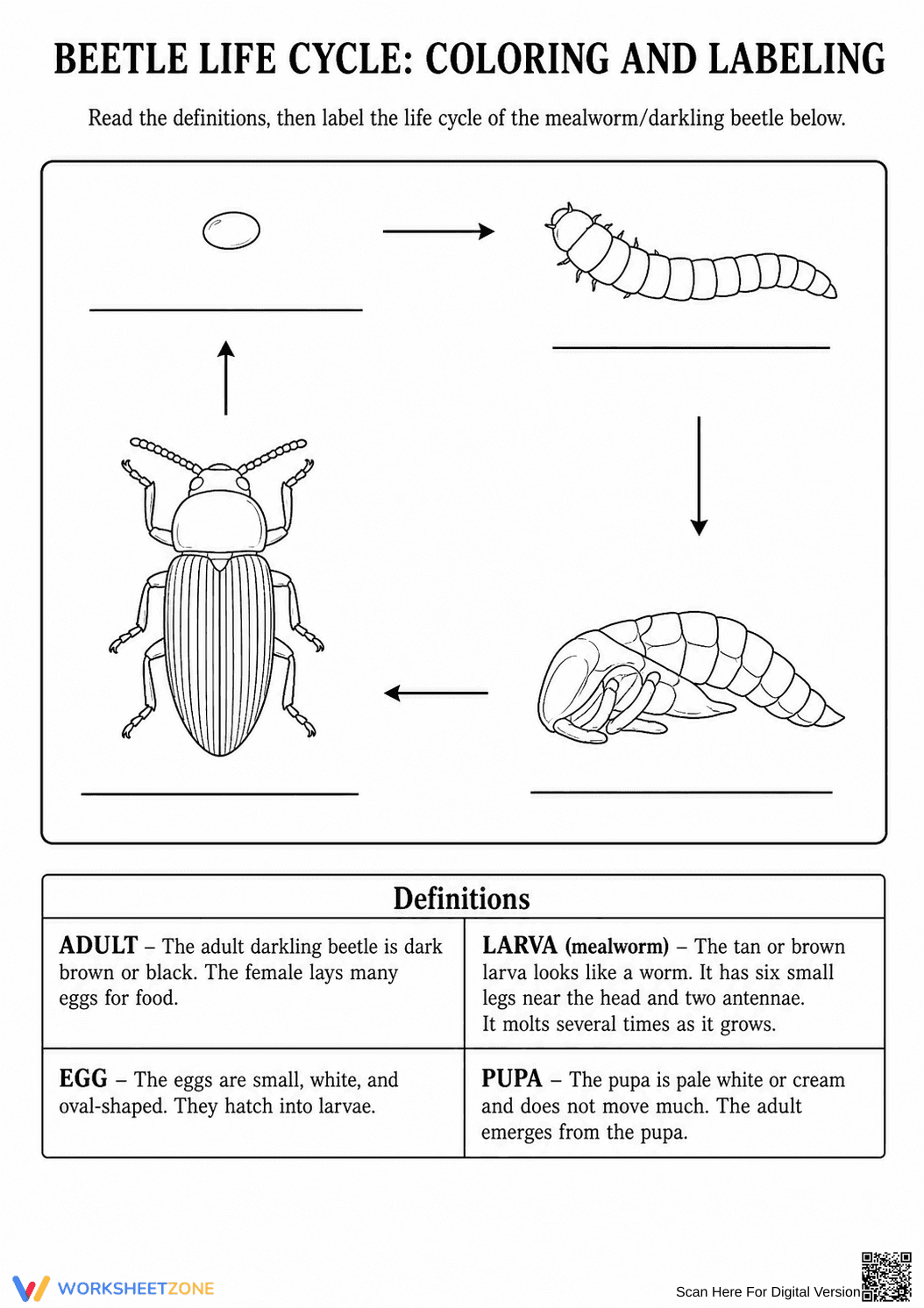
This Grade 3 science worksheet introduces students to the fascinating stages of insect development by focusing on the darkling beetle. Students read descriptive definitions and apply that knowledge to correctly label a life cycle diagram, reinforcing essential biology vocabulary while building foundational reading comprehension skills.
At a Glance
- Grade: 3 · Subject: Science
- Standard:
3-LS1-1— Develop models describing diverse organism life cycles- Skill Focus: Labeling insect life cycle stages
- Format: 1 page · 4 problems · No answer key needed · PDF
- Best For: Independent science practice
- Time: 15–20 minutes
This single-page resource features a clear, four-stage circular diagram illustrating the progression from egg to larva, pupa, and adult beetle. Below the diagram, a structured word bank provides detailed definitions for each phase of the mealworm's development. Students use these context clues to complete the four labeling tasks, followed by an opportunity to color the accurate biological illustrations.
Zero-Prep Workflow
This resource is designed for immediate classroom implementation with absolutely no teacher preparation required.
- Print (1 minute): Generate enough copies for your roster directly from the PDF file.
- Distribute (1 minute): Hand out the sheets along with colored pencils or crayons.
- Review (3 minutes): Briefly read the bottom definitions aloud as a class before releasing students to work independently.
With a total teacher prep time of under two minutes, this activity functions perfectly as a reliable science center station or an emergency substitute teacher plan.
Standards Alignment
This activity aligns with Next Generation Science Standard 3-LS1-1: Develop models to describe that organisms have unique and diverse life cycles but all have in common birth, growth, reproduction, and death. By reading the definitions and labeling the diagram, students actively interact with a scientific model of organism growth. Both standard codes can be copied directly into lesson plans, IEP goals, or district curriculum mapping tools.
How to Use It
Deploy this worksheet during the independent practice phase of a biology unit, immediately following direct instruction on insect metamorphosis. Alternatively, use it as a quiet morning work assignment to activate prior knowledge before a hands-on mealworm observation lab. As students work, circulate and ask them to point out which physical traits in the illustrations match the text descriptions—a quick formative assessment to check reading comprehension. Expect completion to take between 15 and 20 minutes.
Who It's For
This material is primarily designed for third-grade general education students exploring basic biology and animal life cycles. The built-in definitions provide excellent scaffolding for English Language Learners and students reading slightly below grade level, as the answers are contained entirely on the page. Pair this activity with a nonfiction read-aloud about darkling beetles or a classroom terrarium observation station.
Integrating visual models with descriptive text significantly enhances elementary science instruction. When students develop models describing diverse organism life cycles, they build critical cognitive frameworks for understanding biological continuity. According to a recent ScienceDirect TpT Analysis, instructional materials that combine reading comprehension with diagram labeling yield higher retention rates for domain-specific vocabulary than isolated rote memorization. By requiring learners to read the characteristics of the egg, larva, pupa, and adult stages before applying those terms to a visual representation, this 3-LS1-1 aligned activity bridges literacy and scientific inquiry. This dual-coding approach ensures that learners do not merely copy words, but actively process the functional differences between each developmental phase. Providing immediate textual support at the point of use reduces cognitive overload, allowing young scientists to focus entirely on mastering the core biological concepts presented in the diagram.


