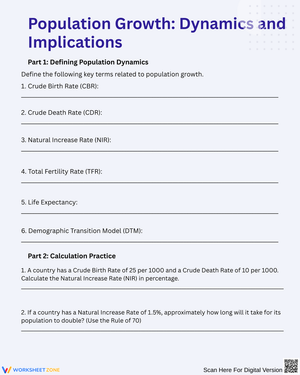
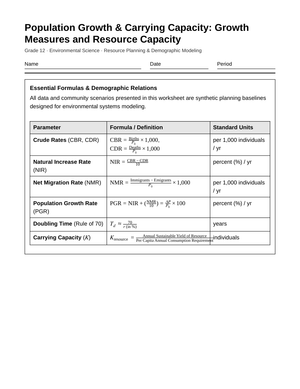
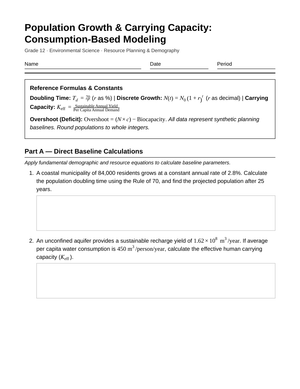
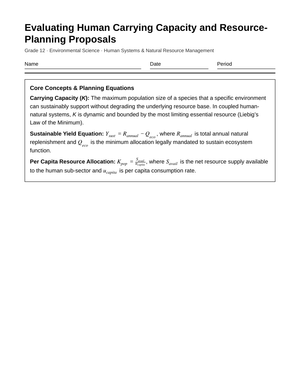
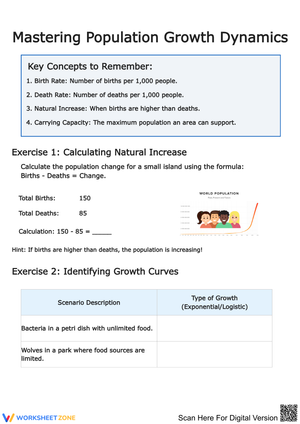
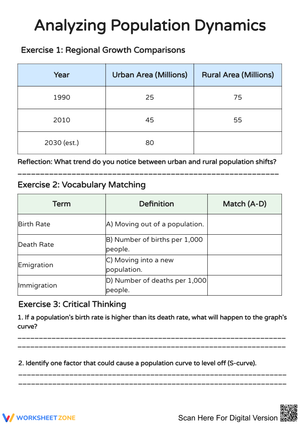
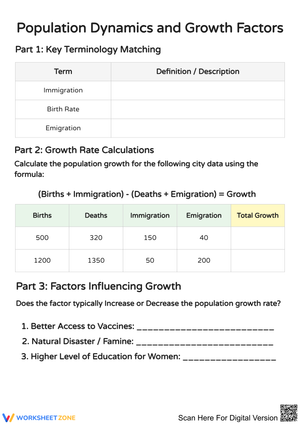
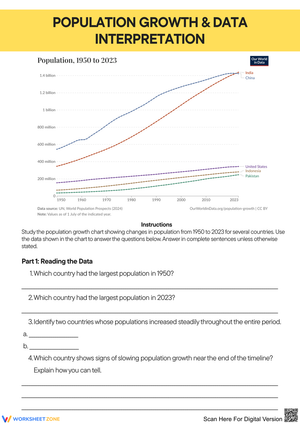
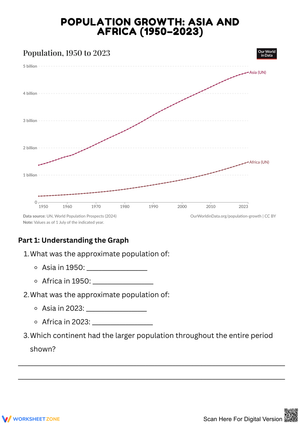
If you are planning a human impact or ecology unit, you likely need more than a definition worksheet. Middle school students studying population growth need practice reading real trend data, calculating rates, and turning numbers into evidence-based arguments. Population growth worksheets built around current global data give you a ready entry point for that work, whether you are opening a unit, running a small-group intervention, or checking understanding before a test.
Regional Data Makes Rate-of-Change Concrete
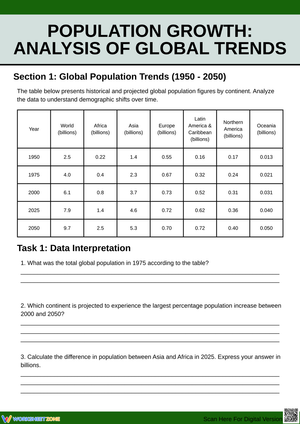
Global averages hide a lot of variation, and that variation is exactly what makes for strong data-analysis practice. Africa's population is growing at roughly 2.5 percent per year, about five times the global average. Asking students to compare Africa's growth rate to the global rate side by side turns an abstract percentage into a concrete comparison they can graph, calculate, and discuss.
This kind of regional contrast also sets up cross-curricular math practice. Students calculate percentages, compare rates of change, and interpret what a five-times difference actually means for two regions with very different population trajectories.
Aligning Worksheets to NGSS Human Impact Standards
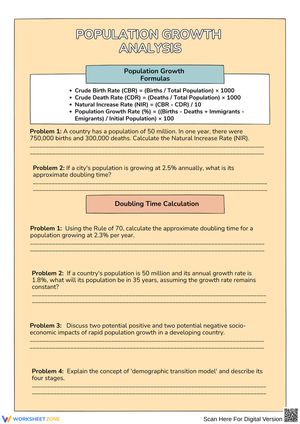
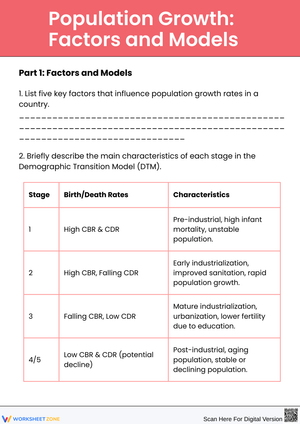
NGSS standard MS-ESS3-4 requires students to construct an argument supported by evidence for how increases in human population and per-capita resource consumption impact Earth's systems. Population growth worksheets that pair a data set with a claim-evidence-reasoning writing prompt give students direct, low-stakes practice with exactly this performance expectation before they face it on a summative assessment.
NGSS standard MS-ESS3-3 asks students to apply scientific principles to design a method for monitoring and minimizing human impact on the environment. Once students understand how population growth data is structured, they are better equipped to design a monitoring plan grounded in real numbers rather than vague generalizations. Guidance on meeting these performance expectations through population content is detailed in Meet the NGSS Science Standards from Population Education, and the standard language itself is available through MS-ESS3-3 Earth and Human Activity on the Next Generation Science Standards site.
Classroom Implementation
Start a lesson by projecting the 8.3 billion figure and asking students to predict the annual growth rate before you reveal it is 0.84 percent. This prediction-reveal routine works well because most students overestimate the rate, which creates a natural hook for discussing why growth has slowed since the 1960s.
For small-group intervention, pull four or five students and have them work through the Africa versus global growth-rate comparison together, talking through the calculation step by step. This is a strong formative checkpoint before a unit test, since it reveals whether students can both compute a rate and explain what it means in context.
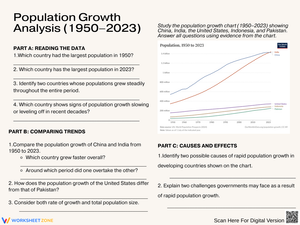
For a full-class formative assessment, assign the projection task: have students plot the 2026 figure and the 2084 projected peak, then write two sentences describing the shape of the curve between those points. Collect these as an exit ticket to gauge readiness before moving into the resource consumption portion of your unit.
Frequently Asked Questions
1. What grade levels are population growth worksheets appropriate for in a US science curriculum
These worksheets fit best in grades 6 through 8, aligned to middle school NGSS human impact standards, though the graph-reading tasks can be scaffolded down for struggling learners or used as a review in early high school environmental science courses.
2. How do these worksheets align with NGSS human impact standards like MS-ESS3-3 and MS-ESS3-4
Worksheets that pair population data with argument-writing prompts directly support MS-ESS3-4's requirement for evidence-based arguments about population and resource consumption, while monitoring-design tasks support MS-ESS3-3's focus on minimizing human impact.
3. How can teachers use population growth data to teach graphing and rate-of-change skills
Have students plot historical and projected population figures, then calculate percentage growth rates between time points, such as comparing the 1960s rate above 2 percent to the current 0.84 percent rate, to build both graphing and percentage-calculation skills.
4. What classroom activities pair well with population growth worksheets for small-group or intervention use
Pair the worksheets with a guided regional comparison, such as Africa's roughly 2.5 percent growth rate against the global average, worked through together in a small group before students attempt an independent argument-writing task.












 Interactive Worksheet Maker
 Quiz Maker
 Word Search Maker
 Crossword Puzzle Maker
 Word Scramble Generator
 Sentence Scramble Generator
 Handwriting Worksheet Generator
 Name Tracing Generator
 Fill In The Blank Generator