


























Views
Downloads



Essential Resource Capacity Worksheet | Grade 12 Science
Paste this activity's link or code into your existing LMS (Google Classroom, Canvas, Teams, Schoology, Moodle, etc.).
Students can open and work on the activity right away, with no student login required.
You'll still be able to track student progress and results from your teacher account.
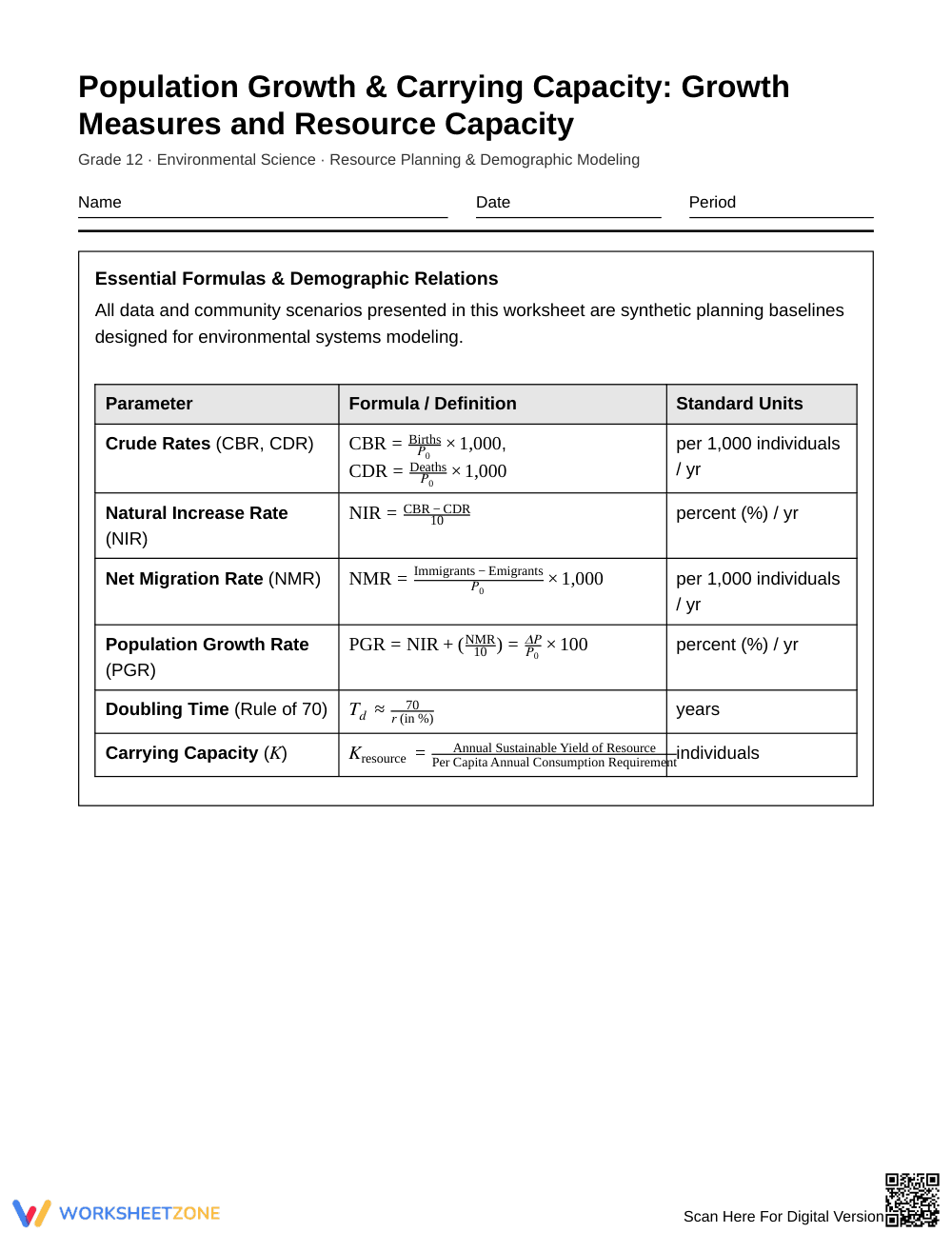
This Grade 12 environmental science worksheet equips high school seniors to analyze demographic rates, model human population kinetics, and calculate environmental carrying capacity. Students evaluate real-world resource constraints, including groundwater yield, agricultural land, electrical grids, and municipal solid waste capacity, through 12 rigorous quantitative and analytical modeling problems.
At a Glance
- Grade: 12 · Subject: Environmental Science
- Skill Focus: Growth Measures and Resource Capacity
- Format: 7 pages · 12 problems · Answer key included · PDF
- Best For: Advanced demographic and carrying capacity modeling
- Time: 60–90 minutes
What's Inside
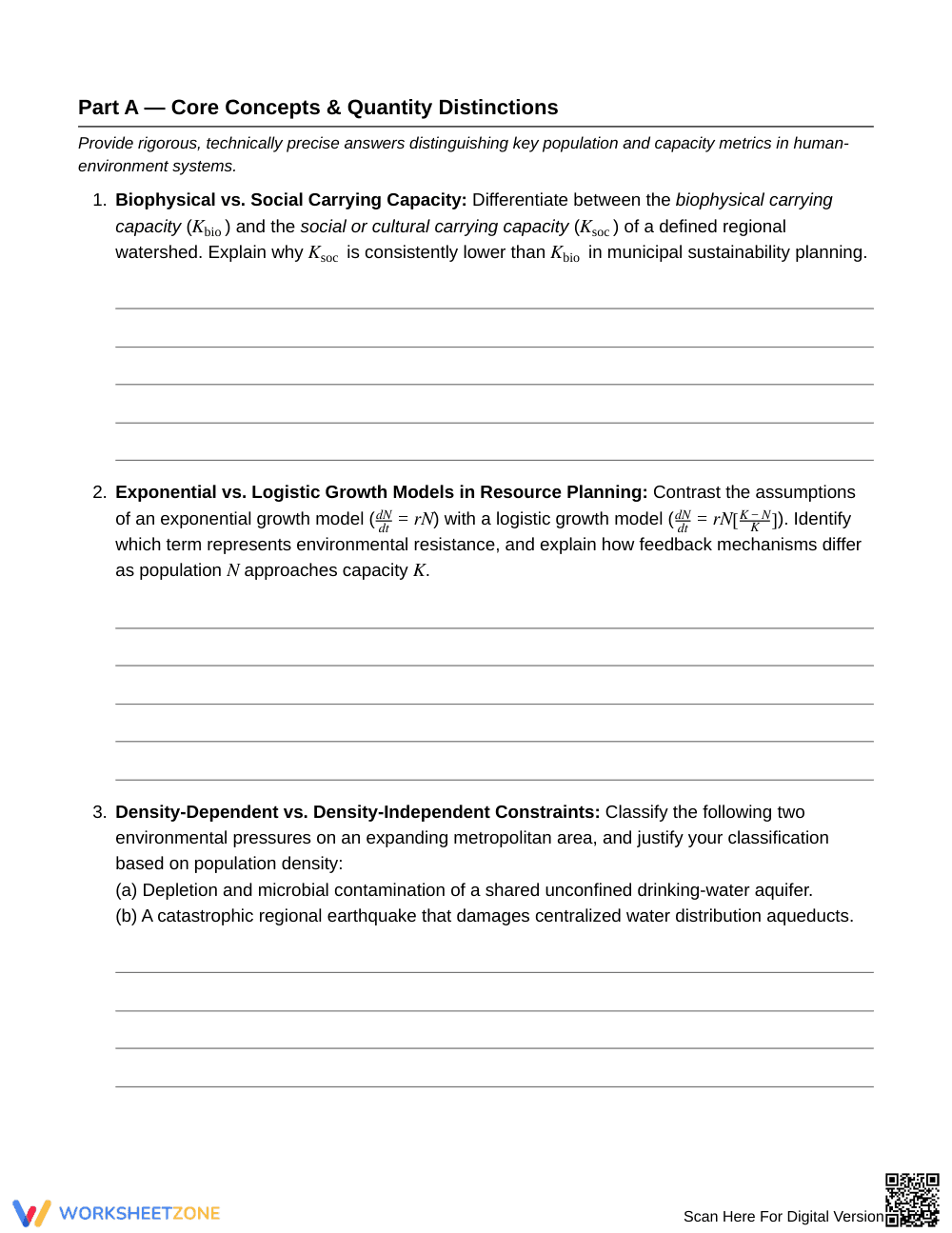
This comprehensive 7-page student packet features a complete demographic reference formula table, 4 conceptual modeling questions, 6 multi-step computational problems, and 2 extended socio-ecological evaluations. A detailed 6-page teacher answer key provides full mathematical steps, dimensional analysis setups, and sample analytical responses.
Skill Progression
- Guided Practice (Part A, Problems 1–4): Conceptual analysis defining biophysical versus social carrying capacity, exponential versus logistic resistance terms, density dependencies, and migration metrics.
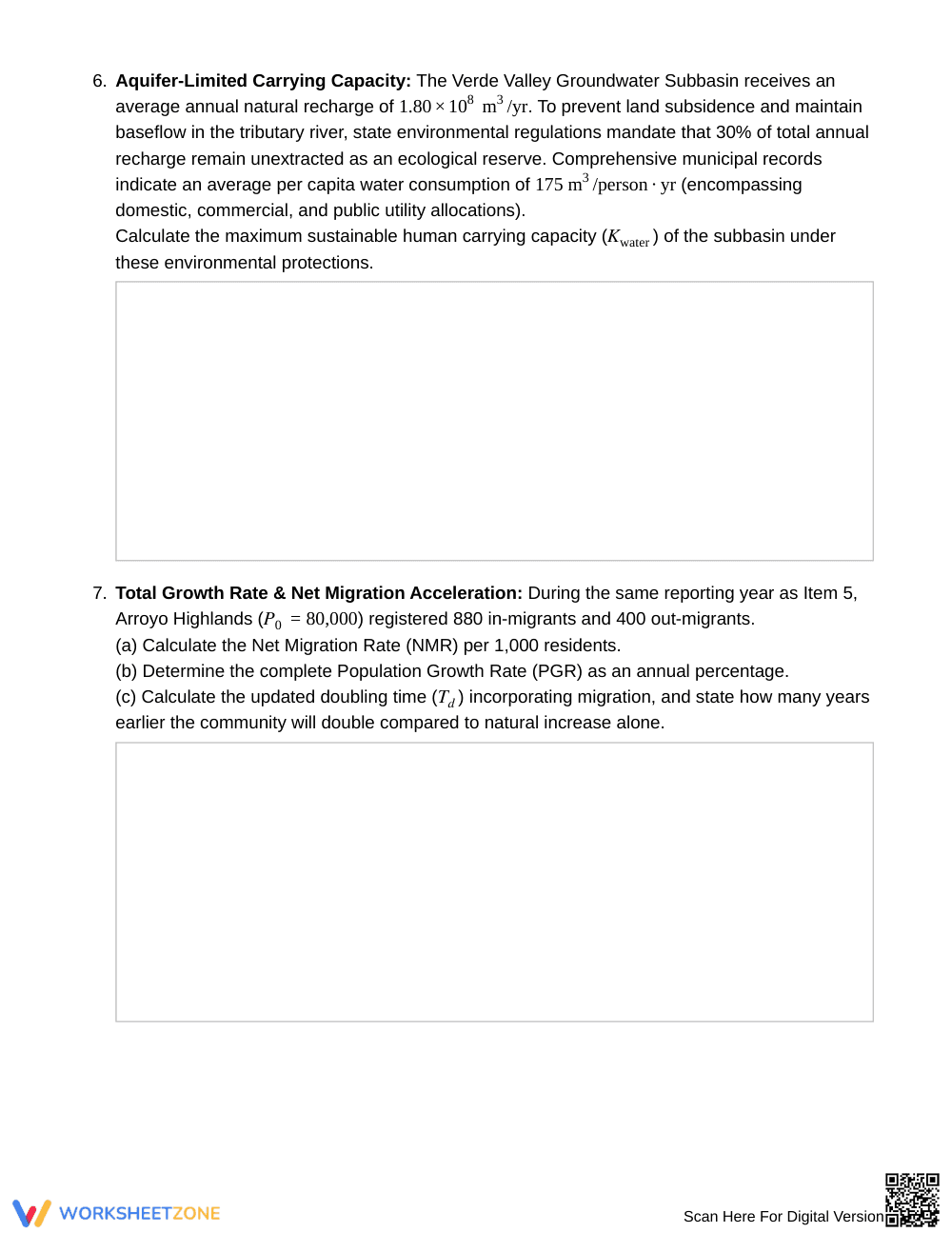
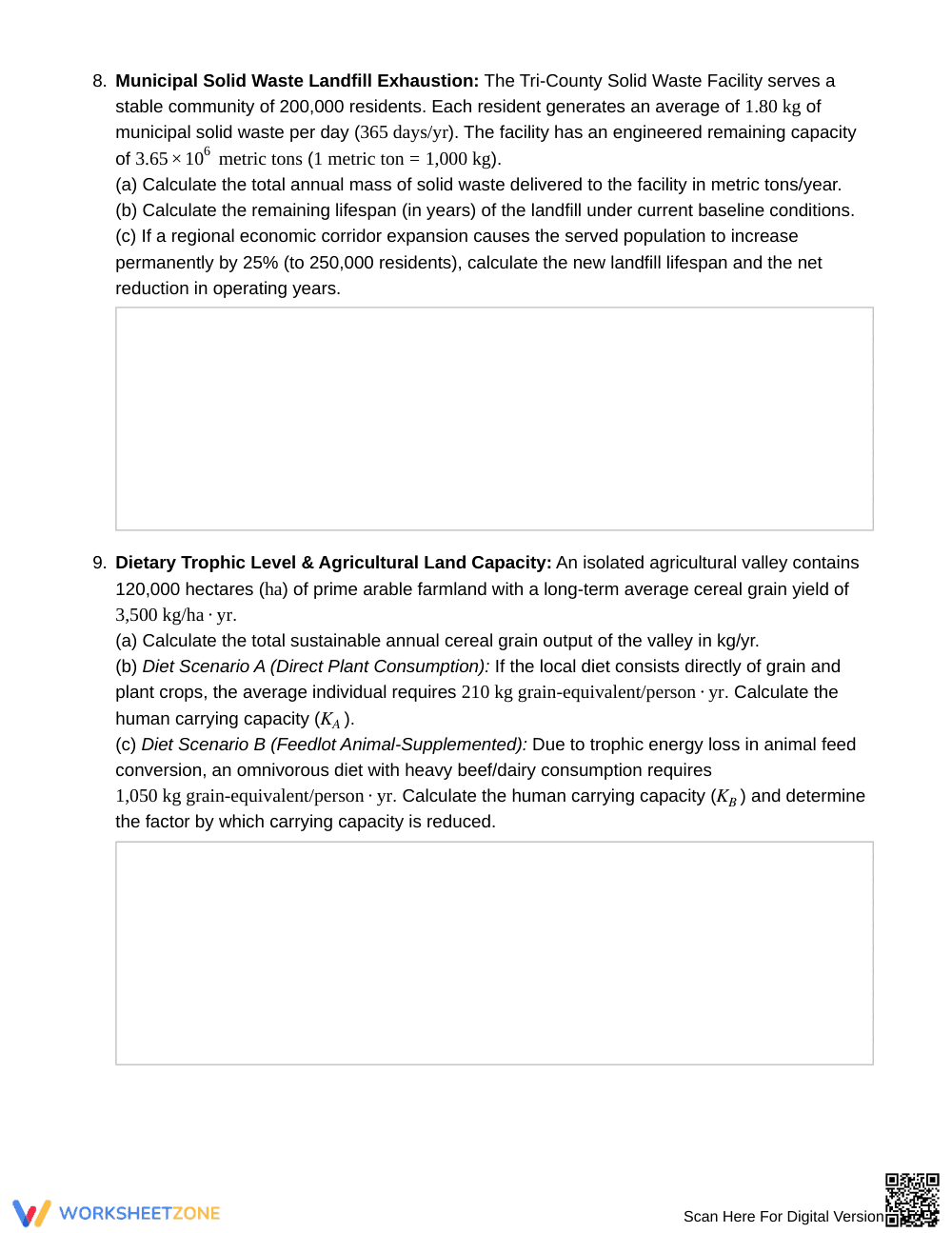
- Supported Practice (Part B, Problems 5–10): Multi-step quantitative calculations determining crude birth and death rates, Rule of 70 doubling times, aquifer-limited carrying capacity, landfill lifespans, trophic calorie limits, and grid bottlenecks using Liebig's Law.
- Independent Practice (Part C, Problems 11–12): High-level synthesis critiquing technological substitution arguments via thermodynamics and debunking municipal net-zero claims through ecological footprint modeling.
This structured progression follows the gradual-release model, bridging foundational demographic principles into authentic municipal planning applications.
Standards Alignment
This activity aligns with high school Earth and Space Sciences standards addressing Earth and Human Activity. Students construct evidence-based models demonstrating how water recharge, soil productivity, and energy availability place mathematical upper bounds on regional populations. Standard statements can be integrated directly into district curriculum frameworks and unit pacing guides.
How to Use It
Deploy this resource following direct instruction on demographic transition theory and population ecology. During student work time, circulate to verify that learners maintain dimensional units throughout multi-step conversions. This assignment functions effectively as a two-day collaborative laboratory analysis or an advanced capstone unit evaluation, typically requiring 60 to 90 minutes.
Who It's For
Designed for Grade 12 Advanced Placement Environmental Science, IB Environmental Systems and Societies, and advanced Earth systems courses. Pair this activity with local regional municipal water reports or demographic census charts to ground theoretical calculations in local civic data.
According to research on science instructional scaffolding by Fisher & Frey (2014), senior secondary students achieve deeper analytical proficiency in environmental systems modeling when quantitative problem sets move systematically from formulaic rate definitions to complex ecological footprint evaluations. This 7-page Grade 12 resource integrates 12 structured tasks that demand both numerical precision and high-level conceptual evaluation of carrying capacity, sustainable yield, and demographic kinetics. By calculating resource limits across groundwater basins, trophic feed conversions, and landfill volumes before critiquing net-zero urban development claims, learners bridge the gap between abstract mathematical models and practical municipal planning constraints. This progressive instructional framework ensures that learners master foundational rate equations before applying their quantitative reasoning to multifaceted regional resource dilemmas, effectively preparing high school scholars to evaluate ecological sustainability data with scientific rigor, mathematical accuracy, and critical clarity.


