


























Views
Downloads



Ready Consumption Tradeoffs Worksheet | Grade 12 Science
Paste this activity's link or code into your existing LMS (Google Classroom, Canvas, Teams, Schoology, Moodle, etc.).
Students can open and work on the activity right away, with no student login required.
You'll still be able to track student progress and results from your teacher account.
This Grade 12 environmental science worksheet equips students to evaluate quantitative tradeoffs when resource consumption and human population change simultaneously. Through applied mathematical modeling and systems thinking, students calculate ecological deficits, determine cultural carrying capacities, and synthesize sustainable resource management policies.
At a Glance
- Grade: 12 · Subject: Environmental Science
- Standard: Environmental Systems — Evaluate resource tradeoffs when demographic scale and per-capita demand shift simultaneously
- Skill Focus: Evaluate Tradeoffs When Consumption and Population Both Change
- Format: 5 pages · 6 problems · Answer key included · PDF
- Best For: Advanced systems modeling and carrying capacity analysis
- Time: 60–90 minutes
What's Inside
This 5-page activity features 6 analytical tasks across three parts, grounded in a theoretical framework of biocapacity and cultural carrying capacity formulas. Problems include watershed demand models, dietary land calculations, decarbonization pathways, and Jevons paradox dynamics. A 3-page answer key provides complete algebraic solutions and policy scoring rubrics.
Skill Progression
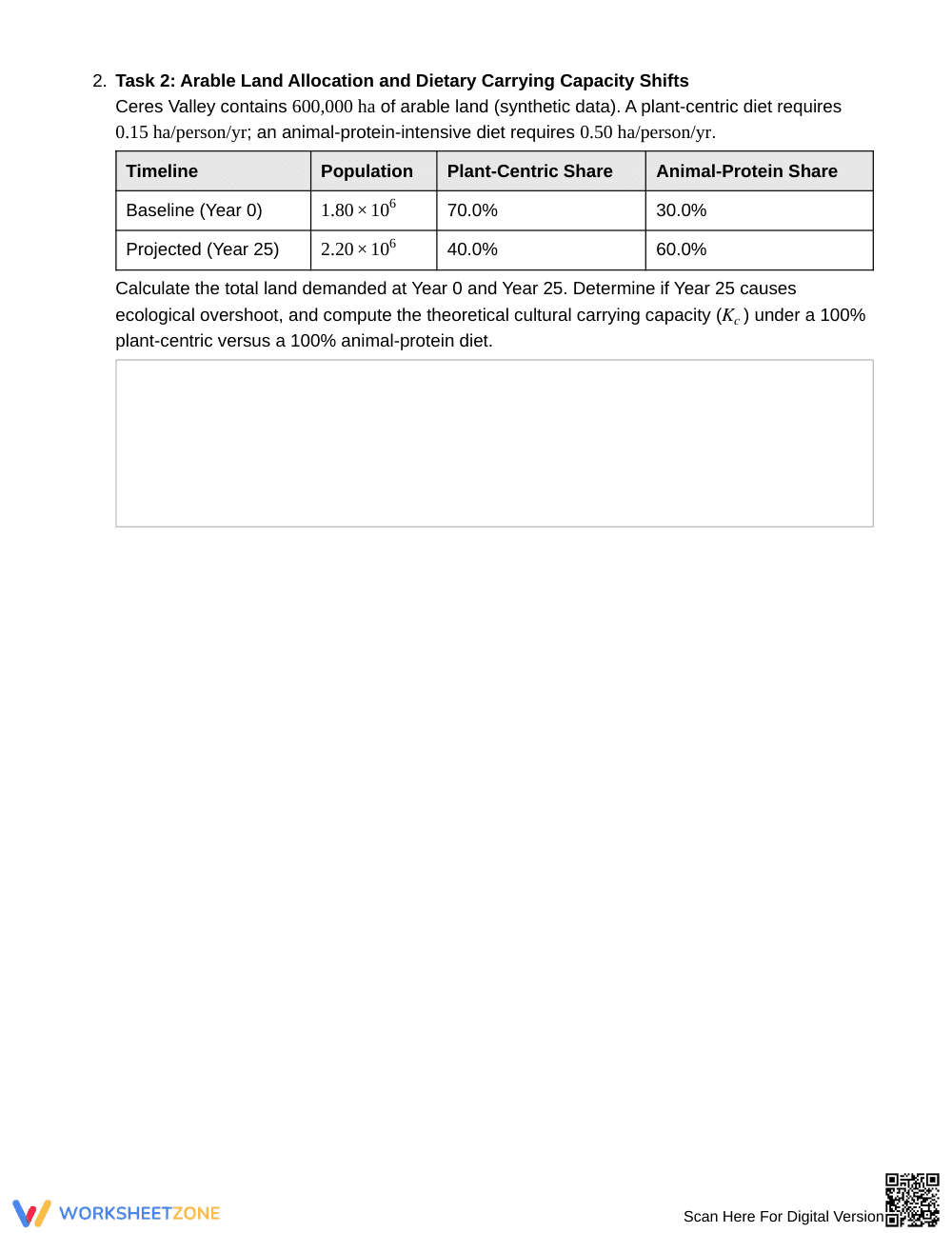
- Guided Practice (Tasks 1–2): Students apply biocapacity formulas to quantify municipal water deficits and dietary arable land overshoot using structured baseline data.
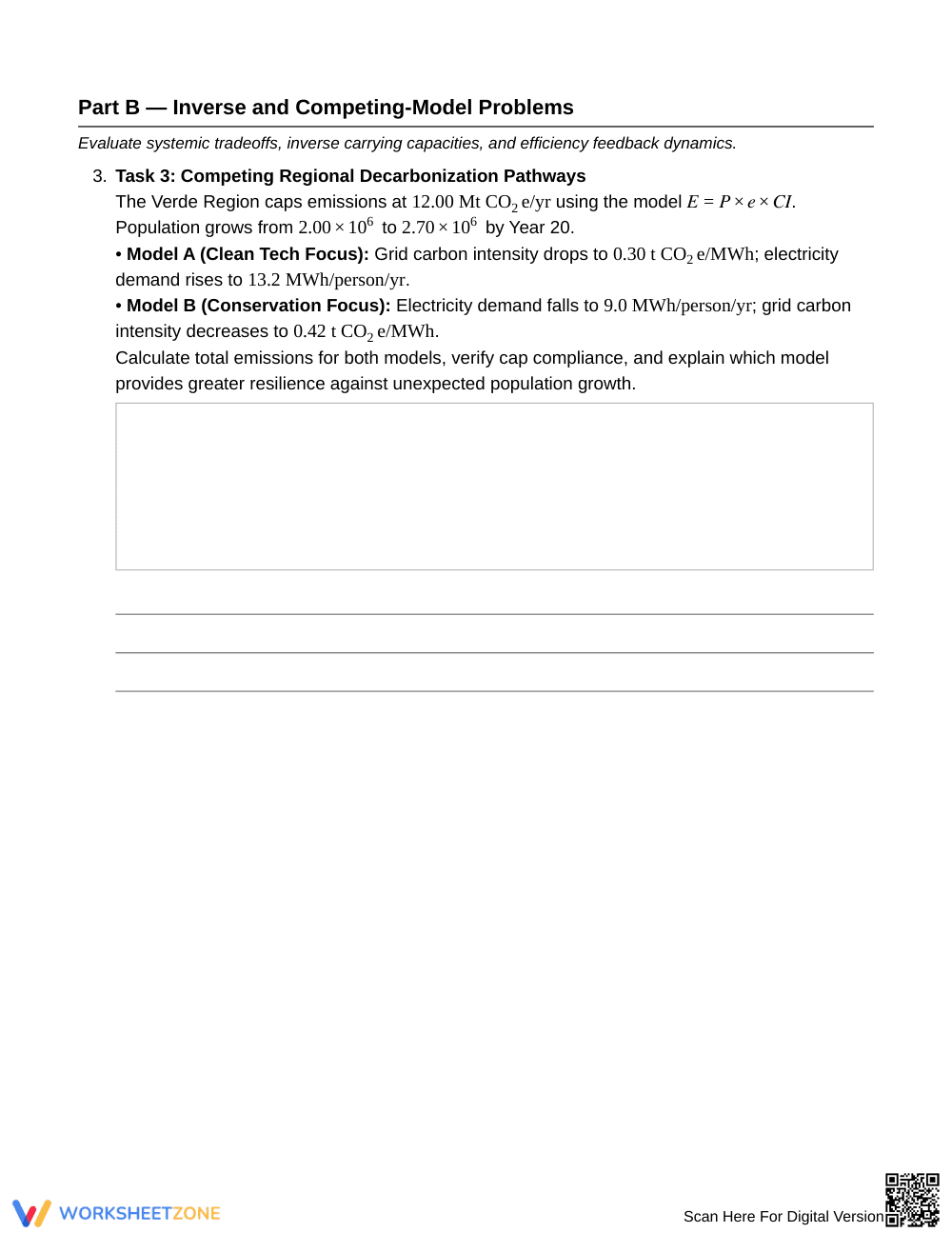
- Supported Practice (Tasks 3–5): Learners model competing decarbonization pathways, inverse carrying capacity curves, and Jevons paradox efficiency rebounds with moderate autonomy.
- Independent Practice (Task 6): Students independently synthesize water and carbon caps into a defended district policy portfolio balancing efficiency and consumption.
This sequence implements the gradual release of responsibility model, guiding learners toward independent systems evaluation.
Standards Alignment
This worksheet aligns with high school environmental science standards requiring computational simulations of relationships between natural resources, human sustainability, and carrying capacity limits. Supporting standards address evaluating competing technological and conservation solutions for resource management. Both standard alignments can be copied directly into lesson plans, IEP goals, or district curriculum mapping tools.
How to Use It
Assign this worksheet following direct instruction on ecological footprints and carrying capacity. Facilitate Tasks 1 through 5 in collaborative pairs, checking unit conversions and paradox interpretations formatively. Reserve Task 6 for individual summative evaluation. Expected completion time is 60 to 90 minutes.
Who It's For
Ideal for Grade 12 Environmental Science, AP Environmental Science, or honors systems modeling courses. Differentiation supports advanced analytical work through open policy defense while tabular prompts guide complex calculations. Natural pairings include footprint calculators or planetary boundary datasets.
Evaluating tradeoffs when consumption and population both change requires students to navigate complex nonlinear interactions between demographic growth and per-capita resource intensity. As articulated by Fisher & Frey (2014) in their foundational research on purposeful instructional design, structured cognitive progressions systematically move secondary learners from teacher-guided quantitative routines toward autonomous systems evaluation. This instructional sequence begins with bounded carrying capacity calculations and culminates in authentic multi-variable policy synthesis. By actively engaging with realistic scenarios involving municipal freshwater allocation, dietary land transitions, regional grid decarbonization, and the Jevons paradox rebound effect, Grade 12 students ground abstract demographic concepts in rigorous mathematical reality. Analytical modeling tasks of this caliber ensure that high school environmental science students develop the advanced quantitative literacy, critical reasoning, and evidence-based decision-making skills necessary to resolve complex sustainability challenges under genuine ecological constraints.


