





























Complete Resource Time Series Worksheet | Grade 12 Science
Paste this activity's link or code into your existing LMS (Google Classroom, Canvas, Teams, Schoology, Moodle, etc.).
Students can open and work on the activity right away, with no student login required.
You'll still be able to track student progress and results from your teacher account.
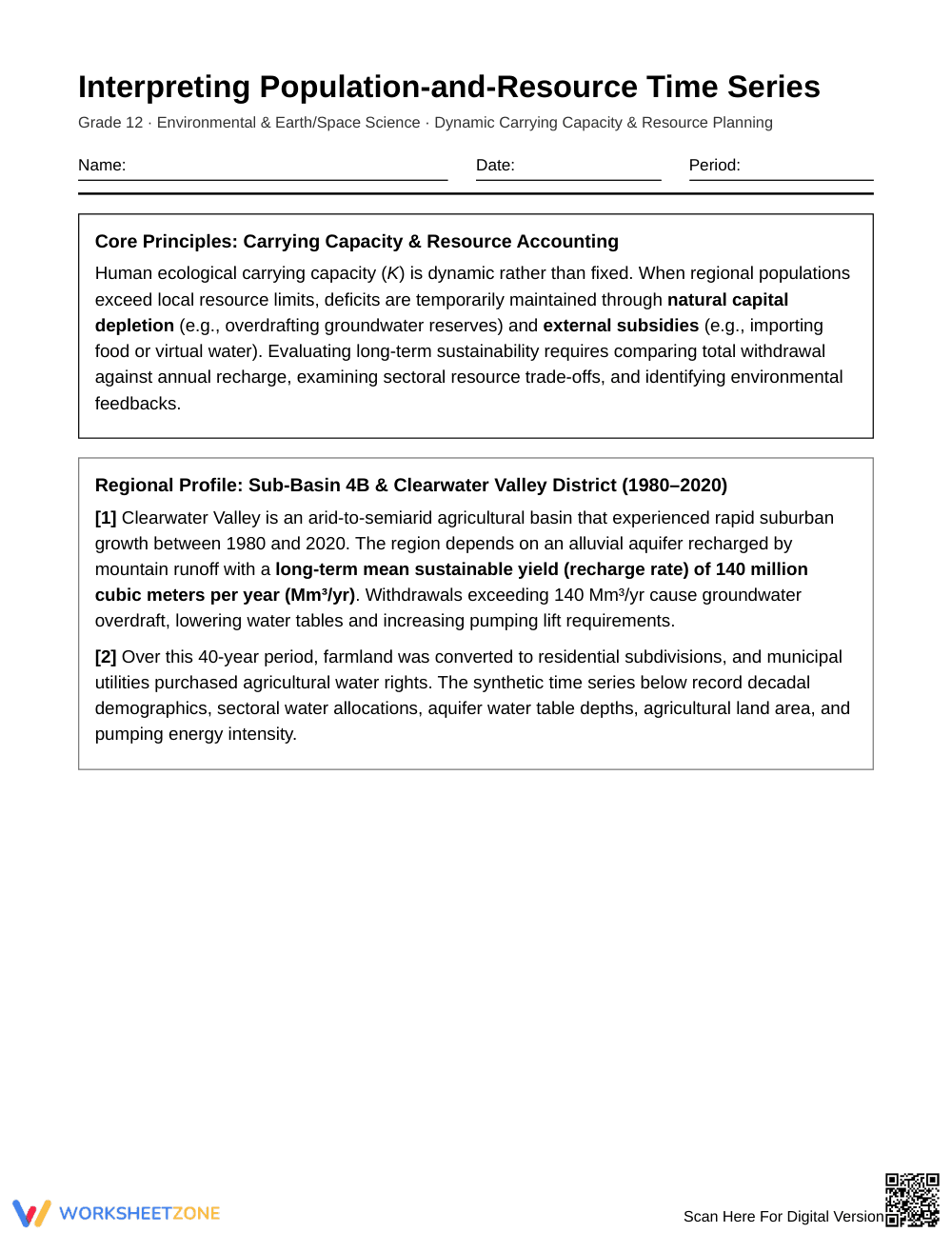
This advanced high school science worksheet equips students to analyze multi-decadal carrying capacity and environmental resource dynamics using empirical monitoring data. Students evaluate hydrological budgets, demographic growth, agricultural land allocation, and energy intensity trade-offs across 40 years of basin-level records, determining how external subsidies and natural capital depletion temporarily mask ecological deficits.
At a Glance
- Grade: 12 · Subject: Environmental & Earth/Space Science
- Standard:
Carrying Capacity Analysis— Evaluate environmental carrying capacity and resource trade-offs using demographic time-series data sets- Skill Focus: Interpret Population-and-Resource Time Series
- Format: 5 pages · 10 problems · Answer key included · PDF
- Best For: Advanced high school environmental science analysis
- Time: 45–60 minutes
What's Inside
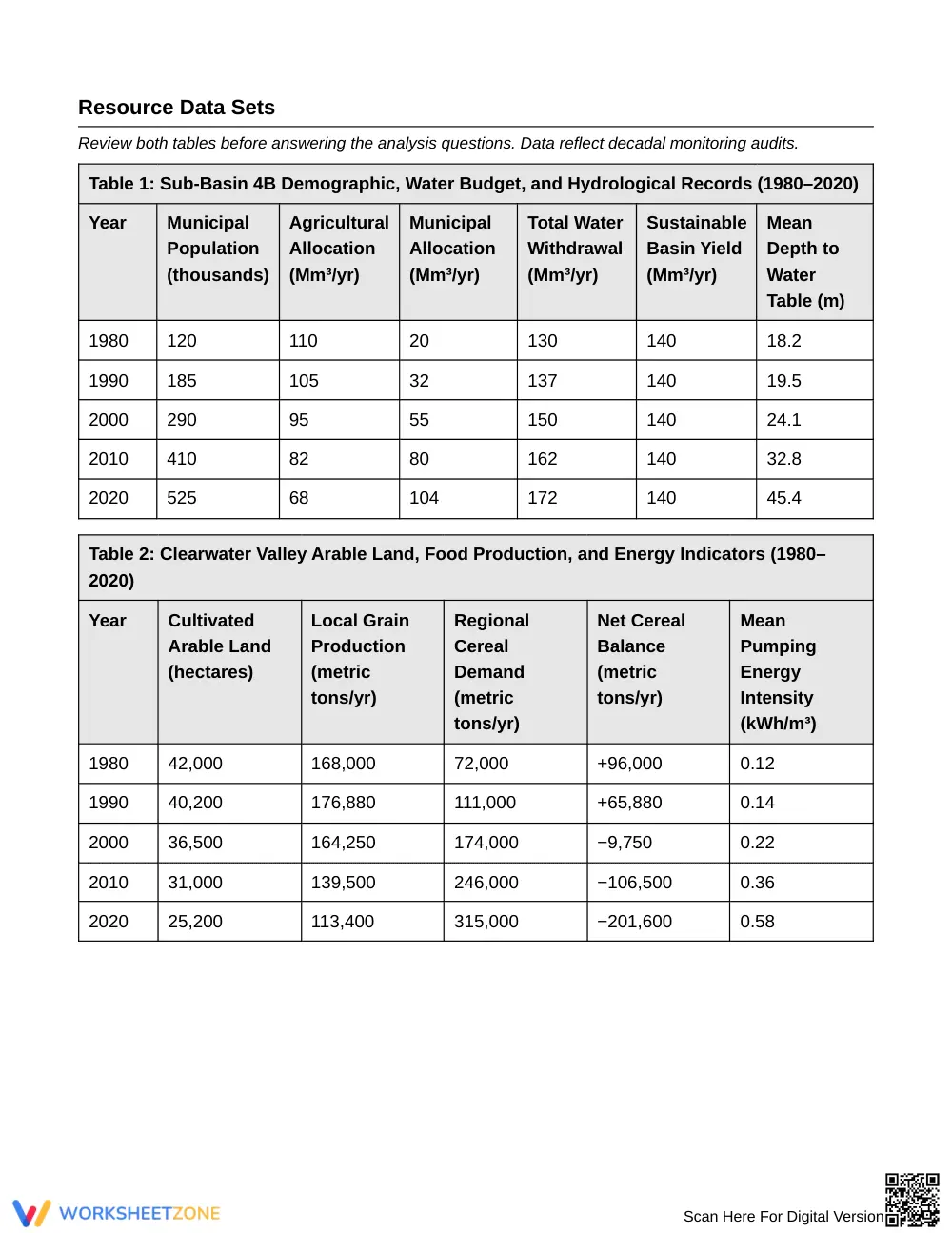
The worksheet contains two comprehensive data tables detailing water allocation, arable land, grain yield, and pumping energy from 1980 to 2020. Across 10 rigorous analytical items, students extract baseline metrics, compute per capita consumption rates, calculate decadal groundwater overdraft trends, and evaluate planning model assumptions. A complete 3-page answer key provides full mathematical calculations and model explanations.
Skill Progression
- Guided Practice (Part A, Problems 1–2): Students establish an empirical baseline by extracting discrete historical figures for water table depth, municipal allocations, and regional cereal balance directly from data tables.
- Supported Practice (Part B, Problems 3–8): Students calculate per capita consumption shifts, identify groundwater overdraft thresholds, quantify energy-lift feedbacks, and explain how external ecological subsidies support populations exceeding local limits.
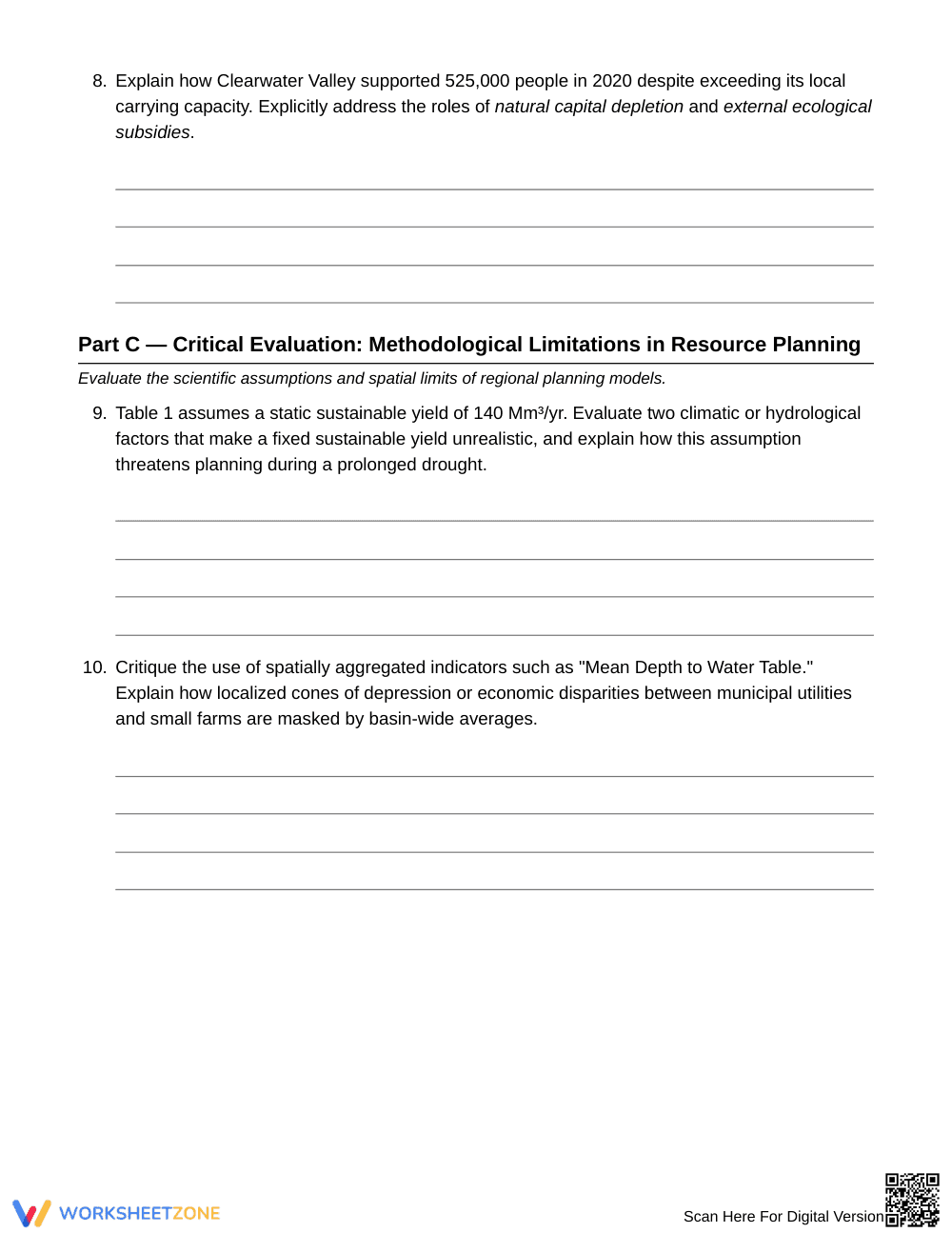
- Independent Practice (Part C, Problems 9–10): Students critically evaluate the methodological constraints of static yield assumptions and spatial averaging in regional resource planning models.
This structured progression reflects the gradual-release model, advancing from foundational table literacy to complex causal synthesis and methodological critique.
Standards Alignment
This resource aligns with high school Environmental and Earth/Space Science standards focusing on dynamic carrying capacity, human population dynamics, and natural resource management. Students evaluate how technological intensification and resource overdraft interact over multi-decadal time scales. This learning objective can be copied directly into lesson plans, IEP goals, or district curriculum mapping tools.
How to Use It
Deploy this resource during or immediately following direct instruction on ecological carrying capacity, groundwater hydrology, or agricultural sustainability. During the activity, conduct a quick formative check on Problem 4 to confirm students calculate decadal water table change rates accurately before they tackle energy intensity physics in Problem 6. The full activity requires 45 to 60 minutes of focused class time or independent study.
Who It's For
Designed for Grade 12 students in AP Environmental Science, Advanced Earth Science, or regional ecology electives. To support differentiated instruction, provide struggling learners with a formula guide for decadal rate calculations, while advanced students can extend findings by modeling future depletion trajectories. Pair this worksheet with a case study on real-world aquifer depletion or agricultural water markets.
According to Fisher & Frey (2014), structured data analysis tasks that follow a gradual-release framework significantly improve adolescent scientific literacy and complex reasoning skills. This 5-page instructional resource engages Grade 12 students in analyzing 40-year demographic and hydrological time-series datasets to evaluate carrying capacity, groundwater overdraft, and energy intensity trade-offs. By examining how agricultural water allocations shift to municipal sectors, learners calculate per capita consumption trends, quantify gravitational lift energy requirements, and evaluate the hidden ecological costs of external resource subsidies. The structured 10-problem sequence transitions from baseline data retrieval to high-level methodological critiques of static planning models. Accompanied by a thorough 3-page explanatory answer key, this resource provides rigorous, authentic practice with quantitative environmental monitoring records.


