




























Views
Downloads


Essential Population Migration Worksheet | Grade 12 Science

Paste this activity's link or code into your existing LMS (Google Classroom, Canvas, Teams, Schoology, Moodle, etc.).
Students can open and work on the activity right away, with no student login required.
You'll still be able to track student progress and results from your teacher account.
Master demographic accounting and environmental carrying capacity with quantitative modeling exercises. This Grade 12 science worksheet guides students through calculating net population change with migration, net migration rates, annual growth, and resource capacity buffers for municipal water, landfills, and agricultural land to evaluate ecological overshoot.
At a Glance
- Grade: 12 · Subject: Environmental Science
- Standard: High School Environmental Science — Calculate population growth rates and carrying capacity using demographic data
- Skill Focus: Calculate Population Change with Migration
- Format: 5 pages · 10 problems · Answer key included · PDF
- Best For: High school demography and resource calculations
- Time: 45–60 minutes
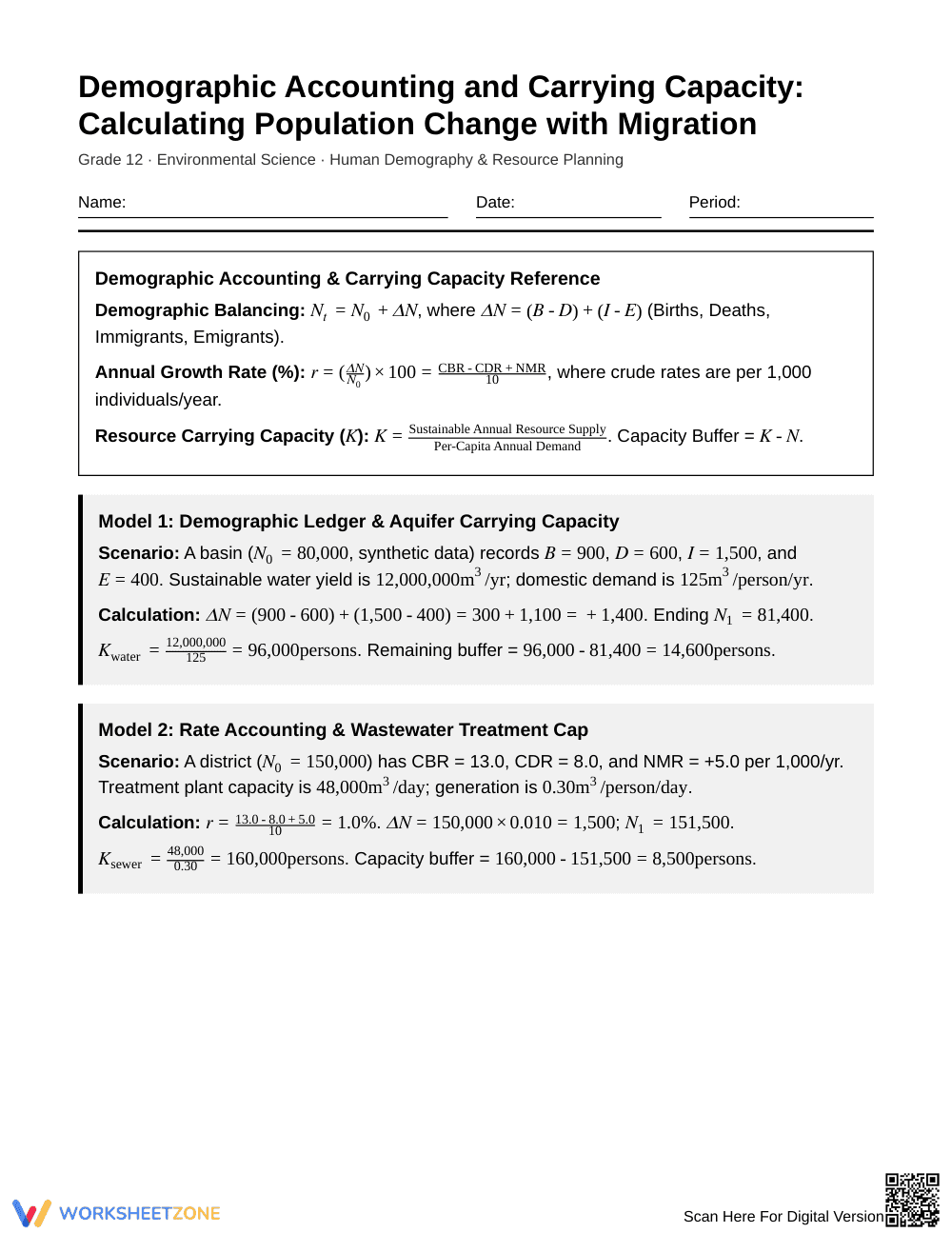
This 5-page resource provides reference formulas and two worked models demonstrating demographic ledgers and wastewater capacity thresholds. Students solve 10 multi-step computational and synthesis tasks, moving from scaffolded community ledgers to resource scenarios involving urban growth boundaries, food sheds, and policy analysis. A complete 3-page answer key supports grading.
Skill Progression
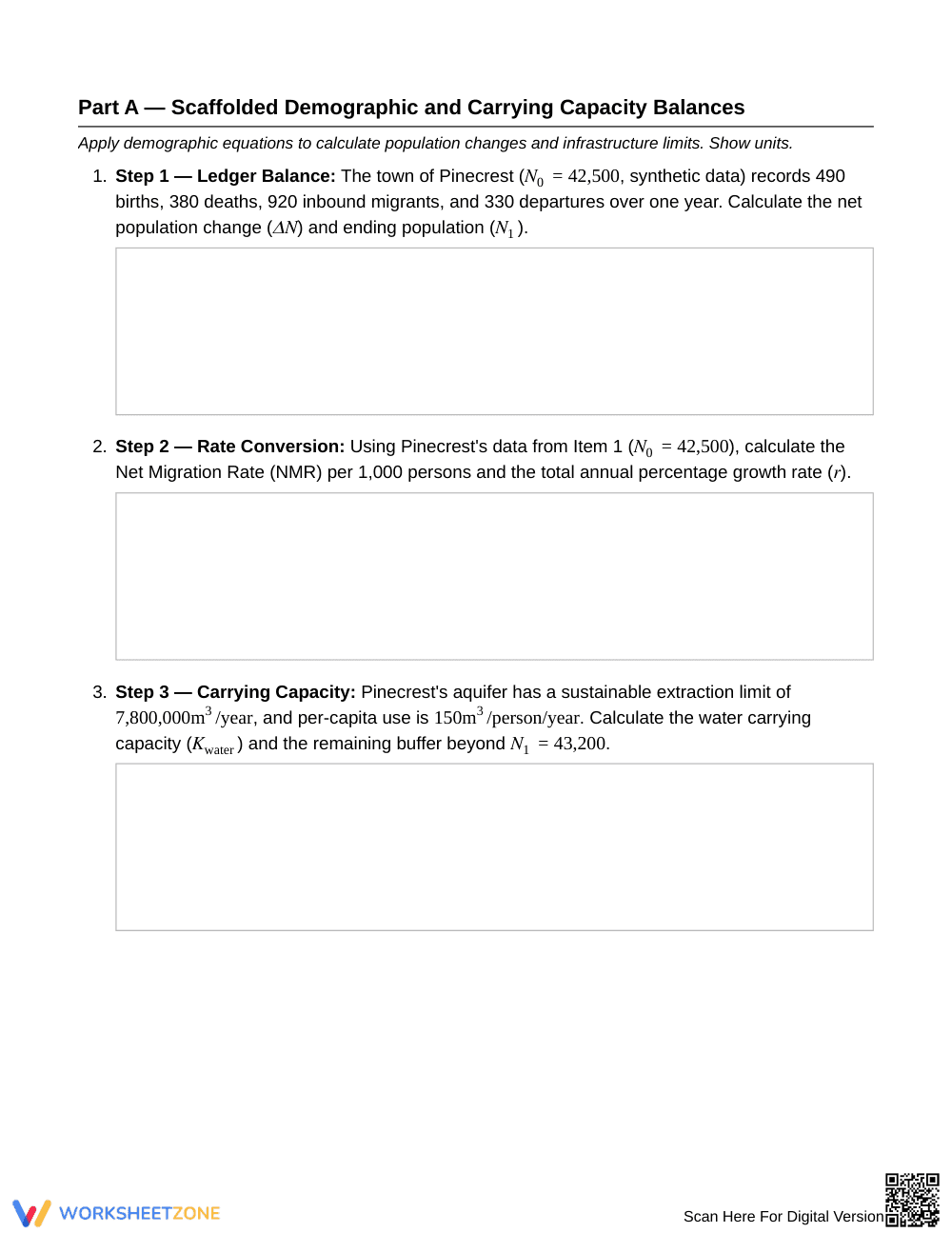
- Guided Practice: Part A presents 3 structured problems where students use demographic formulas to compute net population change, calculate net migration rates per 1,000 residents, and determine aquifer capacity buffers.
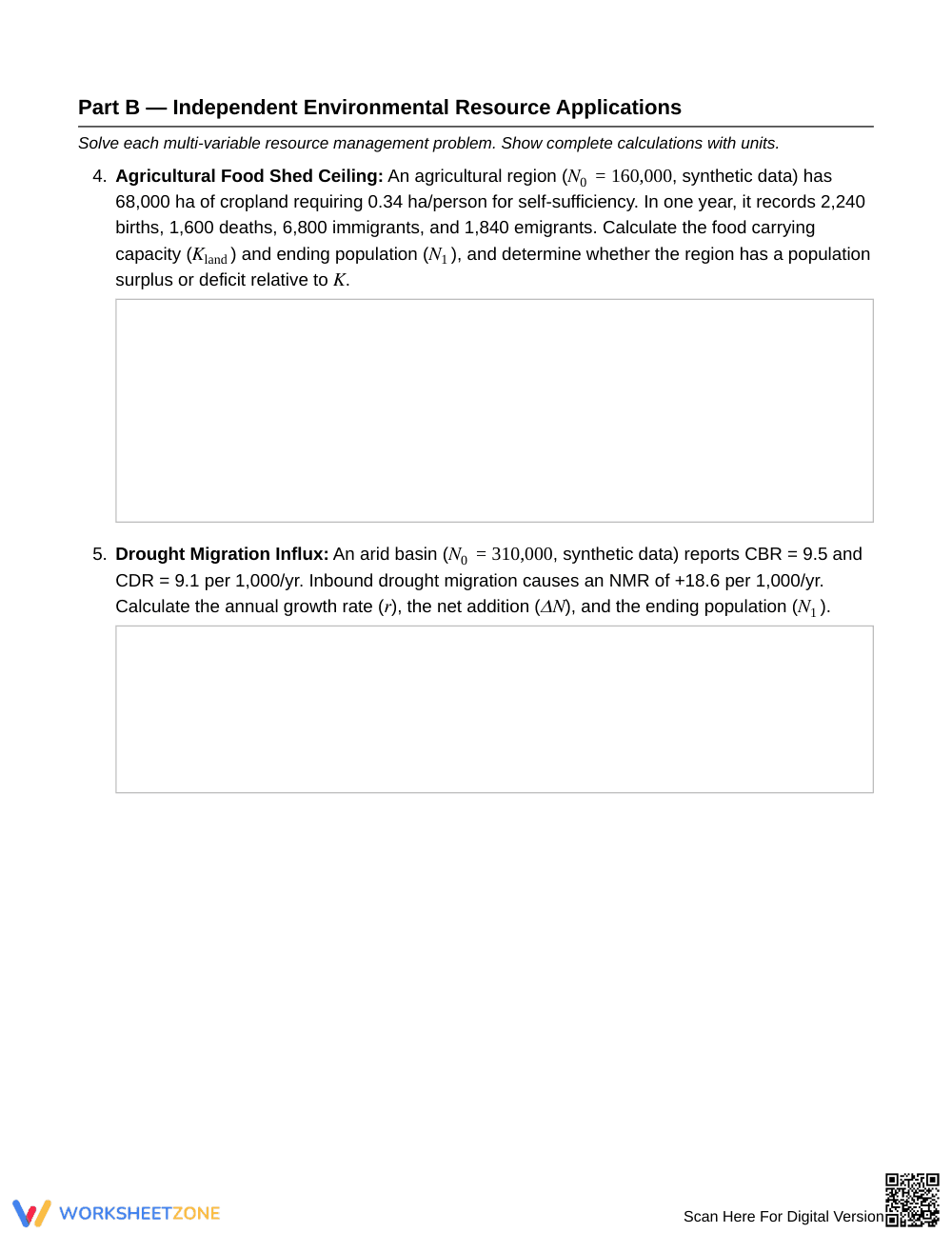
- Supported Practice: Part B features 5 multi-variable resource problems requiring students to independently evaluate landfills, agricultural food sheds, drought migration surges, and island carrying capacity.
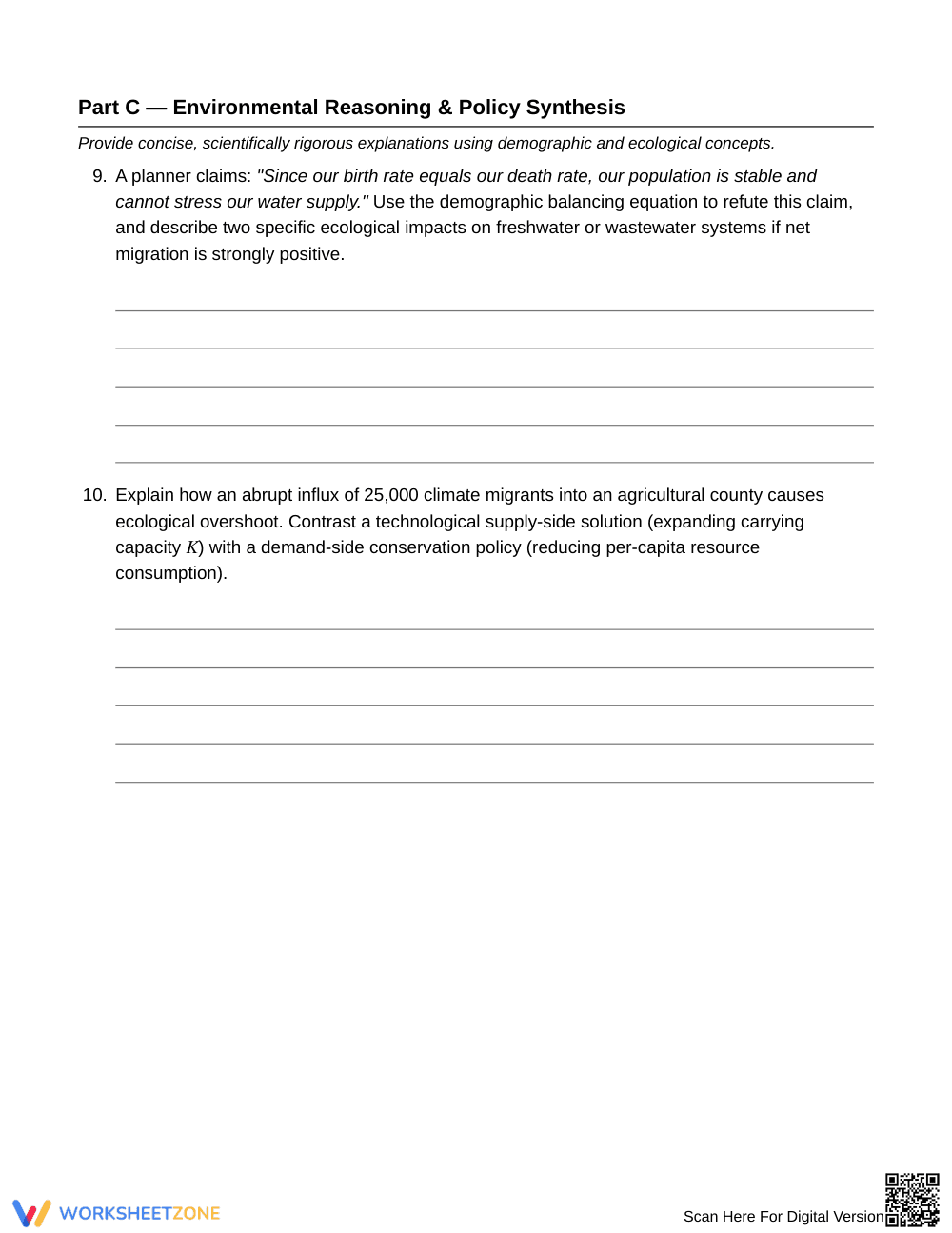
- Independent Practice: Part C challenges learners with 2 synthesis prompts requiring them to refute demographic misconceptions and analyze supply-side versus demand-side solutions for ecological overshoot.
This sequence follows a gradual-release framework, scaffolding mathematical formulas before requiring autonomous environmental analysis.
Standards Alignment
This instructional resource aligns with advanced high school environmental science expectations for analyzing human population dynamics, demographic transitions, and carrying capacity constraints. Students manipulate quantitative demographic equations to evaluate ecological carrying capacity limits. These curriculum connections can be copied directly into lesson plans, IEP goals, or district curriculum mapping tools.
How to Use It
Administer this worksheet after direct instruction on the demographic balancing equation. For collaborative practice, assign Parts A and B during class where student pairs verify unit conversions and capacity buffers before completing Part C individually. Formative assessment tip: check whether students correctly divide crude rates by 10 when calculating annual growth percentages. Expected completion time is 45 to 60 minutes.
Who It's For
Designed for Grade 12 students in Environmental Science, Earth and Space Science, and AP Environmental Science units. For struggling learners, the included reference models provide structured calculation templates; advanced students can extend analysis by modeling non-linear growth curves. Pair this resource with direct instruction on demographic transition models or municipal water management case studies.
Quantitative demographic modeling reinforces critical environmental literacy by linking mathematical calculations directly to ecological carrying capacity. According to Fisher & Frey (2014), structuring student tasks through scaffolded modeling, guided practice, and independent synthesis significantly improves conceptual mastery and procedural fluency in complex secondary science applications. By calculating net migration rates, annual percentage growth, and infrastructure buffer capacities, high school learners transition from rote formula memorization to meaningful ecological problem-solving. These 10 multi-step computational scenarios require students to account for births, deaths, immigration, and emigration while assessing real-world resource constraints like municipal water yields, landfill volume, and agricultural land ceilings. Grounding demographic accounting in tangible environmental management contexts enables learners to evaluate policy interventions and resource sustainability with mathematical precision, preparing them for advanced collegiate coursework and rigorous, data-driven ecological decision-making.


