




























Views
Downloads

Essential Capacity Policy Worksheet | Grade 12 Science

Paste this activity's link or code into your existing LMS (Google Classroom, Canvas, Teams, Schoology, Moodle, etc.).
Students can open and work on the activity right away, with no student login required.
You'll still be able to track student progress and results from your teacher account.
This Grade 12 environmental science worksheet equips students to evaluate and correct flawed carrying capacity policy claims. Learners diagnose ecological errors across water allocation, food systems, and urban growth scenarios. By applying dynamic sustainability constraints, students formulate rigorous policy rules that balance human demand with ecosystem limits.
At a Glance
- Grade: 12 · Subject: Environmental Science
- Standard: Evaluate resource management models and carrying capacity policy claims
- Skill Focus: Correct Fixed-Capacity Policy Claims
- Format: 5 pages · 8 problems · Answer key included · PDF
- Best For: AP environmental science analytical practice
- Time: 45–60 minutes
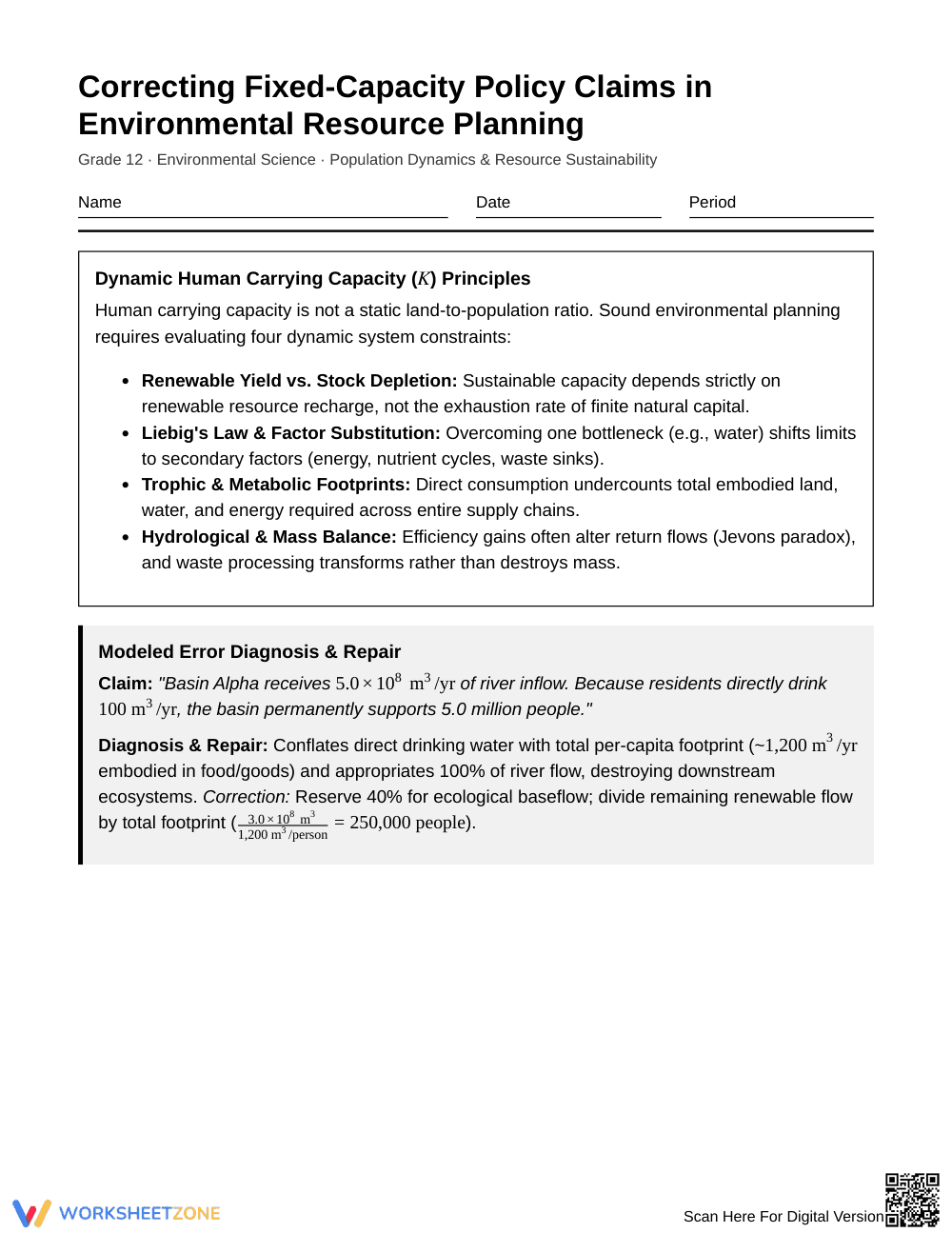
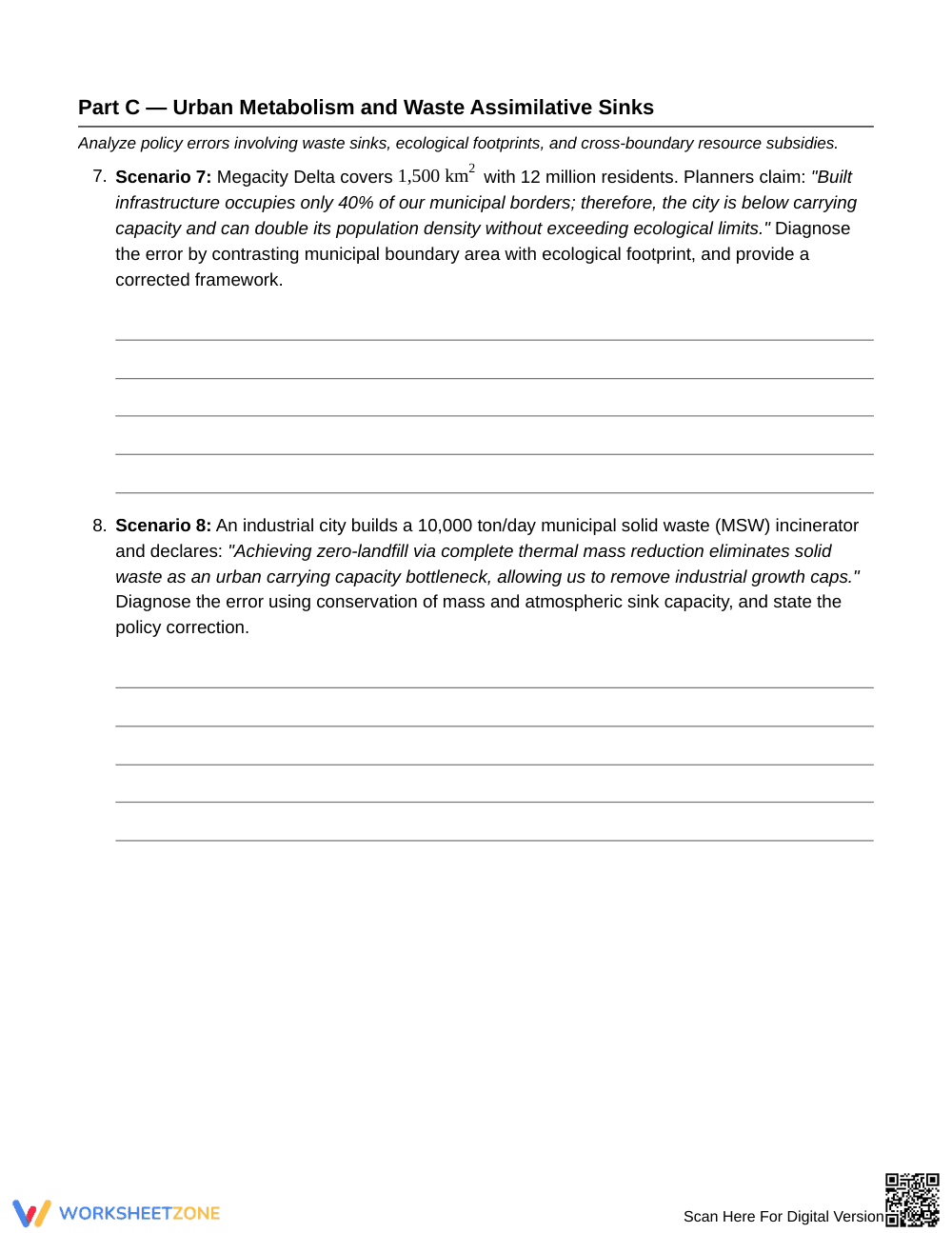
What's Inside: The resource features 8 scenario tasks across 5 printable pages. It opens with a core reference table detailing dynamic carrying capacity principles alongside a modeled error diagnosis. A comprehensive 3-page answer key provides step-by-step mathematical explanations, conceptual corrections, and defensible policy statements for streamlined grading.
Skill Progression
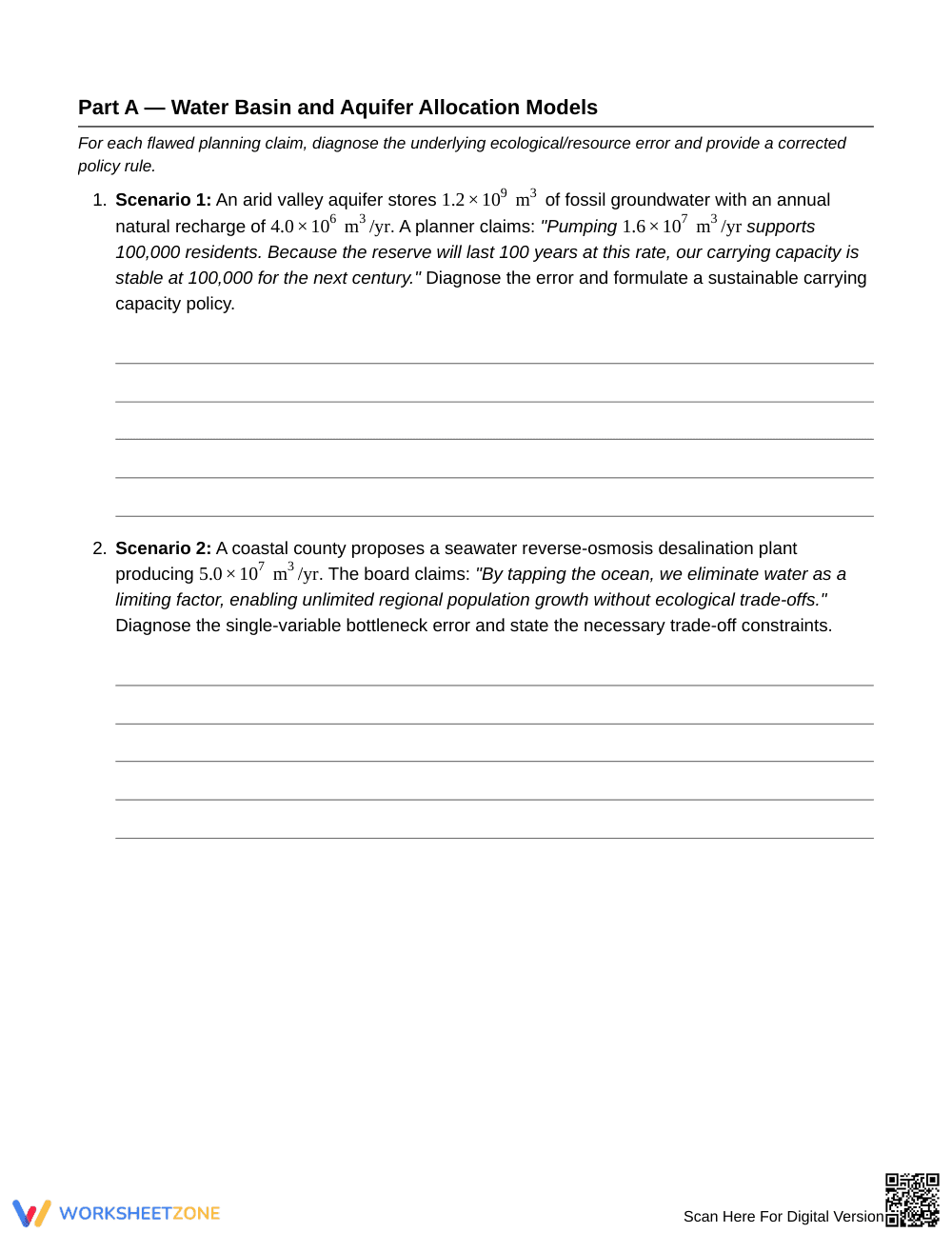
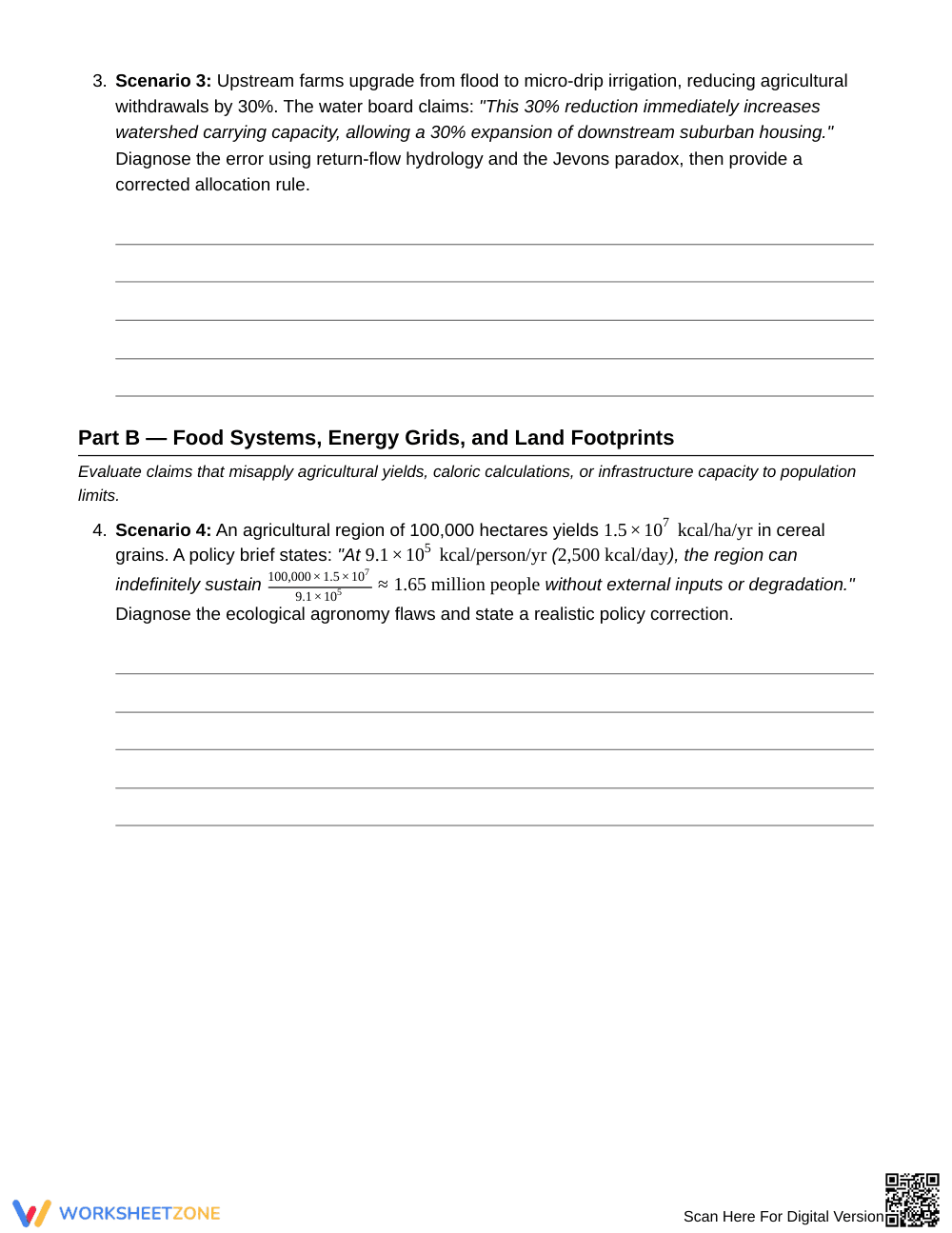
- Guided Practice: Scenarios 1–3 target water basin models, prompting students to spot stock exhaustion and return-flow errors with modeled support.
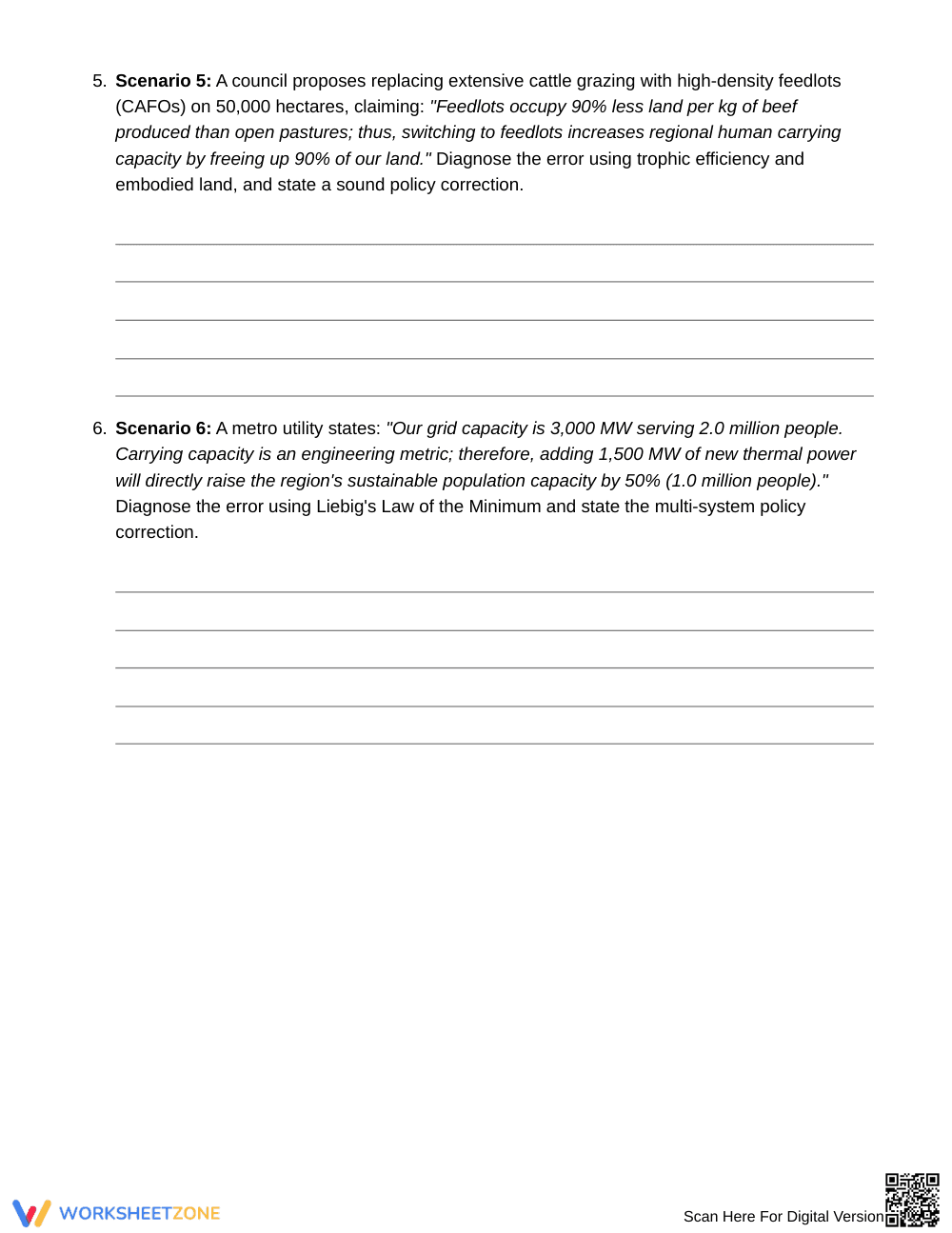
- Supported Practice: Scenarios 4–6 explore caloric yields and grid additions, challenging learners to apply trophic efficiency and Liebig's Law.
- Independent Practice: Scenarios 7–8 present complex urban boundary dilemmas and incinerator mass balances without scaffolding.
This gradual-release progression moves students systematically from supported error identification to autonomous policy formulation.
Standards Alignment
This resource aligns with high school environmental science standards focused on managing natural resources through computational models and systems thinking. Students evaluate competing design solutions for developing and conserving resources based on sustainability limits. Both standard codes can be copied directly into lesson plans, IEP goals, or district curriculum mapping tools.
How to Use It
Use this worksheet after direct instruction on human carrying capacity and ecological footprints. Assign student pairs to evaluate Scenarios 3 and 5 during collaborative workshop time. As a formative assessment check, verify that students account for embodied resource footprints rather than nominal land areas. Expected completion time is 45 to 60 minutes.
Who It's For
This lesson is designed for Grade 12 Environmental Science and AP Environmental Science students mastering resource modeling. Scaffolds support striving learners through reference boxes, while extensions challenge advanced students to quantify safe replenishment yields. It pairs effectively with an introductory lecture on ecological footprints or water conservation case studies.
Evaluating human carrying capacity requires students to critique real-world environmental policy claims, moving beyond static geometric land ratios toward multi-variable dynamic models. This worksheet trains high school learners to identify common planning fallacies, including finite stock exhaustion conflated with renewable yields, Jevons paradox rebound effects, and unmonitored mass-balance waste shifts. According to Fisher & Frey (2014), structured error analysis combined with gradual-release problem sets solidifies conceptual transfer in complex science topics by requiring students to articulate both the failure point and the corrective mechanism. When students deconstruct authentic municipal and agricultural scenarios, they develop critical systems-thinking competencies essential for ecological literacy. Grounded in quantitative principles such as Liebig's Law of the Minimum and trophic transfer inefficiency, this 8-task resource enables educators to measure whether learners can reliably distinguish finite resource depletion from perpetual sustainable yield in municipal governance.


