




























Views
Downloads



Essential Growth Scenarios Worksheet | Grade 12 Science

Paste this activity's link or code into your existing LMS (Google Classroom, Canvas, Teams, Schoology, Moodle, etc.).
Students can open and work on the activity right away, with no student login required.
You'll still be able to track student progress and results from your teacher account.
This Grade 12 environmental science worksheet equips students to compare population growth scenarios under diverse consumption assumptions using rigorous mathematical modeling. Learners apply doubling time, discrete growth equations, and biocapacity metrics to predict how consumption rates reshape ecological carrying capacity. The multi-part problem set guides students directly from foundational calculations to comprehensive policy evaluations.
At a Glance
- Grade: 12 · Subject: Environmental Science
- Standard: Environmental Systems — Analyze human carrying capacity under variable resource consumption rates
- Skill Focus: Compare Growth Scenarios Under Consumption Assumptions
- Format: 5 pages · 12 problems · Answer key included · PDF
- Best For: Quantitative demographic and carrying capacity analysis
- Time: 45–60 minutes
What's Inside
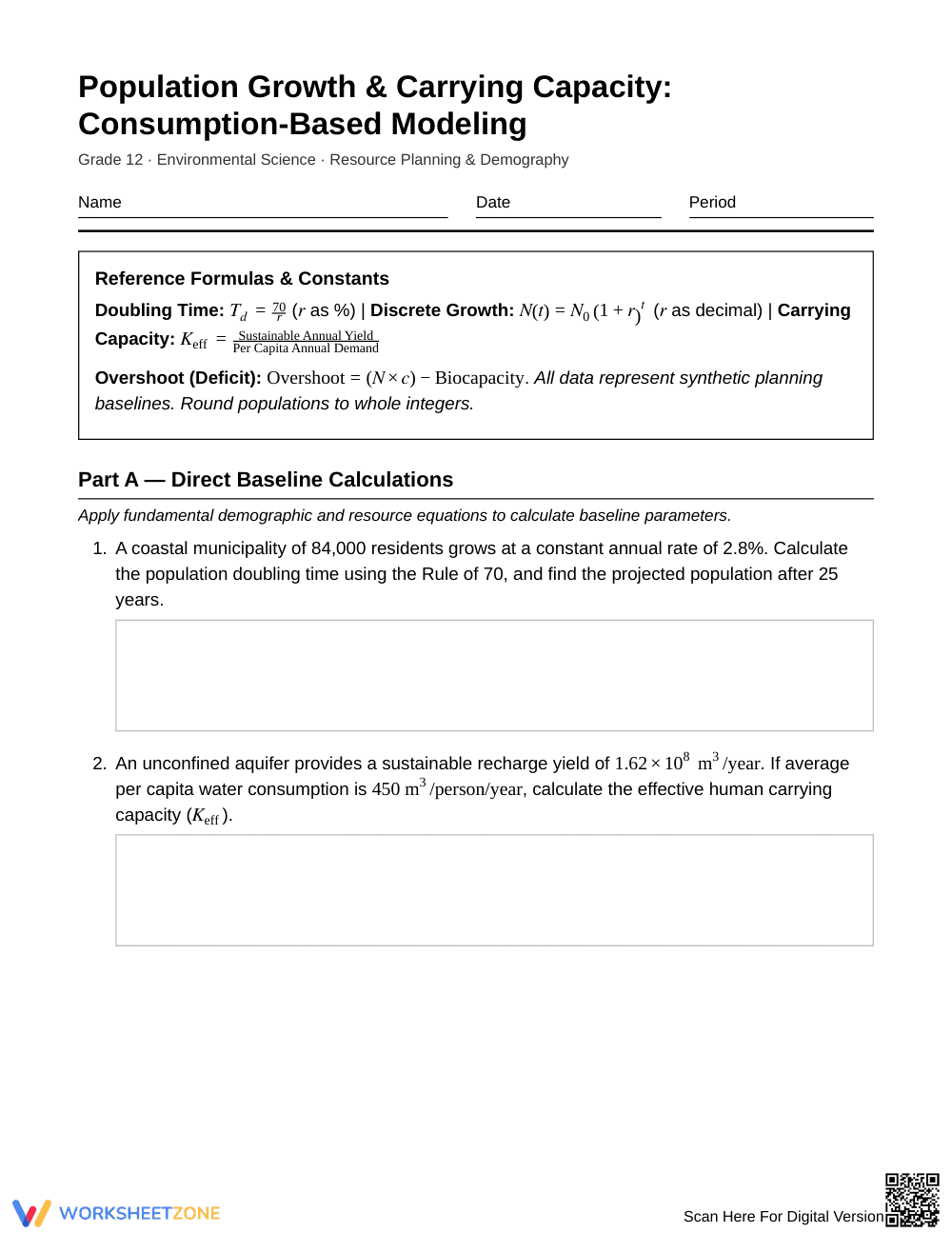
The 5-page worksheet opens with a concise reference formula box covering doubling time, discrete growth, effective carrying capacity, and overshoot formulas. Across 12 multi-step problems, students calculate baseline metrics, dynamic resource-constrained trajectories, and policy trade-offs using structured prompts and a comparative resource consumption table. A complete 2-page answer key provides step-by-step mathematical solutions and rounded integer targets.
Skill Progression
- Guided Practice: Part A features 3 baseline problems reinforcing core equations for doubling time, sustainable aquifer yields, and baseline biocapacity deficits.
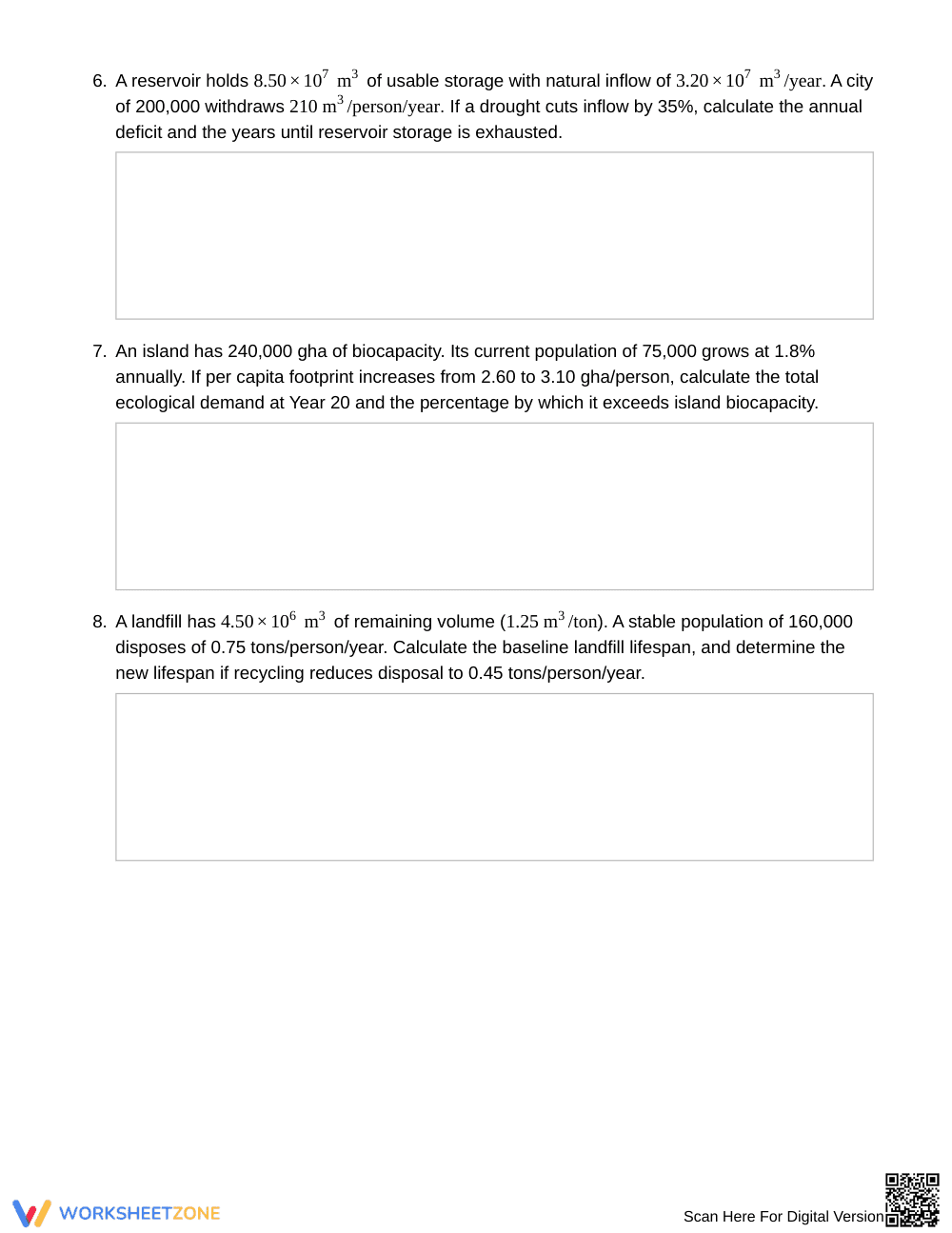
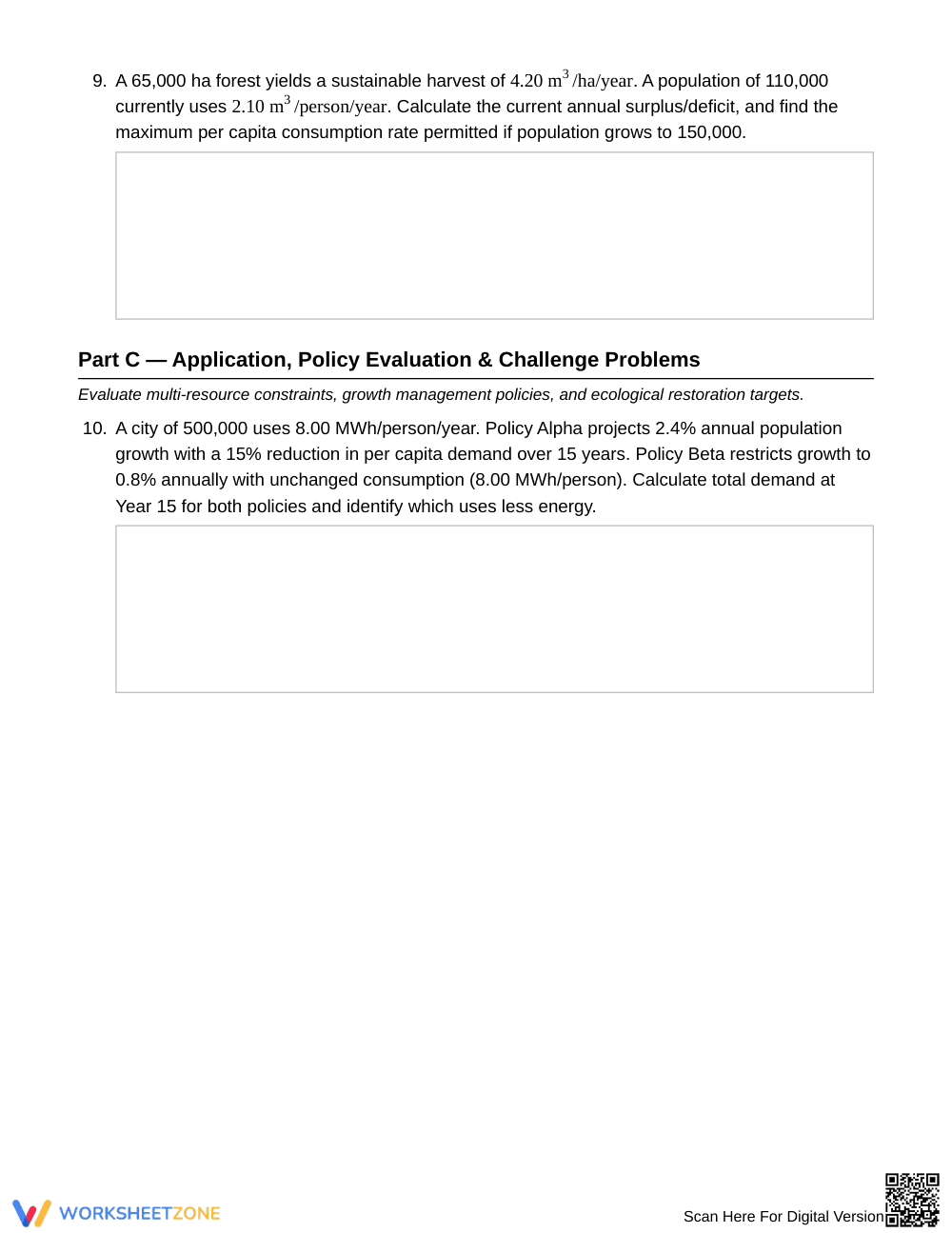
- Supported Practice: Part B expands into 6 multi-step scenario calculations linking dietary shifts, utility growth, reservoir depletion, and landfill lifespans to changing per capita consumption.
- Independent Practice: Part C challenges learners with 3 advanced policy and resource optimization problems requiring multi-variable analysis and carrying capacity reconciliation.
This structured progression reflects an intentional gradual-release model that builds learner autonomy from discrete computation to multi-resource system evaluation.
Standards Alignment
This resource aligns with high school Environmental Science standards focusing on Earth and human activity, specifically evaluating how population dynamics and per capita resource consumption affect environmental sustainability and ecological carrying capacity. Relevant curriculum objectives can be copied directly into lesson plans, IEP goals, or district curriculum mapping tools.
How to Use It
Deploy this worksheet after direct instruction on exponential growth and ecological footprints as an intensive analytical practice session. Alternatively, assign Part B and Part C during small-group collaborative problem-solving to examine policy trade-offs. While circulating, verify that students convert annual percentage growth rates to decimals before executing discrete growth formulas. Typical completion time spans 45 to 60 minutes.
Who It's For
This activity is designed for Grade 12 Environmental Science, AP Environmental Science, or advanced ecology students. It provides targeted quantitative rigor for college-bound learners while offering embedded formula scaffolds for emerging calculators. Pair this worksheet with an interactive global footprint calculator or direct demographic transition lecture.
Comparing growth scenarios under varying consumption assumptions requires students to synthesize quantitative modeling with real-world resource constraints. According to Fisher & Frey (2014), structured problem progressions that transition students from foundational calculations to complex scenario evaluation foster deeper analytical reasoning and long-term skill retention. This instructional worksheet targets advanced environmental science learners, engaging them in calculating discrete population projections, dynamic carrying capacity, and biocapacity deficits across coastal municipalities, agricultural regions, and urban infrastructure. By working through multi-variable scenarios, students evaluate how dietary patterns, technological shifts, and conservation policies alter resource longevity and ecological equilibrium. The gradual-release architecture provides targeted baseline prompts before challenging students with multi-resource optimization matrices and restorative demographic policies. Grounded in quantitative ecological principles, this resource delivers measurable evidence of student mastery in environmental systems analysis, resource budgeting, and demographic modeling.


