




























Views
Downloads


Complete Carrying Capacity Worksheet | Grade 12 Science

Paste this activity's link or code into your existing LMS (Google Classroom, Canvas, Teams, Schoology, Moodle, etc.).
Students can open and work on the activity right away, with no student login required.
You'll still be able to track student progress and results from your teacher account.
This Grade 12 environmental science worksheet equips students to evaluate carrying capacity, resource bottlenecks, and ecological overshoot through quantitative modeling. Learners analyze municipal water budgets, calculate agricultural population ceilings under shifting dietary demands, and assess environmental tipping points to make data-backed infrastructure recommendations.
At a Glance
- Grade: 12 · Subject: Environmental Science
- Focus: Calculate carrying capacity and resource thresholds using multi-variable models
- Skill Focus: Environmental Population Check
- Format: 5 pages · 12 problems · Answer key included · PDF
- Best For: Advanced environmental science practice
- Time: 60–75 minutes
What's Inside
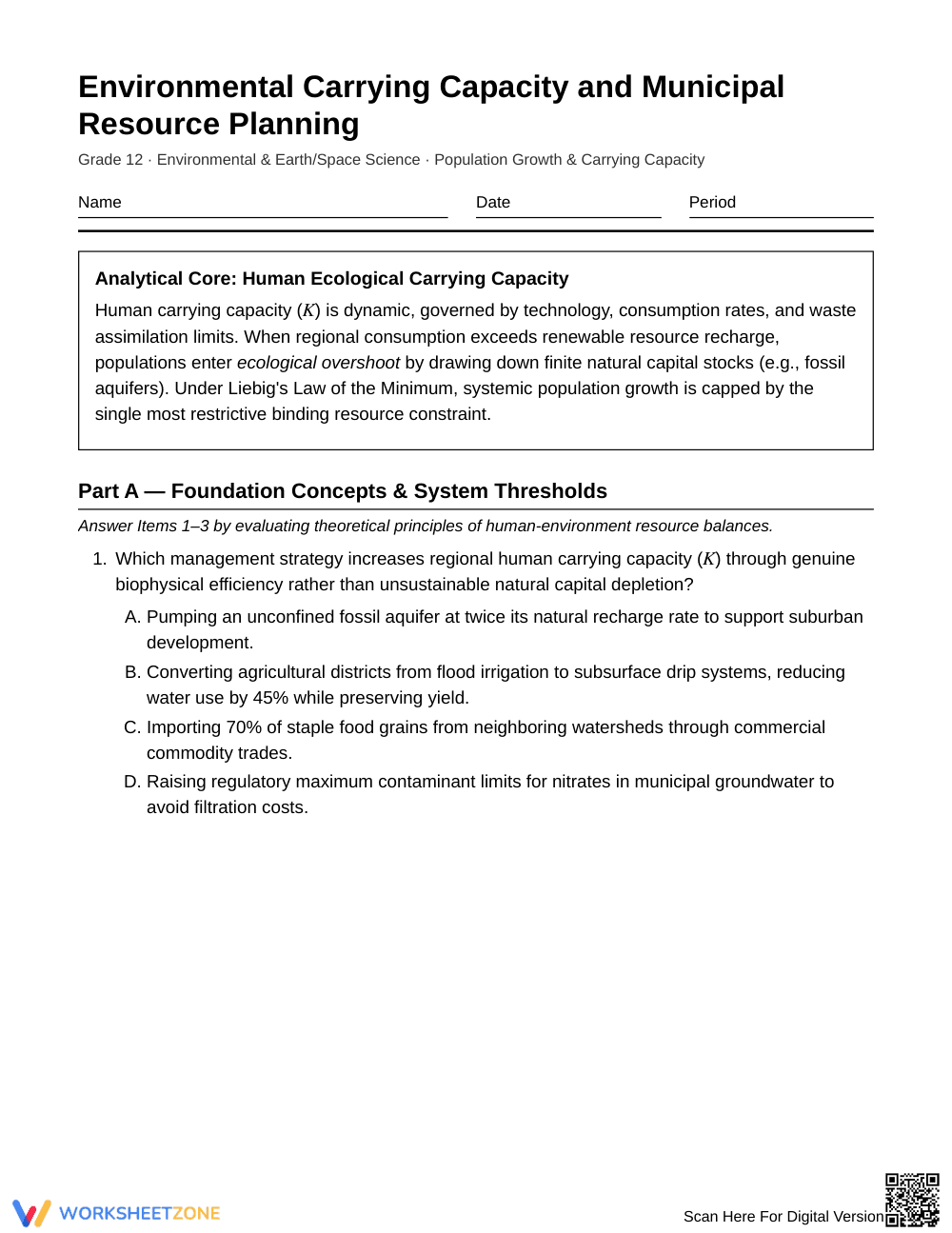
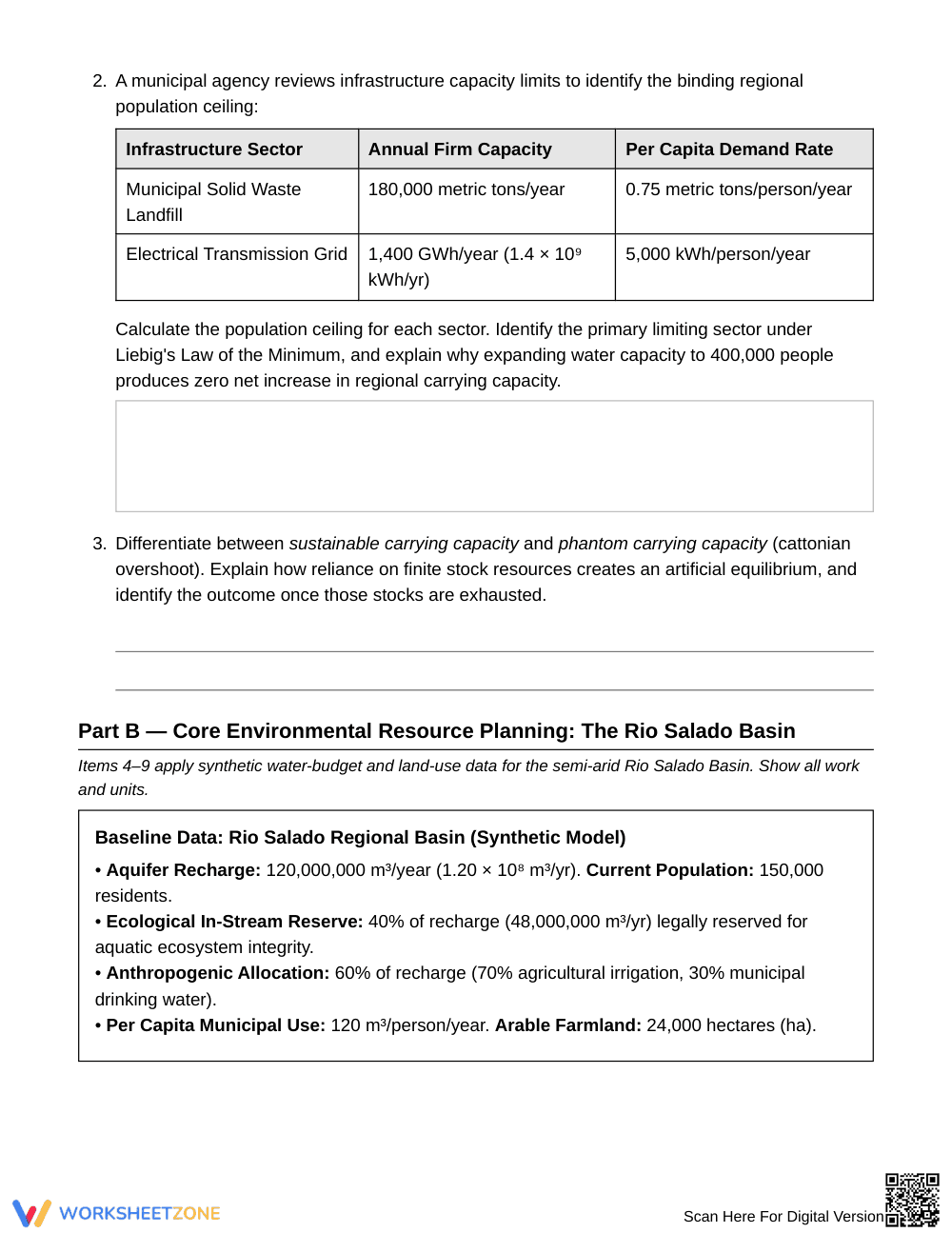
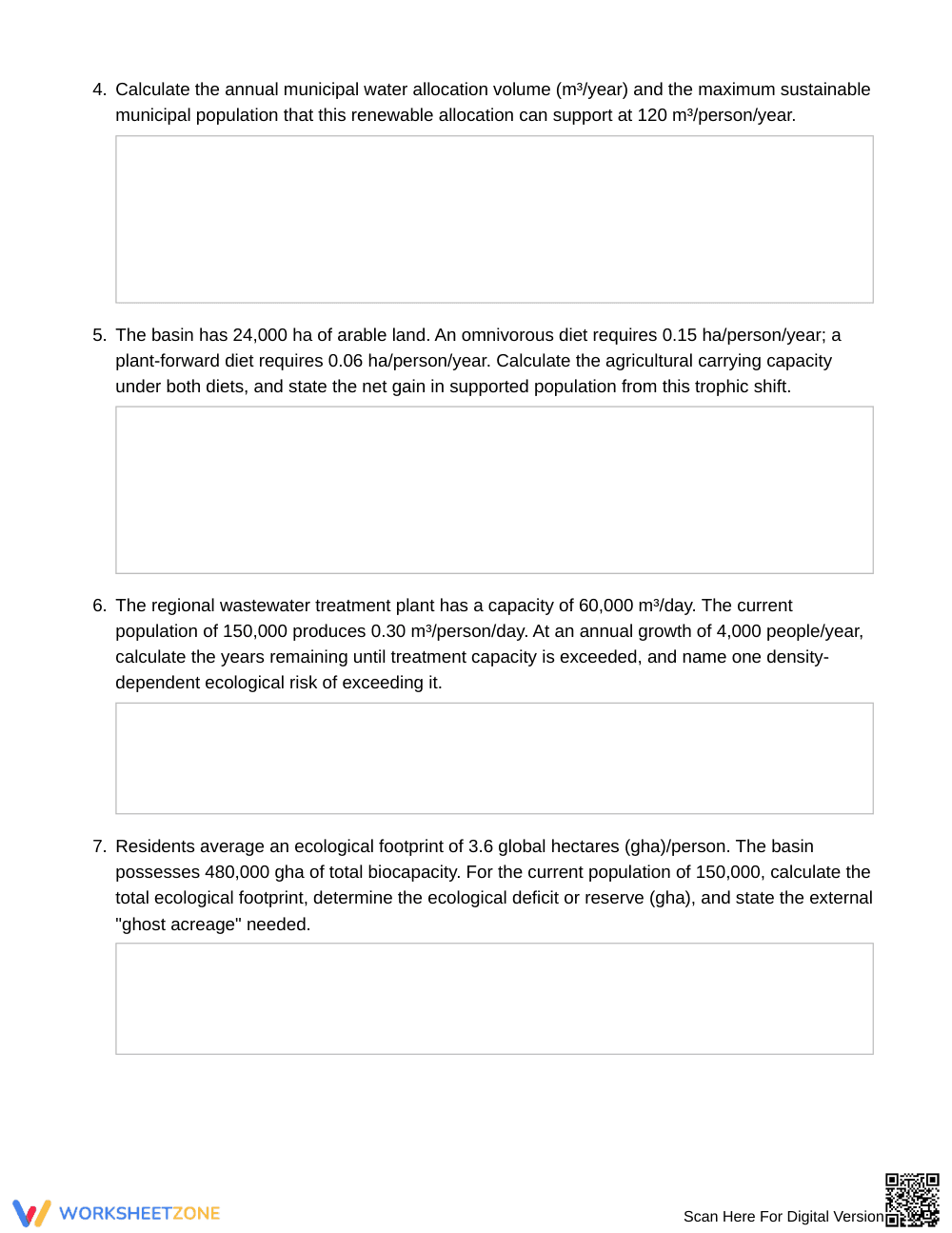
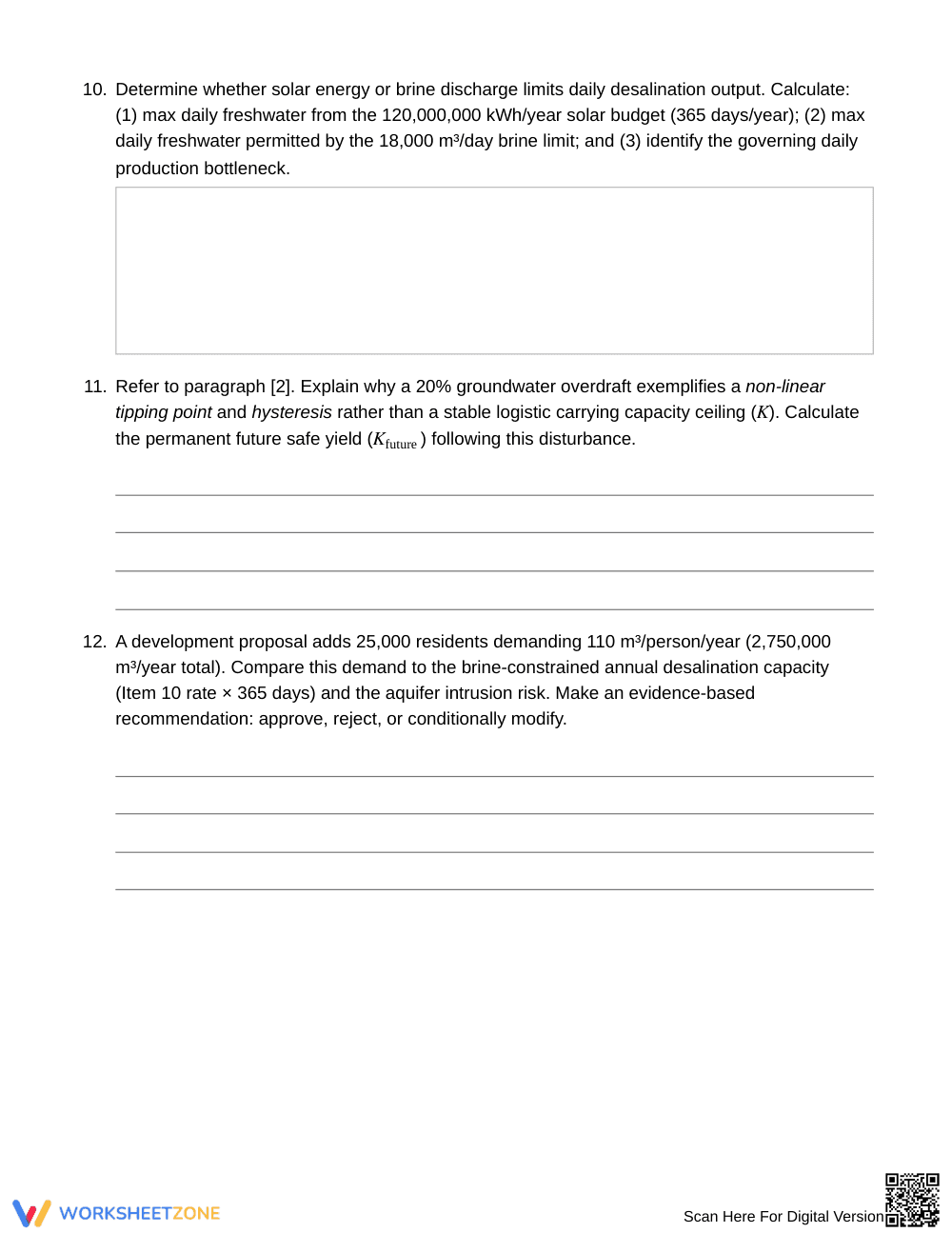
The 5-page worksheet includes 12 multi-step analytical problems organized into three sections, accompanied by a 3-page answer key with worked solutions. Students evaluate infrastructure capacity tables, compute water allocations for the Rio Salado Basin, and analyze the Isla San Marcos Biosphere District case study.
Skill Progression
- Guided practice (Items 1–3): Students evaluate core theoretical principles, identify binding limits via Liebig's Law from municipal tables, and differentiate sustainable from phantom carrying capacity.
- Supported practice (Items 4–9): Learners apply Rio Salado Basin data to compute municipal water limits, diet-dependent farm yields, wastewater timelines, and drought contractions.
- Independent practice (Items 10–12): Students analyze the Isla San Marcos case study, resolving energy and brine discharge bottlenecks, calculating post-tipping point yields, and proposing municipal policy.
This sequence reinforces student autonomy by advancing from foundational theory to complex multi-variable systems modeling through a gradual-release framework.
Standards Alignment
This resource aligns with high school environmental science standards requiring students to use mathematical representations to support explanations of factors affecting carrying capacities at various scales. Students quantify renewable yields and finite capital drawdowns to evaluate how resource constraints cap human population growth. These curriculum expectations can be copied directly into lesson plans, IEP goals, or district mapping tools.
How to Use It
Deploy this worksheet after direct instruction on logistic growth and ecological footprints to transition learners into applied modeling. For formative assessment, check student work on Item 2 and Item 10 to ensure learners identify the single binding bottleneck rather than averaging capacities. The expected completion time is 60 to 75 minutes.
Who It's For
Designed for Grade 12 students in Advanced Placement Environmental Science, Earth systems, or municipal planning courses. For differentiated support, provide a formula reference sheet for unit conversions, while advanced learners model alternative desalination curves. Pair this activity with a lecture on groundwater hydrology or an interactive watershed lab.
According to Fisher & Frey (2014), structured instructional frameworks that guide students through problem-based inquiry establish higher retention in analytical problem solving across STEM disciplines. This worksheet applies those principles to empirical environmental population checks, requiring Grade 12 learners to evaluate carrying capacity, finite resource stocks, and ecological overshoot across 12 quantitative tasks. By guiding students through foundational capacity formulas before introducing non-linear aquifer degradation and hypersaline brine bottlenecks, the resource shifts learners from passive recall to sophisticated systems analysis. Students master Liebig's Law of the Minimum, quantify diet-driven agricultural land demands, and model municipal wastewater thresholds under active growth constraints. The inclusion of full step-by-step mathematical solutions and worked examples allows educators to pinpoint calculation errors and diagnose conceptual misconceptions regarding phantom carrying capacity and resource depletion in rigorous high school environmental science classrooms.


