




























Views
Downloads




Ready Resource-Limit Models Worksheet | Grade 12 Science

Paste this activity's link or code into your existing LMS (Google Classroom, Canvas, Teams, Schoology, Moodle, etc.).
Students can open and work on the activity right away, with no student login required.
You'll still be able to track student progress and results from your teacher account.
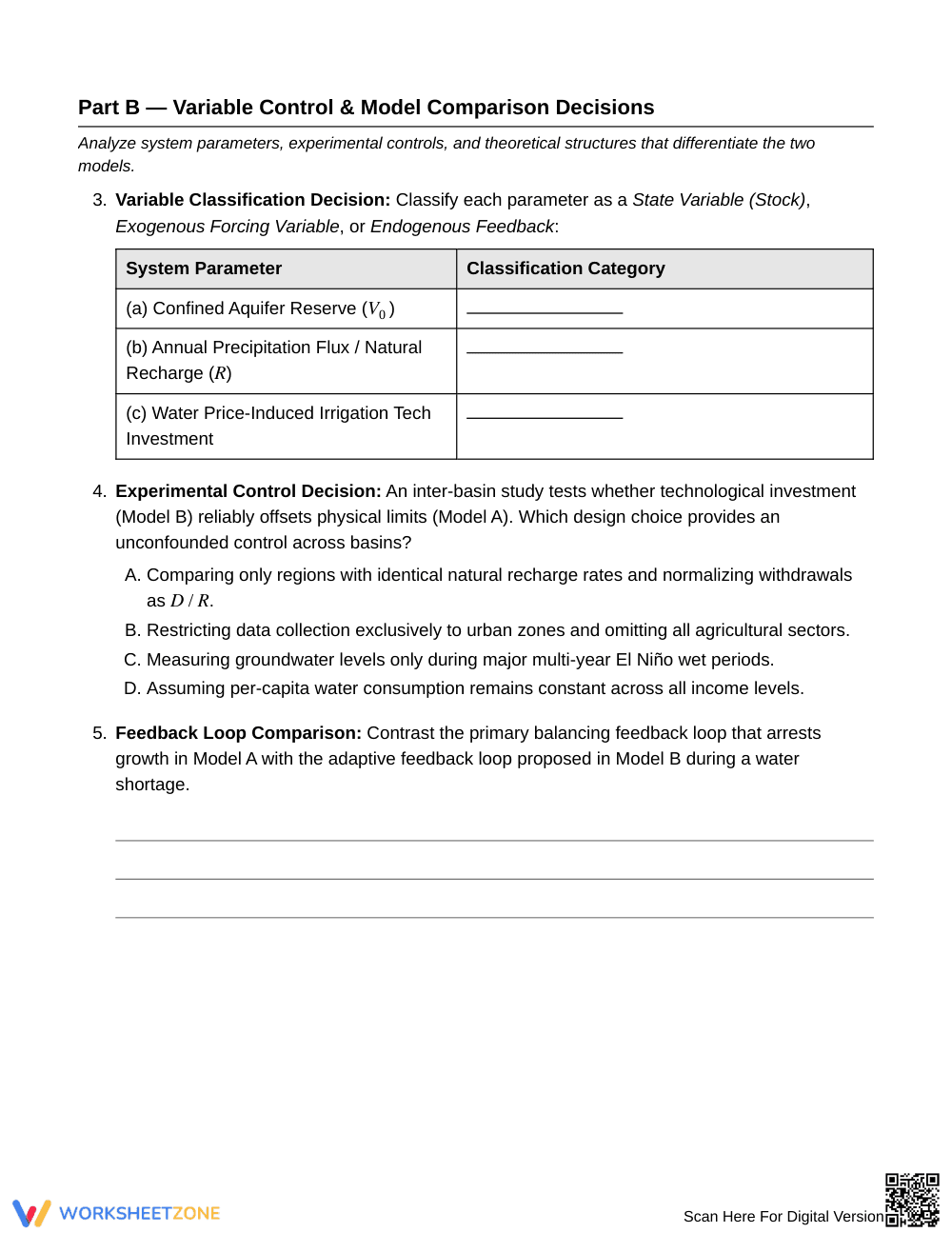
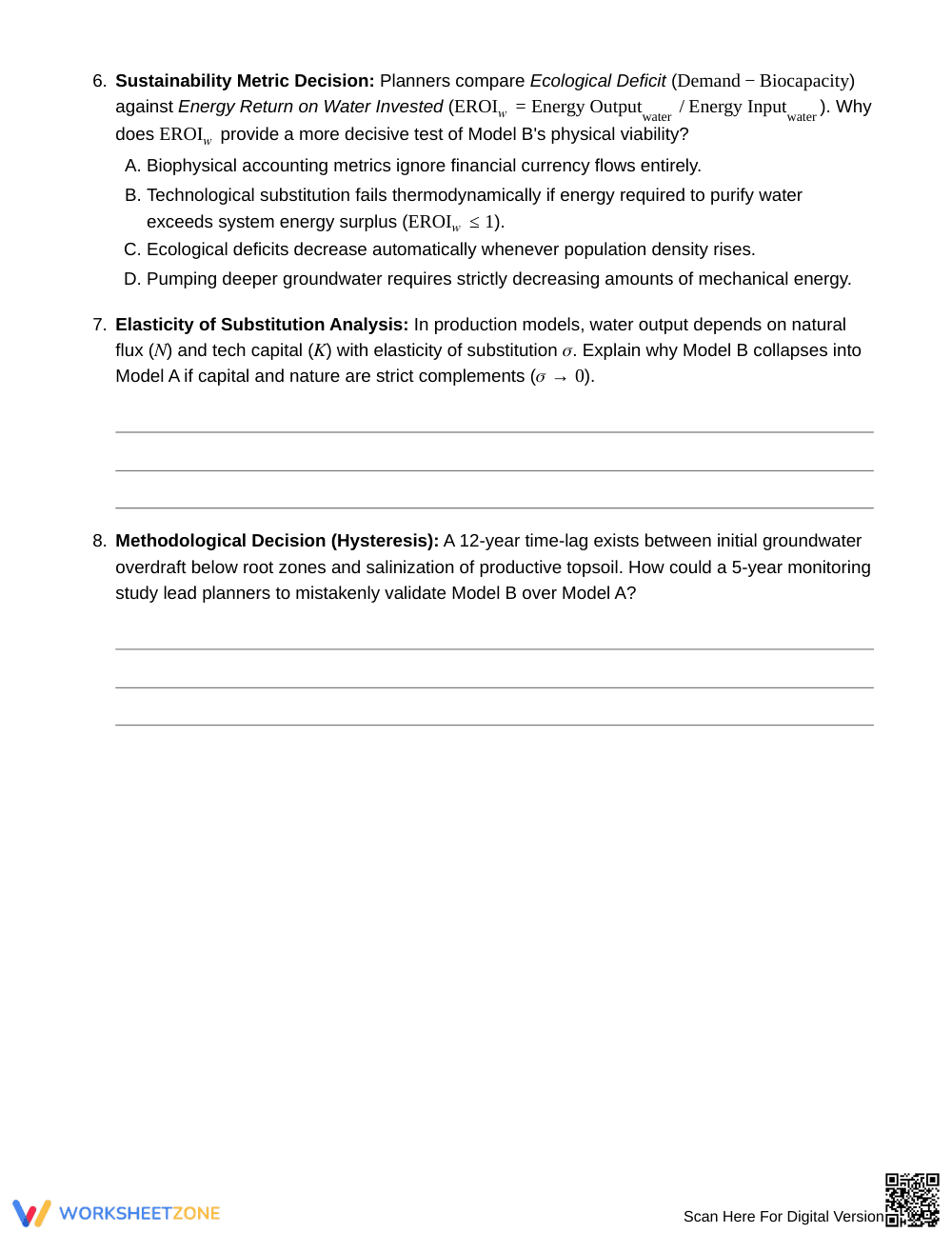
This environmental science worksheet guides Grade 12 students to mathematically compare competing resource-limit models in human-ecological systems. Learners calculate reserve depletion timelines, analyze technological substitution, and interpret hydrological case data. By testing biophysical limits against induced innovation, students establish quantitative arguments regarding population growth and carrying capacity.
At a Glance
- Grade: 12 · Subject: Environmental & Earth/Space Science
- Standard: Compare mathematical carrying capacity models and evaluate empirical resource depletion thresholds in ecological systems
- Skill Focus: Compare Resource-Limit Models
- Format: 5 pages · 10 problems · Full 2-page answer key included · PDF
- Best For: Advanced ecological modeling and data-driven analysis
- Time: 45–60 minutes
Across 5 printable pages, this resource delivers 10 analytical problems set in a synthetic hydrological basin. Students engage with exponential depletion equations, parameter classification matrices, and empirical sub-basin shock scenarios. The handout contrasts Neo-Malthusian biophysical limits with Boserupian innovation, concluding with a comprehensive 2-page answer key detailing mathematical proofs and policy rationales.
Skill Progression
- Guided practice (Part A, Problems 1–2): Students apply exponential growth formulas to calculate non-renewable reserve depletion timelines and per-capita demand decoupling under scaffolded prompts.
- Supported practice (Part B, Problems 3–8): Learners navigate structured decision matrices, classifying variables, isolating controls, and evaluating thermodynamic constraints like Energy Return on Water Invested.
- Independent practice (Part C, Problems 9–10): Working autonomously, students interpret empirical energy shock data and synthesize regional planning rules.
This sequence follows a gradual-release model, advancing students from computational execution to high-level theoretical synthesis.
Standards Alignment
This resource supports advanced environmental science standards focusing on computational modeling of carrying capacity, human impact on Earth systems, and feedbacks governing non-renewable resource depletion. Both standard codes can be copied directly into lesson plans, IEP goals, or district curriculum mapping tools.
How to Use It
Assign this worksheet after direct instruction on ecological carrying capacity to reinforce quantitative comparison. It also serves effectively during an AP Environmental Science unit on population and water resources as a collaborative problem set. During work time, formatively check whether students recognize thermodynamic limits on capital substitution. Completion takes approximately 45 to 60 minutes.
Who It's For
This worksheet is tailored for Grade 12 Environmental Science and AP Environmental Science students tackling complex systems modeling. Provide a reference card on exponential math for struggling learners, while challenging advanced students to calculate multi-parameter elasticity. It pairs naturally with an introductory lecture on regional aquifer depletion and water conservation policy.
According to research by Fisher & Frey (2014), a structured cognitive progression that transitions learners from scaffolded quantitative modeling to unprompted evaluative synthesis significantly deepens conceptual mastery in advanced secondary science. This 5-page Grade 12 environmental science resource directly develops students' analytical capacity to compare resource-limit models across 10 rigorous, classroom-tested tasks. Learners critically evaluate competing biophysical and technological frameworks by calculating exponential aquifer drawdown, identifying system feedback loops, and assessing empirical stress-test data from regional basin case studies. By confronting essential real-world trade-offs such as energy return on water investment and hydrological hysteresis, students move beyond rote definitions to substantiate environmental policy claims with robust quantitative evidence. The included 2-page explanatory answer key supports precise formative evaluation, equipping educators to diagnose and remediate student misconceptions regarding carrying capacity boundaries, capital substitution, and long-term ecological sustainability.


