




























Views
Downloads





Essential Resource Planning Worksheet | Grade 12 Science

Paste this activity's link or code into your existing LMS (Google Classroom, Canvas, Teams, Schoology, Moodle, etc.).
Students can open and work on the activity right away, with no student login required.
You'll still be able to track student progress and results from your teacher account.
This Grade 12 science worksheet prepares students to evaluate resource management proposals using quantitative carrying capacity models and ecological constraints. Through two authentic case studies, learners calculate water budgets, solid waste lifespans, and electrical grid capacities to determine whether regional development policies are environmentally sustainable.
At a Glance
- Grade: 12 · Subject: Environmental Science
- Topic: Evaluating Resource-Planning Proposals
- Format: 7 pages · 10 problems · Answer key included · PDF
- Best For: High school advanced resource management units
- Time: 60–90 minutes
What's Inside
The resource includes 2 synthetic data sets (the semi-arid Verde Arroyo Basin and the tourist-impacted barrier island of Isla Perdida). Students use planning equations, parameter comparison tables, 10 analytical prompts, and a 4-page answer key featuring step-by-step mathematical solutions and model policy critiques.
Skill Progression
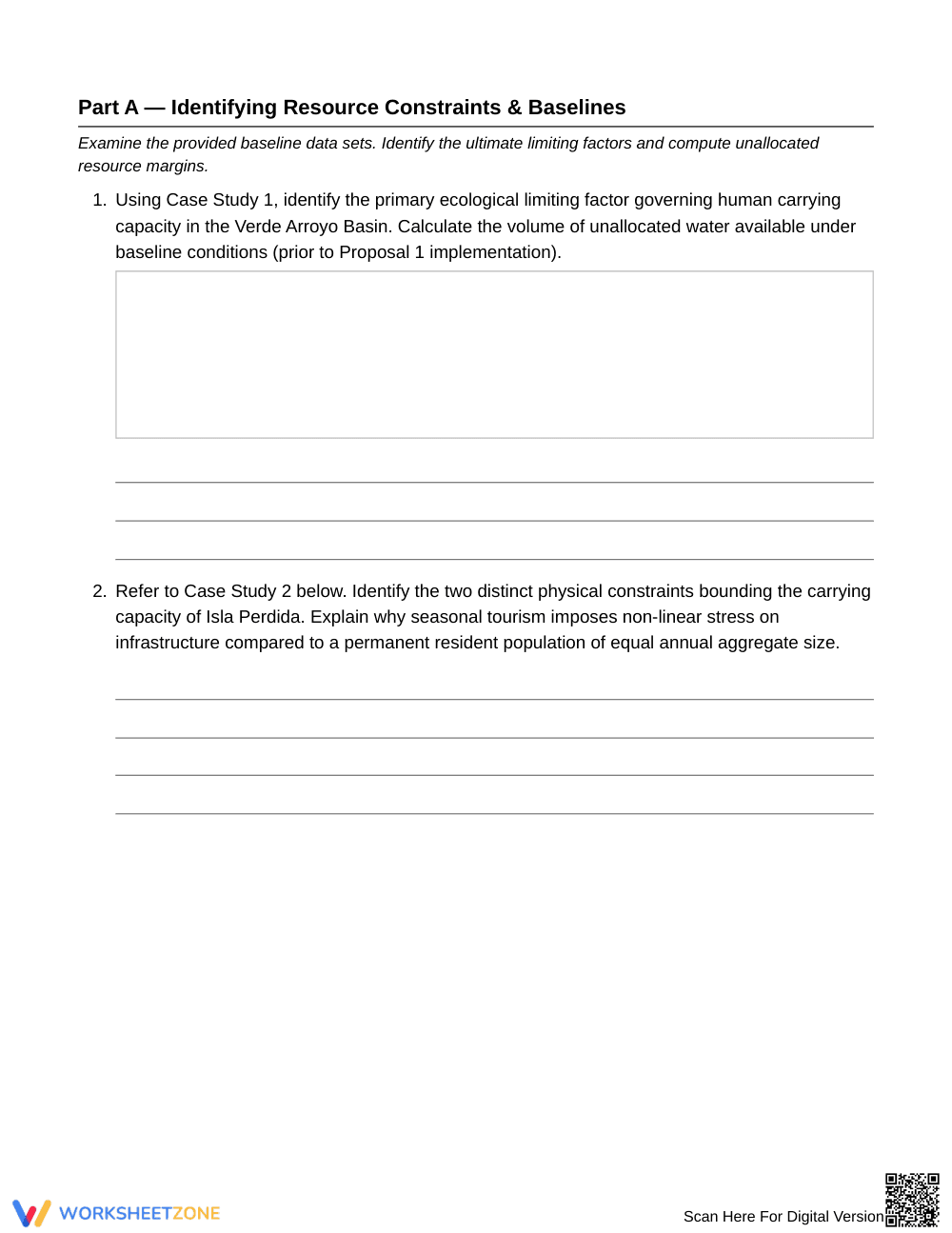
- Guided Practice (Part A, Tasks 1–2): Students analyze baseline data tables to identify ecological limiting factors and calculate unallocated resource margins.
- Supported Practice (Part B, Tasks 3–8): Students apply carrying capacity formulas to calculate population thresholds, landfill volume exhaustion rates, and electrical loads.
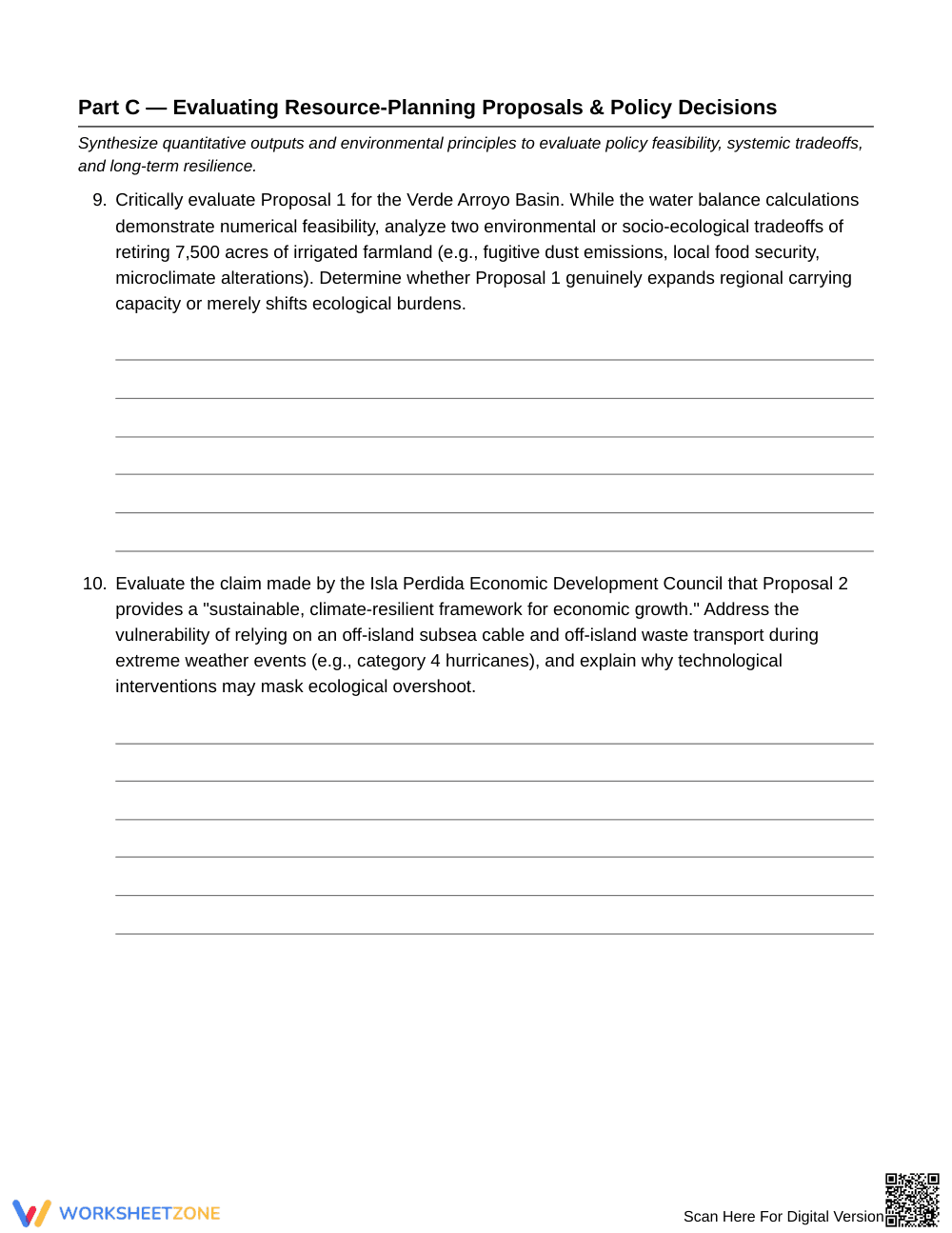
- Independent Practice (Part C, Tasks 9–10): Students synthesize quantitative findings to construct policy evaluations, analyzing socio-ecological tradeoffs and systemic overshoot.
This structured progression reflects the gradual release model, ensuring students master foundational calculations before tackling complex policy critiques.
Standards Alignment
Aligned to high school environmental science performance expectations for Earth and Human Activity, focusing on how human population growth and resource consumption impact natural systems. Students compute sustainable yield limits and evaluate proposed engineering interventions against ecological boundaries. This alignment can be copied directly into lesson plans or curriculum mapping documents.
How to Use It
Deploy this 7-page packet following instruction on carrying capacity and sustainable yield equations. For formative assessment, check student calculations on Part B before students draft their Part C policy critiques. The activity requires approximately 60 to 90 minutes and functions effectively as a capstone or collaborative task.
Who It's For
This resource is designed for Grade 12 Environmental Science, AP Environmental Science, and advanced Earth Systems courses. It includes rigorous data tables that challenge advanced learners while providing clear equation reference boxes to support developing problem-solvers.
According to research highlighted in Fisher & Frey (2014), structured case-based analysis that moves deliberately from concrete quantitative data modeling to open-ended policy evaluation significantly enhances students' capacity to analyze coupled natural-human systems. By requiring 12th-grade learners to calculate numerical carrying capacities across 10 distinct analytical tasks before critiquing regional planning proposals, this instructional resource builds authentic scientific reasoning and ecological literacy. When high school seniors practice identifying finite environmental thresholds, computing mass balances, and evaluating proposed engineering interventions, they transition from passive consumers of scientific facts to active evaluators of complex socio-ecological policies. Grounding environmental decision-making in explicit mathematical models provides the essential instructional scaffolding necessary for advanced learners to weigh competing ecological priorities, anticipate unforeseen systemic consequences, resolve sustainability dilemmas, and articulate rigorous, evidence-based management critiques with measurable confidence across diverse secondary science classroom environments.


