


























Views
Downloads



Printable Carrying Capacity Worksheet | Grade 12 Science
Paste this activity's link or code into your existing LMS (Google Classroom, Canvas, Teams, Schoology, Moodle, etc.).
Students can open and work on the activity right away, with no student login required.
You'll still be able to track student progress and results from your teacher account.
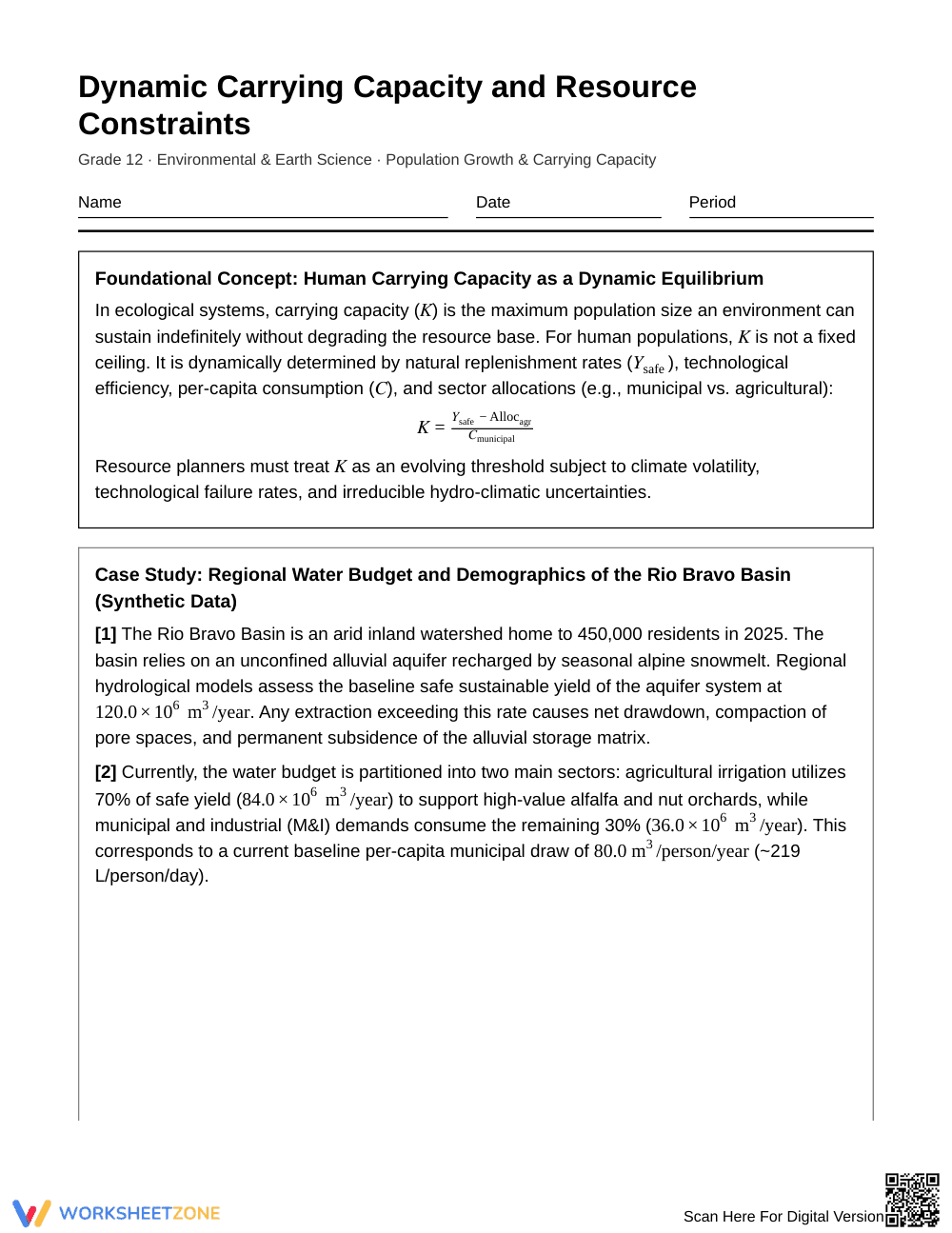
This Grade 12 environmental science worksheet equips students to calculate dynamic human carrying capacity and defend resource management proposals under hydro-climatic uncertainty. Students analyze synthetic hydrological data from an arid river basin, evaluate physical indicators of ecological overdraft, and construct quantitative arguments balancing municipal expansion against agricultural allocations and technological limits.
At a Glance
- Grade: 12 · Subject: Environmental & Earth/Space Science
- Standard: Scientific Argumentation — Evaluate competing design solutions and defend resource decisions using uncertainty models
- Skill Focus: Defending scenarios with stated uncertainty
- Format: 6 pages · 8 problems · Answer key included · PDF
- Best For: AP or advanced environmental science units
- Time: 60–75 minutes
What's Inside
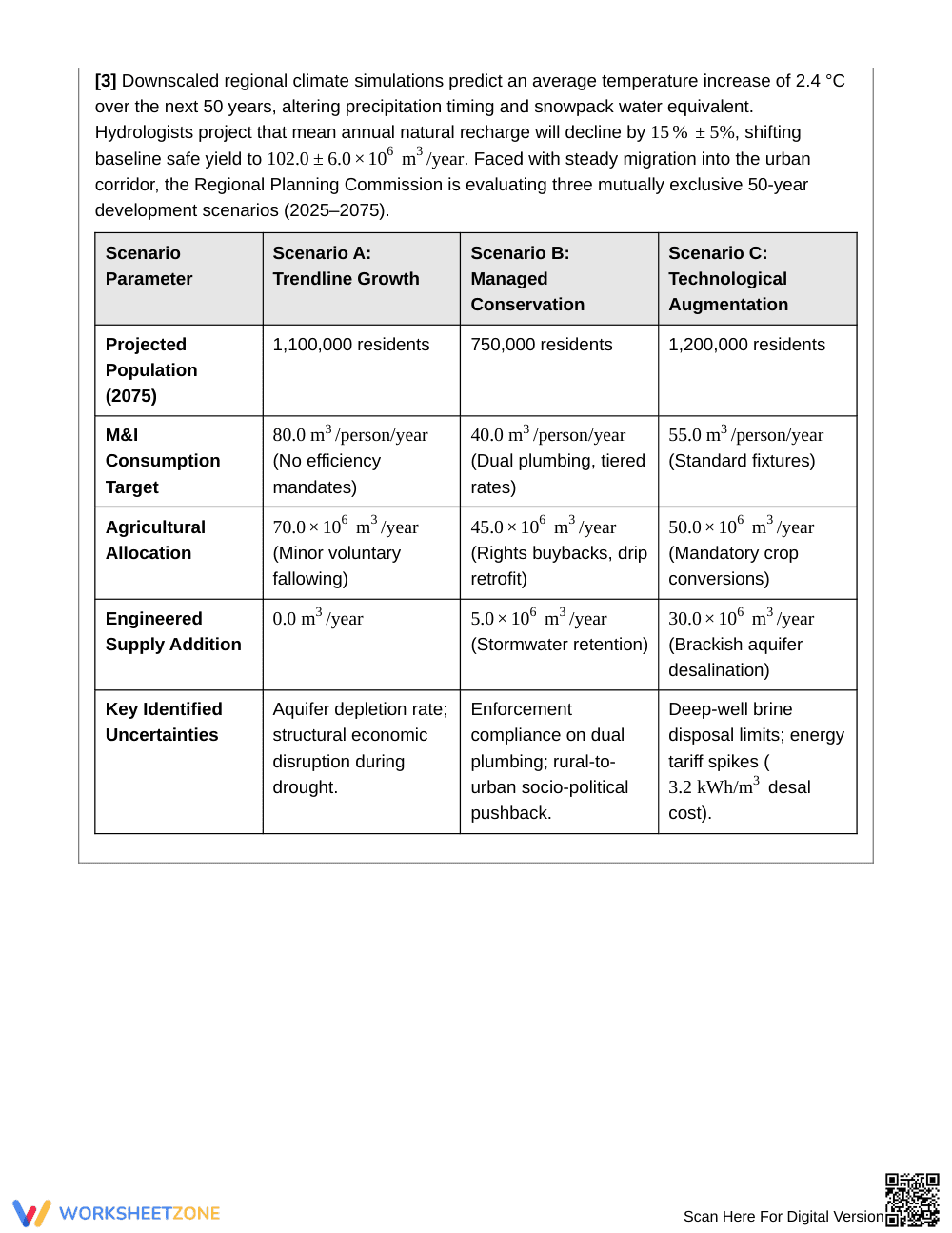
The 6-page activity presents a detailed case study of the Rio Bravo Basin alongside a demographic and water budget scenario matrix. Students work through 8 rigorous analytical items spanning quantitative carrying capacity modeling, physical mechanism explanations of subsidence and snowpack loss, and a structured policy defense addressing operational risks. A comprehensive 5-page answer key provides complete mathematical solutions and sample analytical justifications.
Skill Progression
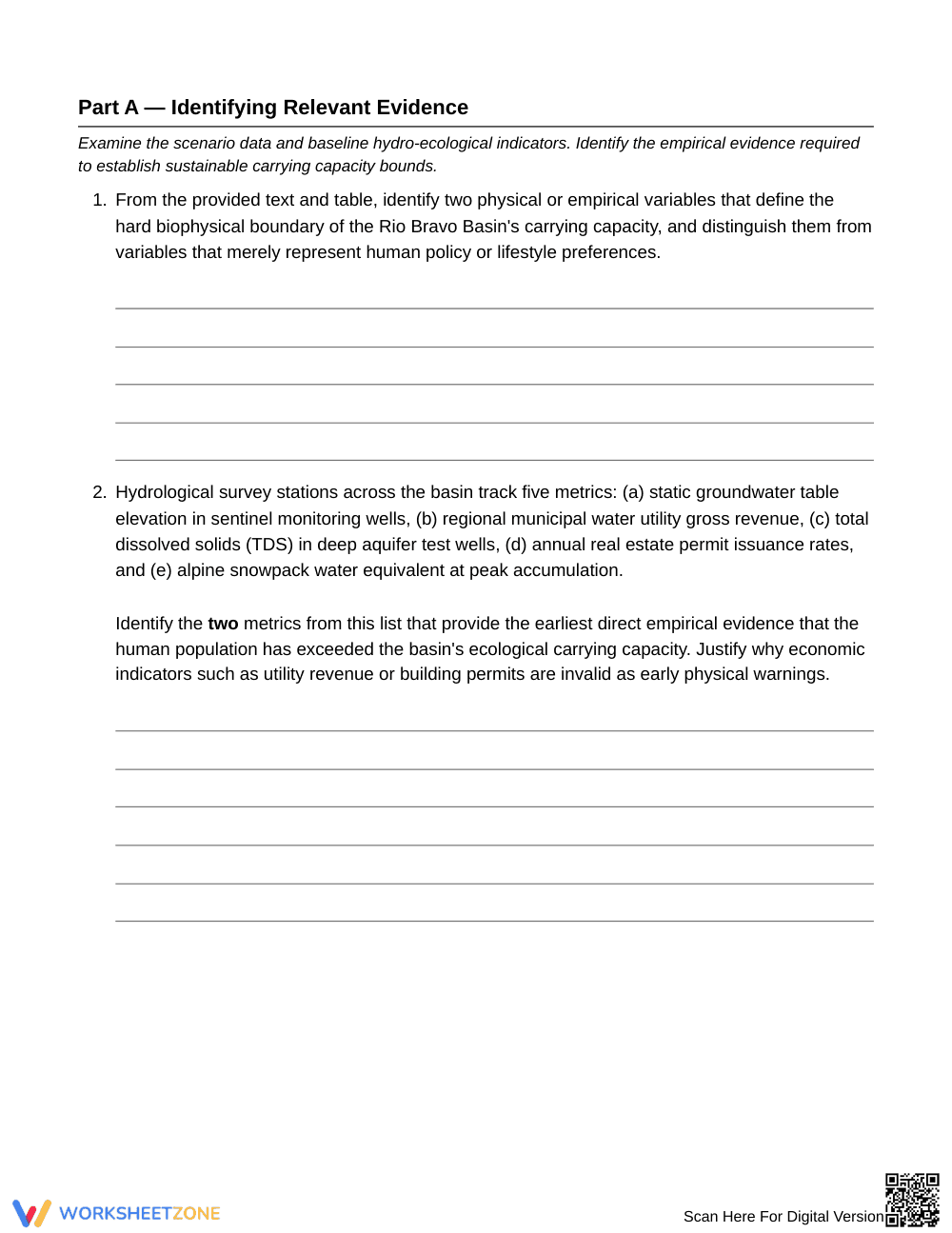
- Guided practice (Part A, Problems 1–2): Students examine hydro-ecological indicators, isolating hard physical limits from policy choices and identifying monitoring well elevations and snowpack data as early warnings of overdraft.
- Supported practice (Part B, Problems 3–6): Learners compute carrying capacity under climate-adjusted safe yields, model pore-pressure loss driving permanent subsidence, and articulate the socio-ecological trade-offs of agricultural water transfers.
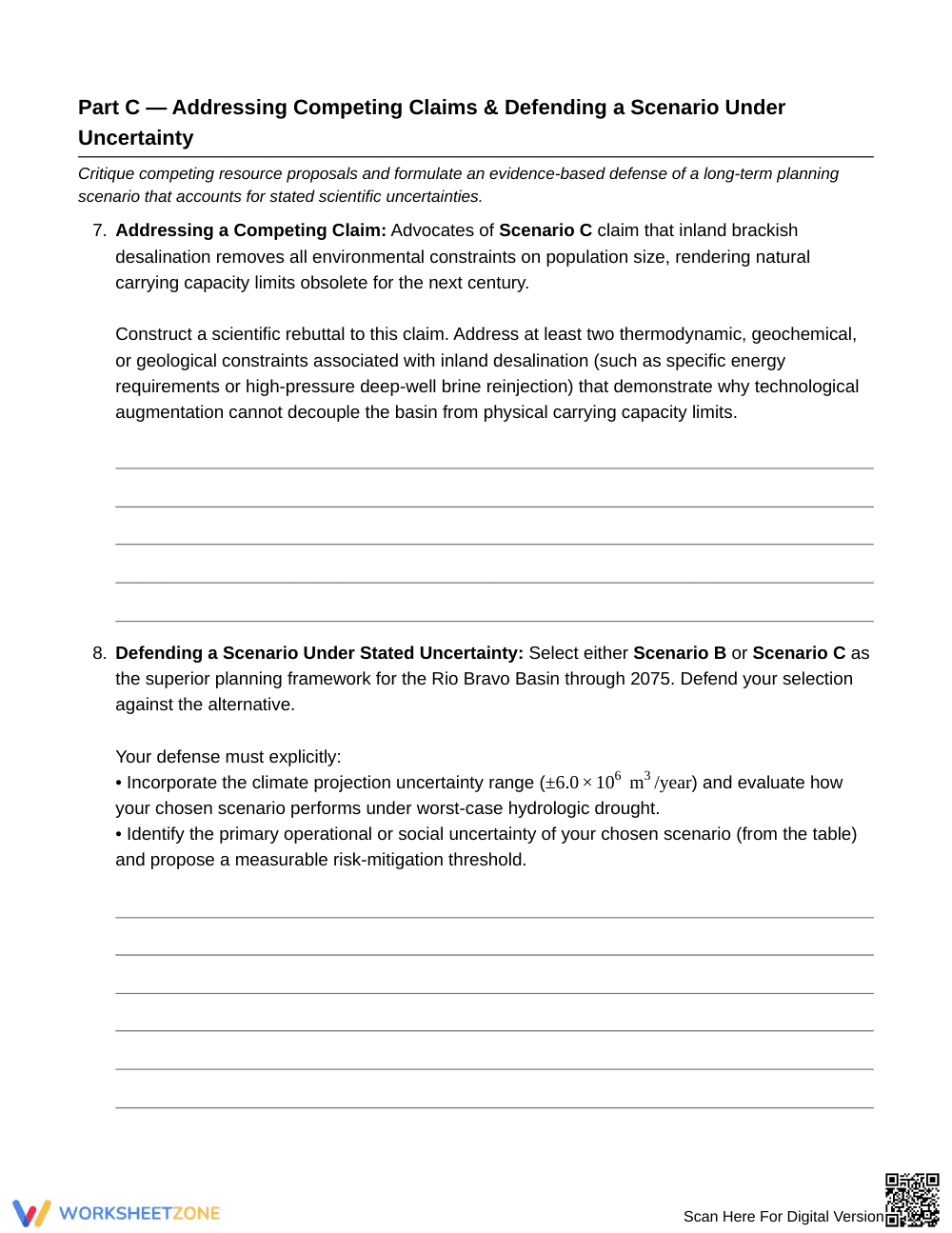
- Independent practice (Part C, Problems 7–8): Students write a scientific rebuttal to technological silver-bullet claims and compose a formal defense of a long-term development pathway incorporating quantitative climate uncertainty margins (±6.0×10⁶ m3/year).
This structured progression reflects the gradual release of responsibility model, guiding advanced learners from data classification to autonomous scientific argumentation.
Standards Alignment
This resource aligns with high school Environmental and Earth Science standards focused on human sustainability, natural resource management, and computational modeling. Students evaluate competing design solutions for developing, managing, and utilizing energy and mineral resources based on cost-benefit ratios and hydro-climatic constraints. Standard descriptions can be copied directly into lesson plans, IEP goals, or district curriculum mapping tools.
How to Use It
Deploy this worksheet after direct instruction on human population dynamics, aquifer hydrogeology, and climate change feedback loops. It serves effectively as a multi-day capstone case study or small-group collaborative challenge. During independent work in Part C, circulate to check whether students incorporate the climate uncertainty margin into their mathematical defense rather than relying solely on mean projections. Expect completion within 60 to 75 minutes across one or two class blocks.
Who It's For
Designed for Grade 12 students in Advanced Placement Environmental Science, Earth and Space Science, or dual-enrollment sustainability courses. It accommodates advanced analytical learners while supporting developing writers through structured calculation prompts and clearly segmented scenario criteria. Pair this activity directly with an aquifer recharge diagram or municipal water budget lecture.
According to Fisher & Frey (2014), engaging high school science students in evidence-based argumentation requires structured opportunities to evaluate competing claims and articulate underlying physical mechanisms. This Grade 12 environmental science case study directly operationalizes that instructional principle. Across 8 rigorous tasks, students analyze realistic hydro-climatic data, model dynamic carrying capacity thresholds, and construct evidence-based defenses that incorporate explicit statistical uncertainty. Rather than treating ecological limits as static values, the resource guides learners to synthesize thermodynamic constraints, geological pore-pressure mechanics, and shifting baseline recharge estimates. By moving systematically from empirical indicator identification to multi-variable policy critique, students develop the quantitative reasoning and critical literacy demanded by contemporary college-level environmental science curricula.


