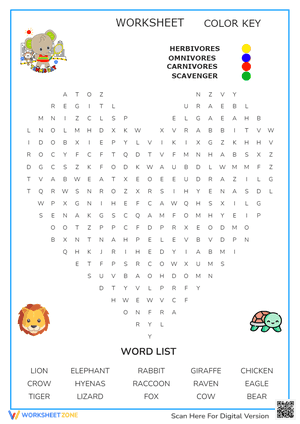
If you teach an ecosystems unit anywhere between grade 3 and grade 7, you already know students walk in with a shaky idea of how energy moves through a habitat. Food webs and food chains worksheets give you a fast, low-prep way to surface that confusion and correct it before it hardens into a misconception that follows kids into middle school. Rather than starting from a general 'worksheets help kids learn' pitch, it helps to start from the actual classroom problem: students draw a straight line from grass to rabbit to fox and think that is the whole story.
A well-built worksheet set walks students from that simple linear chain into a full web, showing how one producer supports many consumers and how removing a single species can ripple outward. That progression matters because it mirrors how the concept is actually assessed on state science tests and in NGSS performance expectations.
Matching Worksheets to NGSS 5-LS2-1 and MS-LS2-3
Fifth grade teachers are working toward NGSS 5-LS2-1, which asks students to use models describing how matter moves among plants, animals, decomposers, and the environment. A food web worksheet that requires students to trace matter through producers, consumers, and decomposers is a direct rehearsal of that performance expectation, not just a vocabulary review.
In the grade 7 band, MS-LS2-3 raises the bar: students must develop a model describing both the cycling of matter and the flow of energy among living and nonliving parts of an ecosystem. Worksheets built for this level should ask students to label energy flow direction with arrows and identify where matter re-enters the system through decomposition, not just identify who eats whom.
One planning detail that is easy to miss: food chains rarely extend past four or five links because of energy pyramid math, and worksheets that pair a food web diagram with an energy pyramint task make this concrete for students. Roughly 90 percent of energy is lost as heat between each trophic level, which is why apex predators are always fewer in number and farther down the visible food web than students expect.
Food Chain Worksheets vs Food Web Worksheets
These two worksheet types look similar but train different skills, and mixing them up in a lesson plan can undercut your objective. A food chain worksheet is linear: one producer, one primary consumer, one secondary consumer, and so on, following a single path of energy. It is the right tool for introducing vocabulary like producer, consumer, and decomposer to students who have never seen the concept before.
A food web worksheet is interconnected: multiple chains overlap into a single diagram showing that a hawk might eat a snake, a rabbit, or a mouse, and that removing one species affects several others at once. Save food web tasks for once students have already practiced the simpler chain format, since asking students to build a web before they understand a single chain tends to produce diagrams that are messy without being meaningful.
Pairing Food Web Practice With Energy Pyramid Worksheets
NGSS 5-PS3-1 connects food chains directly to energy, requiring students to model that the food energy in animals originated from the sun. Pairing a food web worksheet with an energy pyramid worksheet in the same lesson closes the loop: students see where energy enters the system, how it flows between species, and why so much of it is lost at each transfer.
A simple sequence that works well in a single class period: start with a food chain worksheet to review vocabulary, move to a food web worksheet to show interconnection, then finish with an energy pyramid worksheet that asks students to explain why there are more producers than apex predators in any given ecosystem.
Classroom Implementation
Sequence worksheets by complexity across a unit rather than assigning them in a random order. Start with vocabulary-focused food chain worksheets in week one, move to interconnected food web diagrams in week two, and close with an energy pyramid and keystone species task in week three. This sequencing matches how the NGSS performance expectations build on each other across grade bands.
For small-group intervention, pull a simplified food chain worksheet for students still working on basic vocabulary while the rest of the class works on a full food web diagram. For enrichment, give strong students a blank food web template and ask them to build their own from a list of organisms rather than filling in a pre-drawn diagram. This single change turns a review worksheet into an open-ended modeling task that stretches your highest performers without needing an entirely separate resource.
Frequently Asked Questions
1. What grade level are food web and food chain worksheets appropriate for?
They fit best in grades 3 through 7, with food chain worksheets suited to introducing vocabulary in upper elementary and food web worksheets suited to the interconnected modeling expected in NGSS 5-LS2-1 and MS-LS2-3.
2. What is the difference between a food chain and a food web worksheet?
A food chain worksheet follows one linear path of energy from producer to top consumer. A food web worksheet shows multiple overlapping chains, illustrating that most organisms have several food sources and predators.
3. Which NGSS standards do food web worksheets support?
Food web worksheets most directly support NGSS 5-LS2-1 for matter movement in ecosystems, MS-LS2-3 for matter cycling and energy flow, and NGSS 5-PS3-1 for connecting food energy back to the sun.
4. How can teachers use these worksheets for small-group intervention or review?
Use a simplified food chain worksheet with students still learning basic vocabulary, and reserve full food web diagrams and keystone species tasks for students ready to reason about interconnected effects.
5. What vocabulary should students master before completing food web worksheets?
Students should be comfortable with producer, consumer, decomposer, scavenger, and trophic level before starting a food web diagram, since the diagram assumes they can already sort organisms into these categories.















 Interactive Worksheet Maker
 Quiz Maker
 Word Search Maker
 Crossword Puzzle Maker
 Word Scramble Generator
 Sentence Scramble Generator
 Handwriting Worksheet Generator
 Name Tracing Generator
 Fill In The Blank Generator