


























Views
Downloads

Essential Food Webs Worksheet | Grade 3 Science Aligned
Paste this activity's link or code into your existing LMS (Google Classroom, Canvas, Teams, Schoology, Moodle, etc.).
Students can open and work on the activity right away, with no student login required.
You'll still be able to track student progress and results from your teacher account.
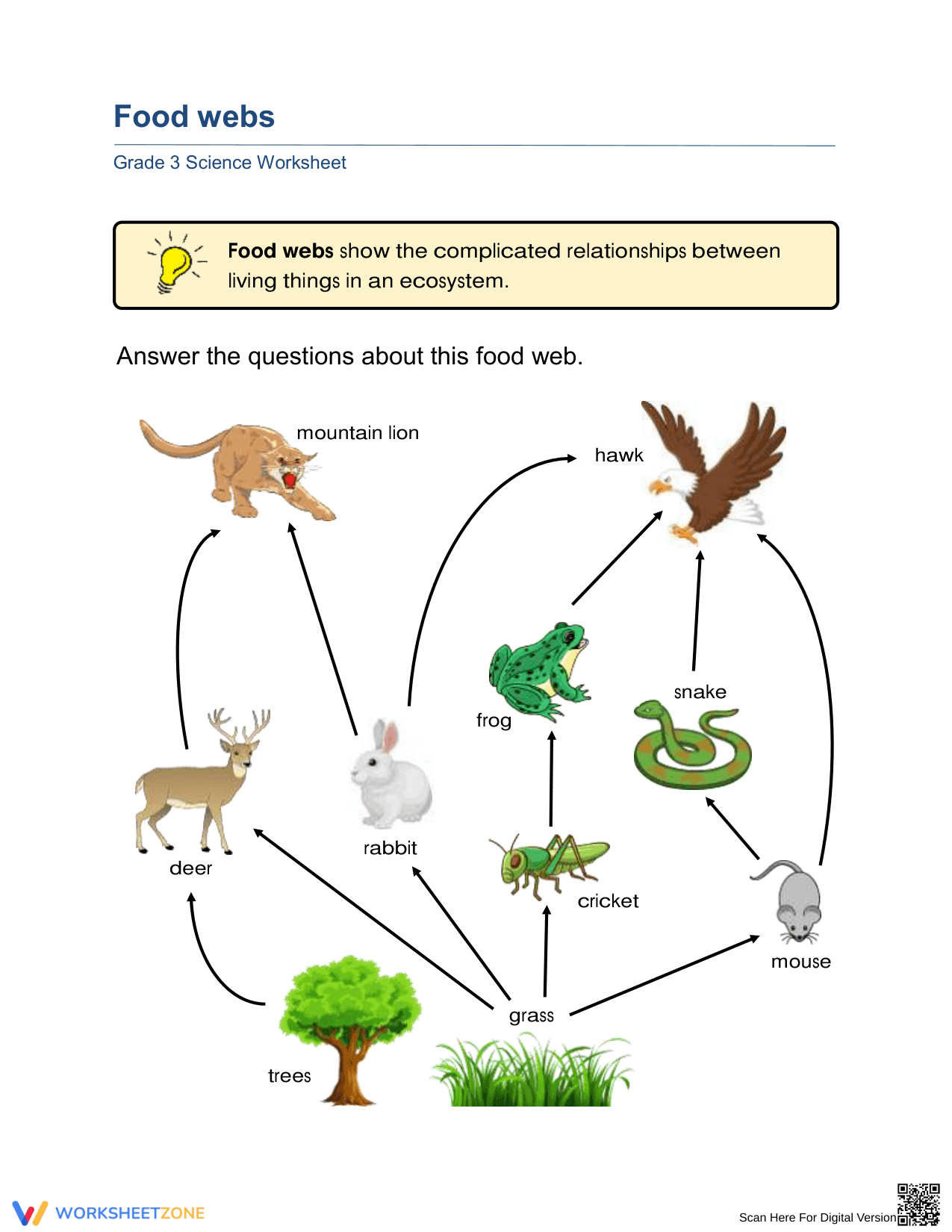
This Grade 3 science worksheet provides a comprehensive introduction to food webs and energy transfer within an ecosystem. Students analyze a detailed forest food web diagram to identify predator-prey relationships and trace the flow of energy from the sun through producers to various consumers. It builds critical thinking skills regarding environmental balance.
At a Glance
- Grade: 3 · Subject: Science
- Standard:
3-LS4-3— Construct an argument with evidence that in a particular habitat some organisms can survive well- Skill Focus: Food Web Analysis & Energy Flow
- Format: 2 pages · 7 problems · Answer key included · PDF
- Best For: Independent practice or formative assessment
- Time: 15–20 minutes
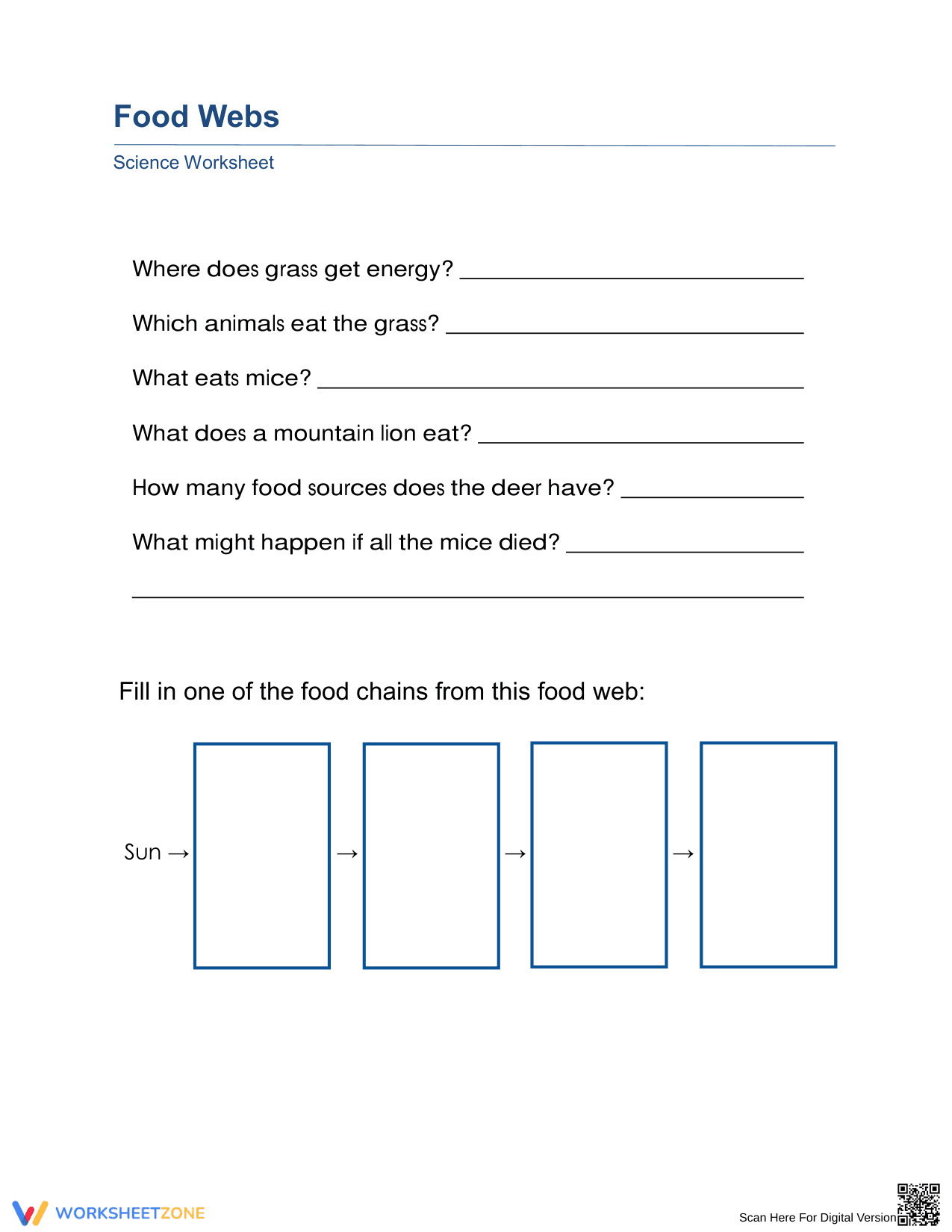
This 2-page resource features a clear, labeled diagram of a forest food web including trees, grass, deer, rabbits, crickets, mice, frogs, snakes, hawks, and mountain lions. The task set includes six analytical questions requiring students to identify energy sources and feeding patterns, plus a structured food chain template to map energy flow starting from the sun.
Zero-Prep Workflow
- Print: Generate copies in under 30 seconds with no complex formatting required.
- Distribute: Pass out to students for a quiet independent activity or homework assignment.
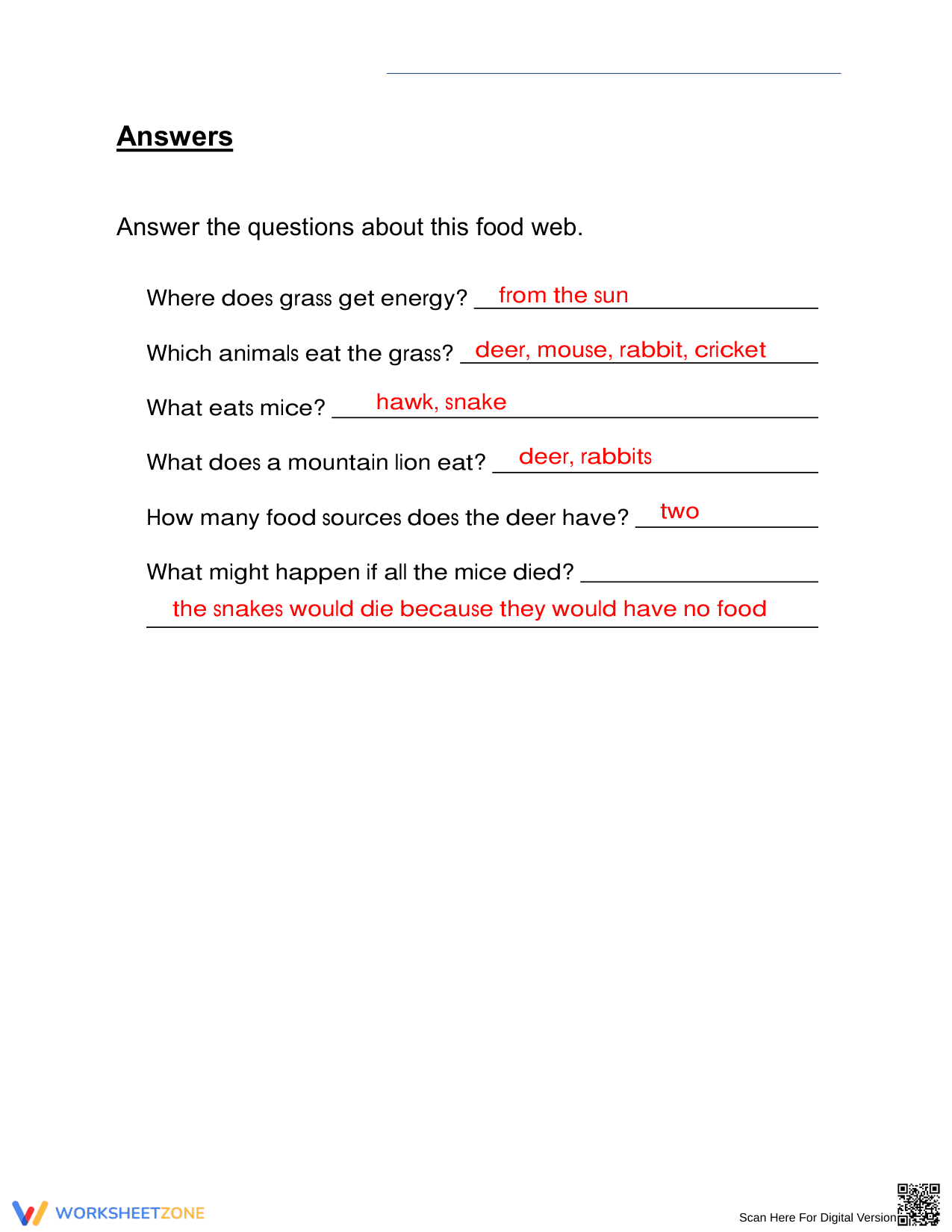
- Review: Use the included answer key to check for understanding in less than 5 minutes.
This worksheet is designed for immediate use with zero teacher preparation, making it an ideal choice for emergency sub plans or quick transitions.
Standards Alignment
This worksheet is primarily aligned to NGSS 3-LS4-3, which focuses on understanding how organisms interact within their habitats to survive. It also supports foundational concepts of energy transfer by requiring students to model simple chains within a larger web. Both standard codes can be copied directly into lesson plans, IEP goals, or district curriculum mapping tools.
How to Use It
Assign this worksheet as a follow-up to a direct lesson on ecosystems to gauge student understanding of consumer roles. During the activity, observe if students can correctly trace the arrows to determine which way the energy flows; a common misconception is that arrows point to what is being eaten rather than where the energy goes. Expected completion time is 15–20 minutes.
Who It's For
Designed for Grade 3 elementary students, this resource is excellent for general education classrooms, homeschool environments, and science intervention groups. It pairs naturally with an anchor chart on producers, consumers, and decomposers to support visual learners during the identification process.
According to research from ScienceDirect TpT Analysis, high-quality visual aids in science worksheets significantly enhance the retention of complex concepts like energy flow in ecosystems. This resource aligns with standard 3-LS4-3 by requiring students to analyze the interconnectedness of species, a fundamental skill for constructing arguments about habitat survival. By identifying specific feeding relationships among ten different organisms, learners develop a robust understanding of how energy moves through a biological community. The inclusion of a structured food chain template supports the scaffolding needed for third-graders to transition from linear food chains to complex food webs. This systematic approach to ecosystem vocabulary and relationship mapping ensures that students are prepared for more advanced middle school life science standards. This content serves as a reliable formative assessment tool for educators tracking mastery of 3-LS4-3 in diverse classroom settings.


