




























Views
Downloads

Essential Food Chains on Land Cut and Paste | Grade 2-3

Paste this activity's link or code into your existing LMS (Google Classroom, Canvas, Teams, Schoology, Moodle, etc.).
Students can open and work on the activity right away, with no student login required.
You'll still be able to track student progress and results from your teacher account.
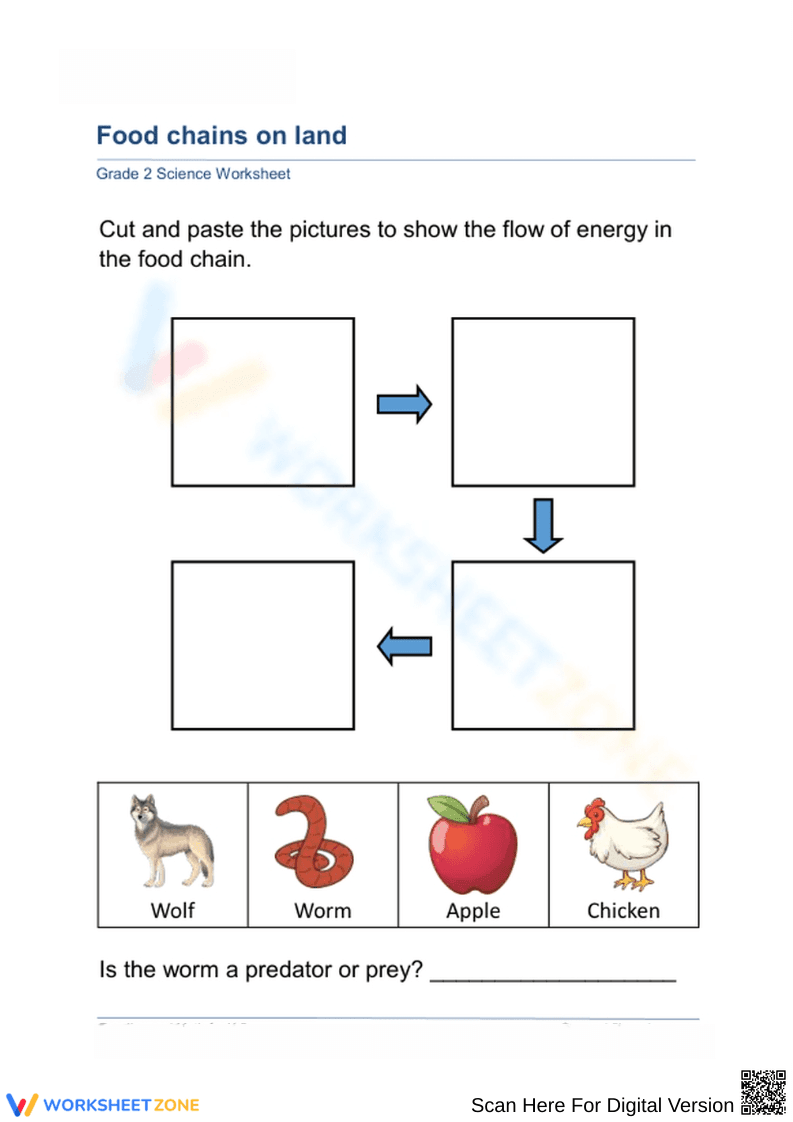
This Grade 2-3 science worksheet simplifies the concept of energy flow through a hands-on cut-and-paste activity. Students identify the roles of producers and consumers by organizing a land-based food chain involving an apple, worm, chicken, and wolf. This interactive approach helps learners visualize how plants and animals depend on one another for survival in nature.
At a Glance
- Grade: Grade 2–3 · Subject: Science
- Standard:
5-PS3-1— Use models to describe that energy in animals was once energy from the sun- Skill Focus: Food chain organization and energy flow
- Format: 1 page · 5 tasks · Answer key included · PDF
- Best For: Independent practice or quick science stations
- Time: 15–20 minutes
The worksheet features a primary cut-and-paste diagram where students sequence four components to illustrate a functional energy cycle. It includes illustrations of a wolf, worm, apple, and chicken, providing visual cues for younger learners. A concluding critical thinking question asks students to categorize the worm as a predator or prey, reinforcing vocabulary related to ecological roles. The single-page PDF format is optimized for quick printing and includes a comprehensive answer key.
Zero-Prep Workflow
Teachers can implement this resource in under two minutes. First, print the single-page document for the class, requiring zero digital setup. Second, distribute the sheets along with scissors and glue; students typically spend about 15 minutes completing the sequencing and the final question. Finally, review the results as a whole group using the included answer key for immediate formative feedback. This streamlined process makes it an ideal choice for substitute lesson plans or science stations.
Standards Alignment
This resource is explicitly aligned to 5-PS3-1, which focuses on modeling the flow of energy from producers to consumers within an ecosystem. By constructing a sequence of energy movement, students demonstrate mastery of biological interdependence and basic ecological roles. The standard code 5-PS3-1 can be copied directly into lesson plans, IEP goals, or district curriculum mapping tools.
How to Use It
Use this worksheet as a concluding activity during a direct instruction lesson on ecosystems to check for student understanding. It also serves as an excellent formative assessment observation tool; teachers can walk around during the "paste" phase to identify students who struggle with the concept of energy starting with producers. Expected completion time is roughly 15 to 20 minutes, making it perfect for the final segment of a science block.
Who It's For
Designed for second and third-grade elementary students, this worksheet is particularly effective for tactile learners who benefit from physical manipulation of concepts. The visual-heavy design provides necessary support for English Language Learners and students with reading scaffolds. It pairs naturally with an introductory video on land-based habitats or a classroom anchor chart detailing the differences between producers and consumers.
Effective science instruction in early elementary grades relies on concrete models to explain abstract ecological relationships. Hands-on activities like cut-and-paste sequencing significantly improve long-term retention of "energy flow" concepts compared to passive methods. This worksheet targets standard 5-PS3-1, helping students master the fundamental skill of identifying how energy moves from plants to animals. By engaging with the specific land-based chain of an apple, worm, chicken, and wolf, learners build critical foundational knowledge for more complex food web analysis. The vocabulary-based question at the end ensures students actively process predator-prey dynamics. This resource provides a research-backed method for delivering science standards in a classroom-ready format that reduces teacher workload while maximizing student engagement in biological sciences.


