


























Views
Downloads

Essential Food Chains Worksheet | Grade 2 Science
Paste this activity's link or code into your existing LMS (Google Classroom, Canvas, Teams, Schoology, Moodle, etc.).
Students can open and work on the activity right away, with no student login required.
You'll still be able to track student progress and results from your teacher account.
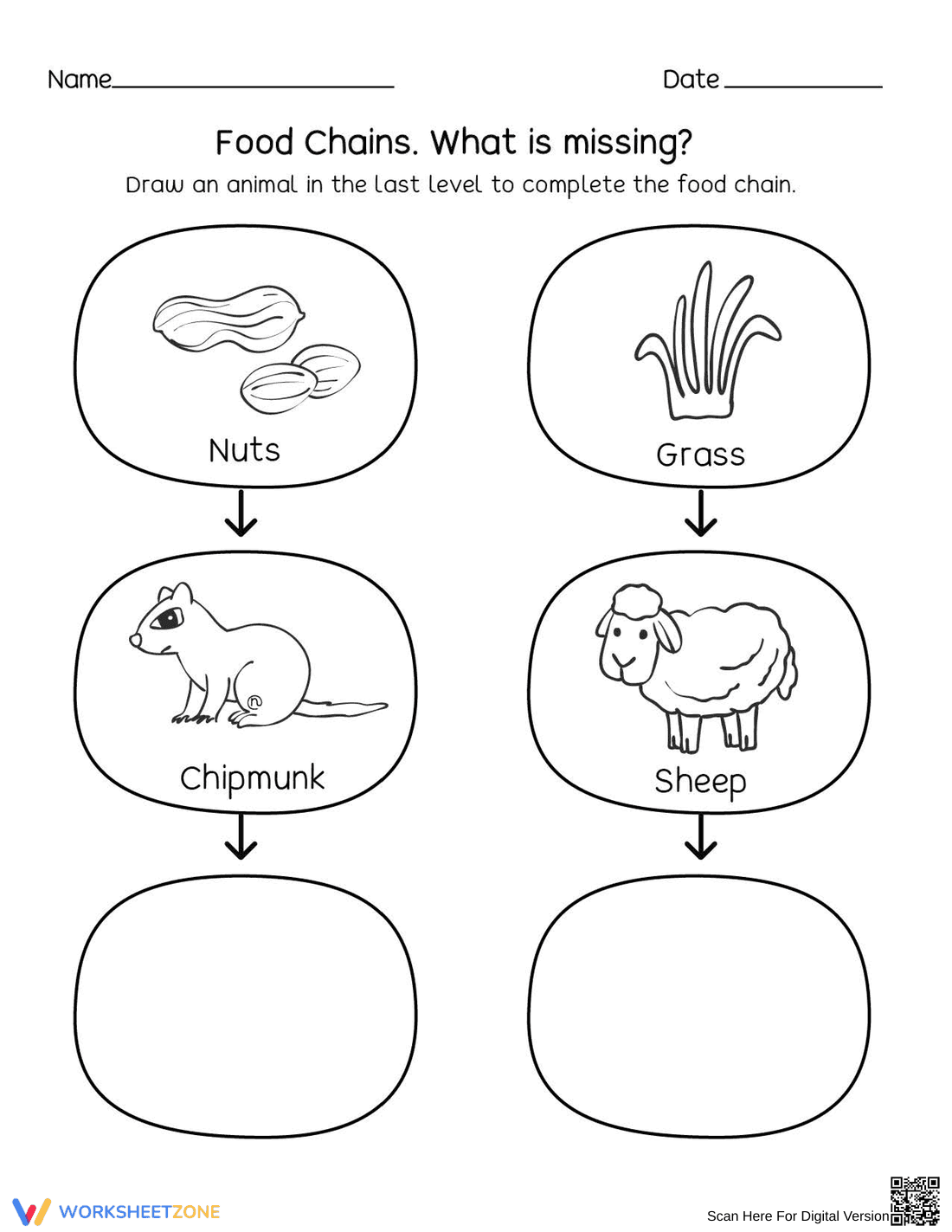
This Grade 2 food chains worksheet helps students visualize energy transfer in nature. By identifying and drawing the missing consumer in two distinct ecological sequences, learners demonstrate their understanding of how animals depend on plants and other animals for survival. It provides a clear, engaging way to assess foundational biology concepts.
At a Glance
- Grade: 2 · Subject: Science
- Standard:
5-PS3-1— Describe how the energy in animals’ food was once energy from the sun- Skill Focus: Completing food chains
- Format: 1 page · 2 problems · Answer key included · PDF
- Best For: Quick formative assessment or science centers
- Time: 10–15 minutes
Inside this resource, you will find a single-page PDF featuring two incomplete food chains. The first sequence begins with nuts and a chipmunk, while the second starts with grass and a sheep. Students are prompted to draw the final animal in each chain, encouraging creative expression alongside scientific reasoning. A clear answer key is provided for quick grading.
The zero-prep workflow is designed for busy educators. First, print the single-page PDF in approximately 30 seconds. Next, distribute the sheets to students during your life science block, which takes about 1 minute. Finally, review the drawings as a whole class to discuss potential predators for 5 minutes. Total teacher preparation time is under 2 minutes, making it an ideal sub plan.
This worksheet aligns with `5-PS3-1`: "Use models to describe that energy in animals’ food (used for body repair, growth, motion, and to maintain body warmth) was once energy from the sun." It also supports K-LS1-1 by identifying animal needs. Both standard codes can be copied directly into lesson plans, IEP goals, or district curriculum mapping tools.
Use this worksheet as a "ticket out the door" after a lesson on producers and consumers. It serves as an excellent formative assessment to see if students can identify appropriate predators for specific prey. Alternatively, place it in a science center with colored pencils to encourage detailed illustrations of the final consumer. Expected completion time is 15 minutes.
This resource is perfect for early elementary students in Grades K-2 who are beginning to explore ecosystems. It is particularly effective for visual learners and English Language Learners (ELLs) due to the heavy use of illustrations. Pair this with a read-aloud about forest or meadow habitats for a complete instructional experience.
According to the RAND AIRS 2024 report, visual modeling in early science education significantly improves retention of complex biological concepts like energy transfer. This worksheet utilizes the 5-PS3-1 standard to help students bridge the gap between observing individual animals and understanding their roles within a larger system. By requiring students to draw the missing link, the activity promotes higher-order thinking beyond simple identification. Research from Fisher & Frey (2014) suggests that such scaffolded tasks are essential for the gradual release of responsibility, allowing students to demonstrate mastery of the plain-English skill of completing food chains. This 1-page resource provides 2 specific tasks that can be completed in approximately 15 minutes, offering a high-impact, low-prep solution for classroom teachers. The inclusion of an answer key ensures that even non-specialist substitutes can effectively facilitate the lesson and provide immediate feedback to learners.


