


























Views
Downloads

Printable Food Chain Worksheet | Grade 1
Paste this activity's link or code into your existing LMS (Google Classroom, Canvas, Teams, Schoology, Moodle, etc.).
Students can open and work on the activity right away, with no student login required.
You'll still be able to track student progress and results from your teacher account.
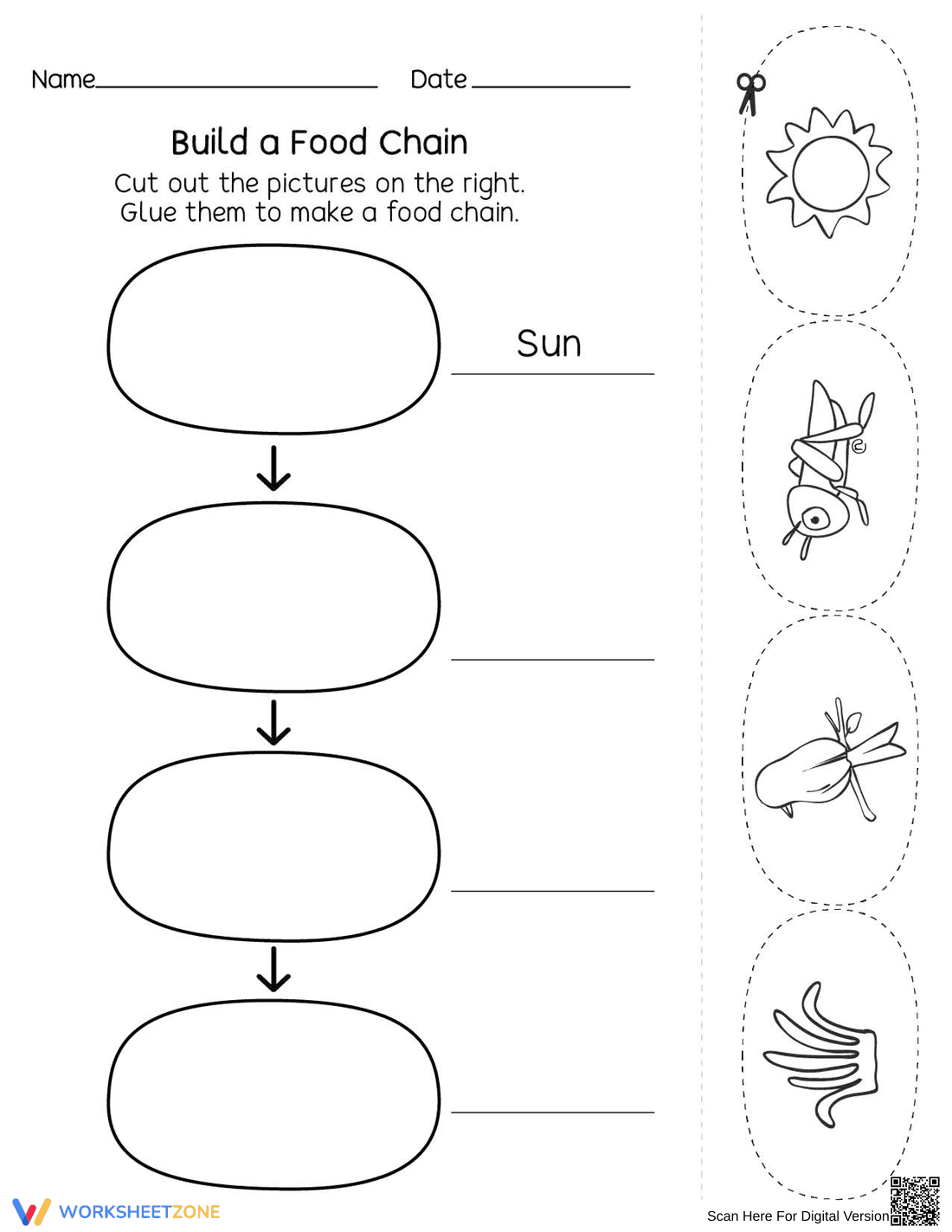
This hands-on science worksheet helps early learners understand how energy flows through an ecosystem by building a simple food chain. Students cut out four distinct images and paste them in the correct sequential order, demonstrating the relationship between the sun, plants, and animals.
At a Glance
- Grade: Kindergarten · Subject: Science
- Standard:
K-LS1-1— Describe patterns of what plants and animals need to survive- Skill Focus: Sequencing food chains
- Format: 1 page · 4 problems · No answer key · PDF
- Best For: Independent practice
- Time: 10–15 minutes
This single-page resource features a clear layout for young students. The right side includes a dashed cut-out section with four illustrations: sun, plant, grasshopper, and bird. The main section provides four blank ovals connected by arrows, guiding students to paste images in the correct biological sequence. A space for writing "Sun" reinforces early literacy.
This activity requires minimal teacher preparation, ideal for busy mornings.
- Print (30 seconds): Simply print the single-page PDF. No specialized materials or color ink are required.
- Distribute (1 minute): Hand out the sheets along with scissors and glue sticks. The instructions are self-explanatory for visual learners.
- Review (2 minutes): Quickly check student sequences as they work or review the correct order together as a class.
Total teacher prep time is under two minutes. This straightforward format also makes it an excellent, reliable option to leave in a substitute teacher plan.
This activity is directly aligned with K-LS1-1, requiring students to use observations to describe patterns of what plants and animals need to survive. By sequencing the sun, a producer, and consumers, students visually map these survival dependencies. Both standard codes can be copied directly into lesson plans, IEP goals, or district curriculum mapping tools.
Use this worksheet during independent practice in a life science unit. After a whole-class discussion or storybook reading about what animals eat, students can complete this cut-and-paste task to solidify their understanding. As a formative assessment tip, observe students while they sequence the cards before gluing; if a student places the grasshopper before the plant, it provides an immediate opportunity to gently correct their understanding of energy sources. Most students will complete this engaging task within 10 to 15 minutes.
This resource is perfectly tailored for Preschool, Kindergarten, and first-grade students developing their fine motor and basic science skills. The visual nature of the cut-and-paste format provides built-in scaffolding, making it highly accessible for English Language Learners and students requiring modified assignments. It pairs wonderfully with a classroom anchor chart illustrating local woodland or backyard ecosystems.
Integrating tactile activities like this K-LS1-1 aligned worksheet, where students describe patterns of what plants and animals need to survive, significantly reinforces early scientific comprehension. According to a ScienceDirect TpT Analysis, early childhood science instruction that combines physical manipulation—such as cutting and pasting—with conceptual sequencing leads to stronger retention of biological relationships. When young learners physically move the components of a food chain into their correct sequential order, they are not merely memorizing facts; they are actively constructing a mental model of energy transfer in nature. This hands-on approach bridges the gap between abstract ecological concepts and concrete, observable patterns. By engaging multiple senses and requiring active decision-making, this simple yet effective instructional tool ensures that foundational life science principles are firmly established, preparing students for more complex environmental studies in subsequent grade levels.


