




























Views
Downloads

Grade 4 Animal Diets — Printable No-Prep Worksheet

Paste this activity's link or code into your existing LMS (Google Classroom, Canvas, Teams, Schoology, Moodle, etc.).
Students can open and work on the activity right away, with no student login required.
You'll still be able to track student progress and results from your teacher account.
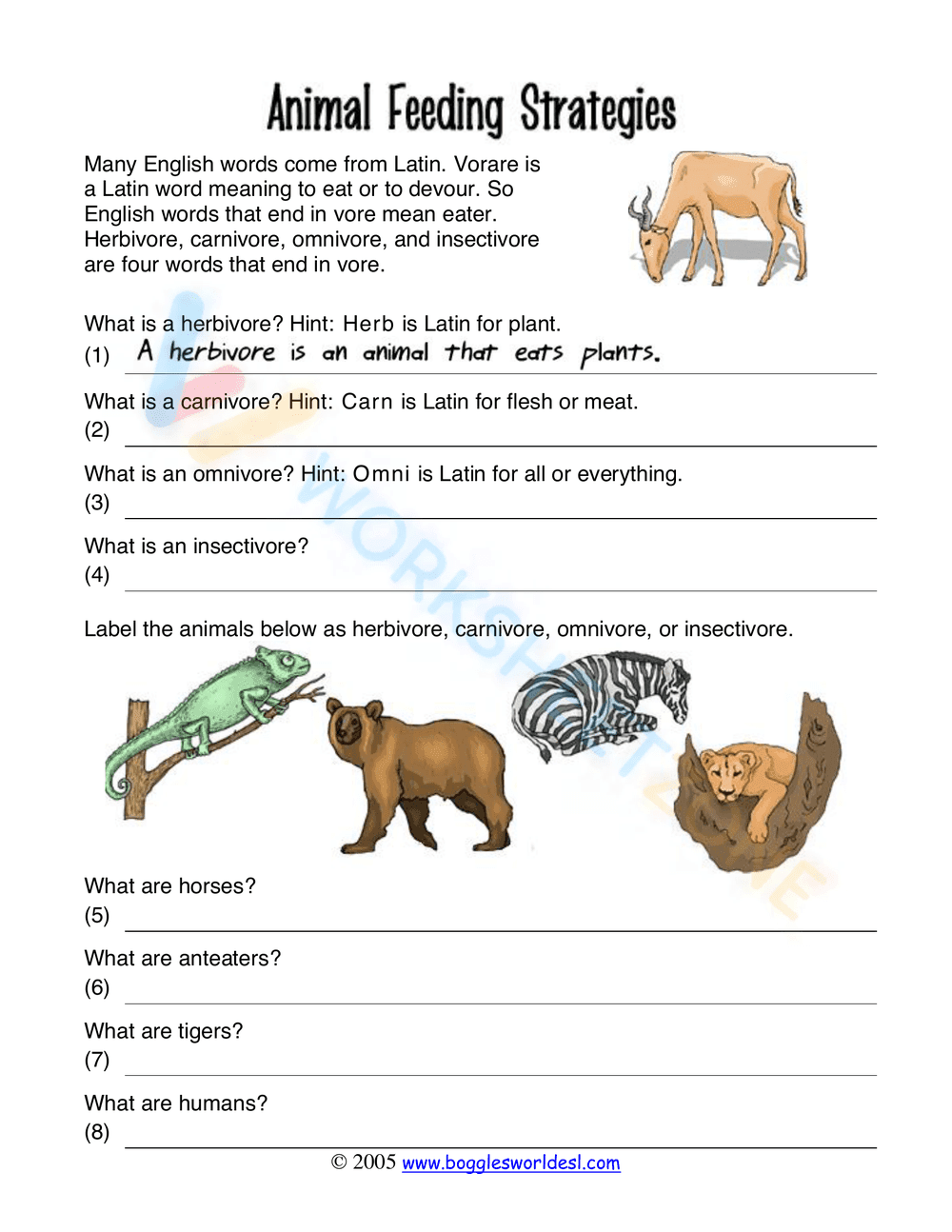
This Grade 4 cross-curricular worksheet helps students understand animal feeding strategies by connecting scientific concepts to Latin root words. Students will define key vocabulary terms and classify common animals based on their diets, building both their biological knowledge and their morphological decoding skills in one focused activity.
At a Glance
- Grade: 4 · Subject: Science
- Standard:
CCSS.ELA-LITERACY.L.4.4.B— Use Latin roots as clues to word meaning- Skill Focus: Animal diets and root words
- Format: 1 page · 8 problems · Answer key included · PDF
- Best For: Independent practice or morning work
- Time: 15–20 minutes
Inside this single-page resource, educators will find a structured vocabulary exercise that introduces the Latin root "vorare" alongside prefixes like "herb," "carn," and "omni." The worksheet features eight numbered tasks, split between writing definitions based on root clues and classifying specific animals like horses, tigers, and humans. A visual labeling section provides additional context. A complete answer key is included.
Zero-Prep Workflow
- Print (1 min): Download the PDF and print a class set.
- Distribute (1 min): Hand out the worksheet. The instructions and root word hints are self-explanatory, requiring no teacher setup.
- Review (3 min): Use the provided answer key to quickly check responses.
With total prep time under two minutes, this resource is perfect for sub plans or quick transitions.
Standards Alignment
This activity aligns with CCSS.ELA-LITERACY.L.4.4.B: Use common, grade-appropriate Greek or Latin affixes and roots as clues to the meaning of a word. By explicitly teaching the roots for plant, flesh, and all, students learn to decode complex scientific terminology. Both standard codes can be copied directly into lesson plans, IEP goals, or district curriculum mapping tools.
How to Use It
Deploy this worksheet during a science unit on ecosystems or an ELA block focused on morphology. As an introductory activity, it allows students to deduce meanings using Latin hints. Alternatively, assign it as independent practice. For a formative assessment observation tip, watch how students classify humans and bears; this reveals their understanding of the "omni" prefix. Expected completion time ranges from 15 to 20 minutes.
Who It's For
Designed for fourth-grade students, this serves as excellent review for fifth graders tackling complex food webs. To support differentiation, built-in hints provide scaffolding for struggling readers, allowing them to rely on morphological clues. Pair this worksheet with a visual anchor chart detailing ecosystem energy pyramids to reinforce the vocabulary.
Integrating morphological instruction into science content significantly improves vocabulary retention and reading comprehension across disciplines. According to a recent ScienceDirect TpT Analysis, cross-curricular resources that explicitly teach root words within a specific content area increase student engagement and conceptual mastery. This worksheet targets CCSS.ELA-LITERACY.L.4.4.B, requiring students to use Latin roots as clues to word meaning. By breaking down terms like insectivore into their constituent parts, learners develop a decoding strategy they can apply to unfamiliar scientific text. This approach not only builds immediate knowledge of animal feeding strategies but also fosters long-term linguistic awareness. Providing structured opportunities to practice these skills ensures students are better equipped to handle the rigorous academic language found in upper elementary and middle school science curricula.


