


























Views
Downloads
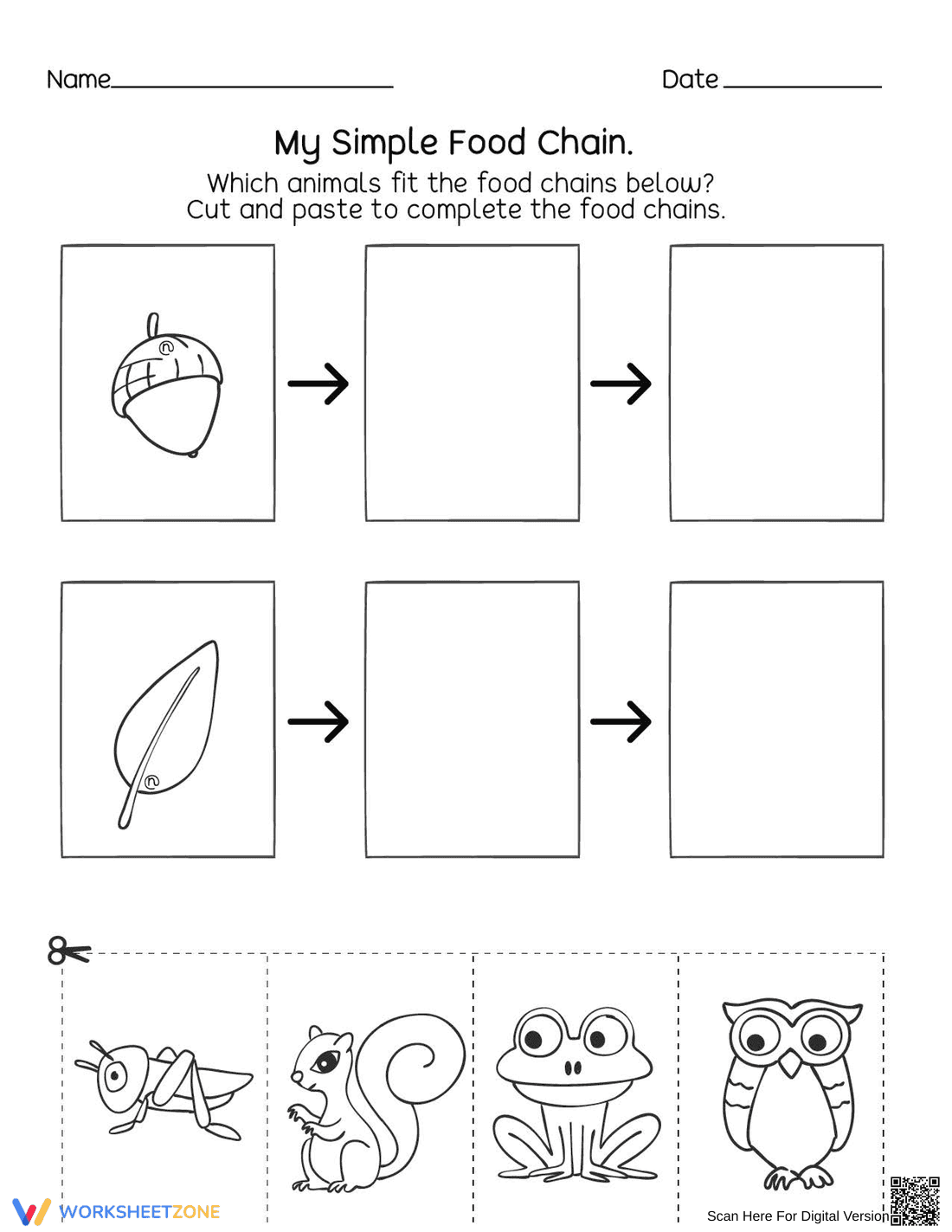

Simple Food Chain Worksheet | Printable Grade 1 Science
Paste this activity's link or code into your existing LMS (Google Classroom, Canvas, Teams, Schoology, Moodle, etc.).
Students can open and work on the activity right away, with no student login required.
You'll still be able to track student progress and results from your teacher account.
This simple food chain worksheet helps early learners understand how energy moves between plants and animals. Students practice sequencing by completing two distinct food chains using a hands-on cut-and-paste format. This activity builds foundational life science skills while reinforcing fine motor development for kindergarten and first-grade students.
At a Glance
- Grade: Kindergarten · Subject: Science
- Standard:
K-LS1-1— Describe what plants and animals need to survive- Skill Focus: Sequencing food chains
- Format: 1 page · 4 problems · Answer key included · PDF
- Best For: Independent practice or science centers
- Time: 10–15 minutes
This single-page resource features two incomplete food chain diagrams starting with a plant source (an acorn and a leaf). At the bottom of the page, students will find four animal illustrations—a grasshopper, a squirrel, a frog, and an owl—separated by dashed cutting lines. Students must identify which animals belong in which sequence and paste them into the correct blank boxes to complete the energy flow. A straightforward answer key is included for quick checking.
Zero-Prep Workflow
- Print (1 minute): Simply print the PDF. No special materials are required beyond standard scissors and glue sticks for the students.
- Distribute (1 minute): Hand out the sheets during your science block or place them in a designated center folder.
- Review (3 minutes): Quickly check student work against the provided answer key or review together as a class on the board.
Total teacher prep time is under two minutes, making this an excellent, self-explanatory activity for emergency sub plans or busy afternoons.
Standards Alignment
This activity aligns with K-LS1-1: Use observations to describe patterns of what plants and animals (including humans) need to survive. By sequencing the acorn to the squirrel and the leaf to the grasshopper, students visually map these survival dependencies. Both standard codes can be copied directly into lesson plans, IEP goals, or district curriculum mapping tools.
How to Use It
Use this worksheet immediately after a direct instruction lesson on what animals eat. It serves as a perfect independent practice activity while the teacher circulates the room. As a formative assessment tip, observe whether students correctly place the herbivores (squirrel, grasshopper) immediately after the plant sources before the carnivores (owl, frog). Expected completion time ranges from 10 to 15 minutes, depending on the students' cutting and pasting speed.
Who It's For
This resource is designed primarily for kindergarten and first-grade students in general education classrooms. The visual nature of the cut-and-paste tasks provides built-in differentiation for English Language Learners and students who struggle with writing, allowing them to demonstrate science comprehension without language barriers. It pairs naturally with introductory picture books about woodland habitats or a classroom anchor chart detailing producers and consumers.
Early exposure to ecological concepts like those found in standard K-LS1-1 helps students describe what plants and animals need to survive. According to a ScienceDirect TpT Analysis, integrating fine motor tasks such as cutting and pasting with core academic content significantly increases student engagement and retention in early childhood settings. When young learners physically manipulate the components of a food chain, they build stronger cognitive connections regarding energy transfer in nature. This hands-on approach transforms abstract biological concepts into concrete, observable patterns. By combining tactile activity with foundational life science standards, educators can foster a deeper understanding of environmental interdependence. This method not only supports academic growth but also develops essential classroom skills, ensuring that foundational science instruction is both developmentally appropriate and highly effective for early elementary students.


