


























Views
Downloads

Grade 2 Animal Diet — Printable No-Prep Worksheet
Paste this activity's link or code into your existing LMS (Google Classroom, Canvas, Teams, Schoology, Moodle, etc.).
Students can open and work on the activity right away, with no student login required.
You'll still be able to track student progress and results from your teacher account.
This Grade 2 science worksheet empowers students to investigate animal nutrition by categorizing six different species based on their dietary habits. Students identify specific foods for each animal before classifying them as herbivores, carnivores, or omnivores. This targeted practice builds foundational biological knowledge while strengthening observational and classification skills essential for early scientific inquiry.
At a Glance
- Grade: 2 · Subject: Science
- Standard:
2-LS4-1— Make observations of animals to compare the diversity of life- Skill Focus: Animal Diet Classification
- Format: 2 pages · 12 tasks · Answer key included · PDF
- Best For: Independent practice or quick formative assessment
- Time: 15–20 minutes
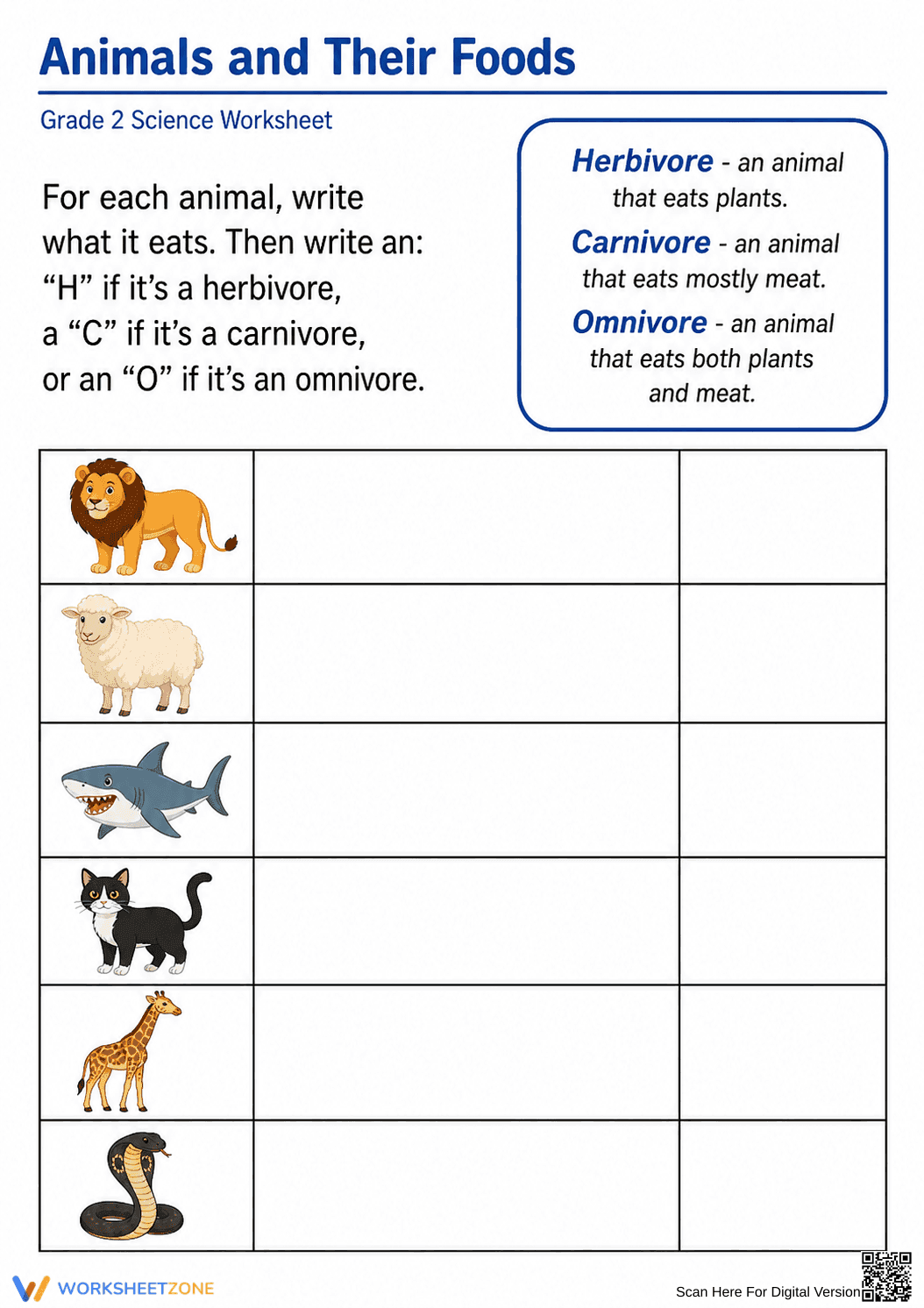
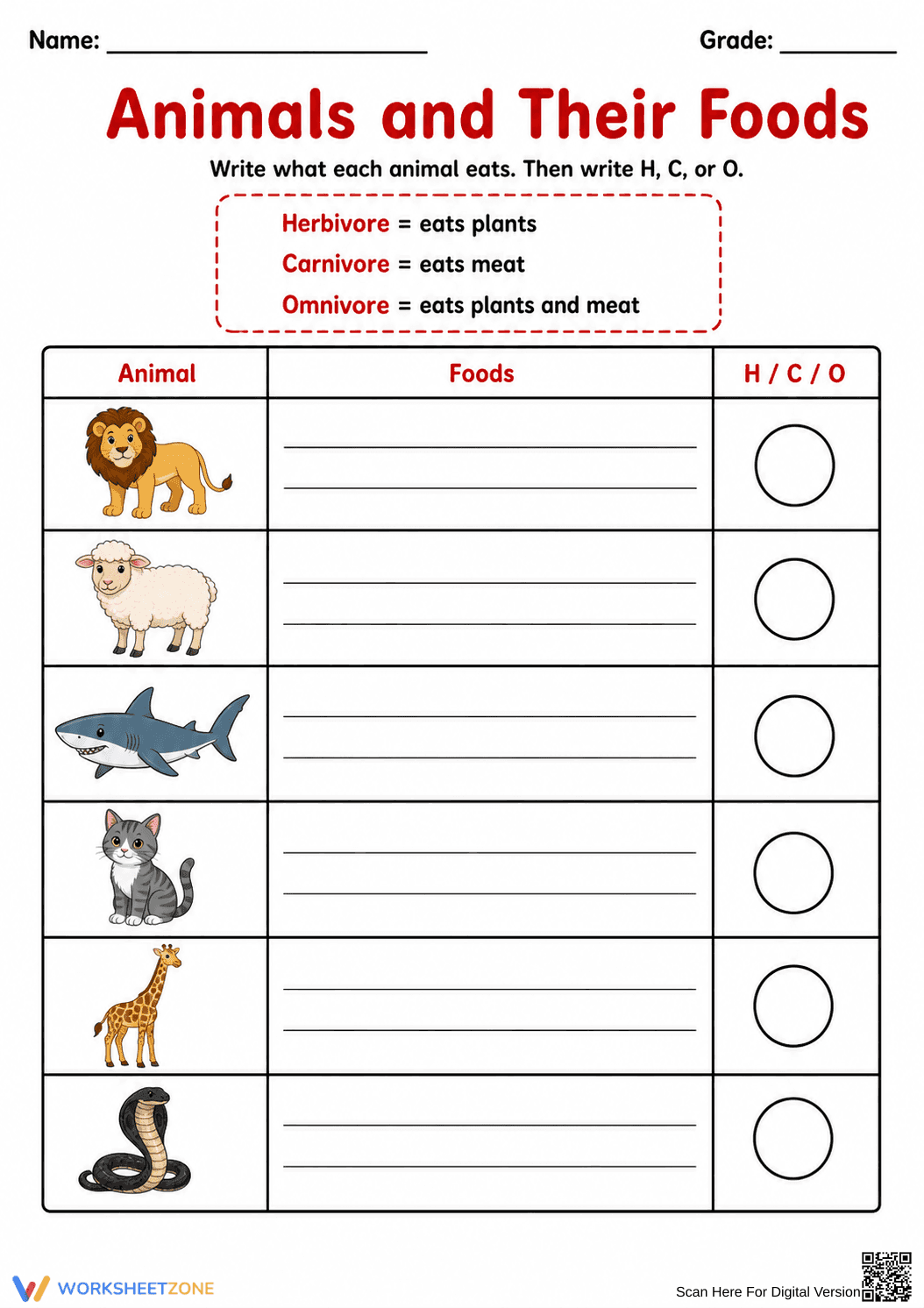
The packet includes a single-page student activity and a comprehensive answer key. The worksheet features six clear illustrations of diverse animals: a lion, sheep, shark, cat, giraffe, and cobra. For every animal, students are prompted to write out specific food sources in the middle column and assign the appropriate "H", "C", or "O" label in the final column. A concise reference box at the top provides definitions for herbivores, carnivores, and omnivores, ensuring students have the scaffolding needed for success.
This resource is designed for immediate classroom implementation with a total preparation time of under two minutes. First, print the single-sided student page for your class (30 seconds). Second, distribute the worksheets during your "Living Things" unit (30 seconds). Third, utilize the included answer key to conduct a rapid whole-group review or check for understanding (1 minute). Its clear instructions and self-contained reference box make it an ideal choice for substitute lesson plans or morning work.
The primary alignment is to 2-LS4-1, where students make observations of animals to compare life across different habitats. By understanding what animals eat, students gain insight into their roles within specific ecosystems. Supporting standard K-LS1-1 is also addressed as students describe patterns in what animals need to survive. Both standard codes can be copied directly into lesson plans, IEP goals, or district curriculum mapping tools.
Use this worksheet as a concluding activity after a direct instruction lesson on animal classifications to verify mastery. During the activity, circulate and observe if students can differentiate between the cat (omnivore) and the lion (carnivore), as this often reveals misconceptions about domesticated versus wild animals. The expected completion time is approximately 15 to 20 minutes, making it a perfect fit for a science center rotation.
This activity is tailored for second-grade students but serves as an excellent reinforcement for first graders or a review for third graders. It naturally supports English Language Learners through visual cues and consistent sentence frames. Pair this resource with a classroom anchor chart displaying animal teeth (flat vs. sharp) to provide a physical connection to why animals eat different foods.
Aligned to the 2-LS4-1 standard, this worksheet focuses on the fundamental biological skill of diet classification, requiring students to link animal morphology and behavior to their nutritional needs. According to research published by Fisher & Frey (2014), providing students with clear definitions and structured categorization tasks like this one significantly improves the retention of scientific vocabulary and the ability to generalize patterns across different species. By identifying herbivores, carnivores, and omnivores through 12 specific tasks, learners build a conceptual framework for understanding energy flow within ecosystems. This resource serves as a vital component in a comprehensive life science curriculum, allowing for the quick assessment of student ability to observe and record scientific data. The inclusion of a clear answer key ensures that feedback is immediate, a practice recognized by EdReports 2024 as critical for closing learning gaps in early elementary science education.


