


























Views
Downloads
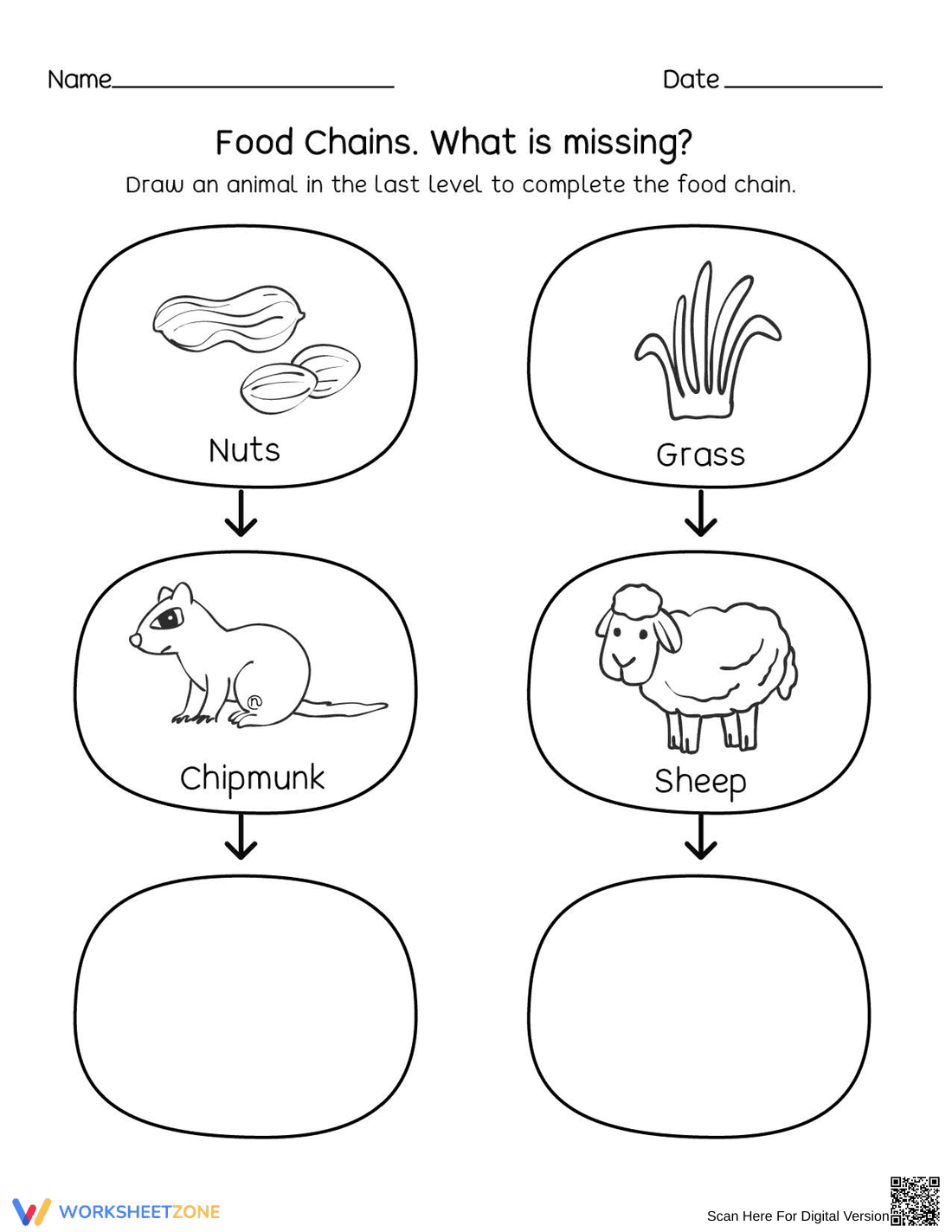

Food Chain Completion Worksheet | Grade 1 Essential
Paste this activity's link or code into your existing LMS (Google Classroom, Canvas, Teams, Schoology, Moodle, etc.).
Students can open and work on the activity right away, with no student login required.
You'll still be able to track student progress and results from your teacher account.
This Grade 1 science worksheet helps young learners visualize energy transfer by completing simple food chains. Students observe two distinct sequences—starting with nuts and grass—to determine which animal might come next in the cycle. It encourages critical thinking about animal diets and the interconnectedness of living things in various habitats.
At a Glance
- Grade: 1 · Subject: Science
- Standard:
K-LS1-1— Use observations to describe patterns of what plants and animals need to survive- Skill Focus: Food chain sequences
- Format: 1 page · 2 problems · Answer key included · PDF
- Best For: Introduction to ecosystems and energy flow
- Time: 10–15 minutes
Inside this single-page PDF, you will find two vertical food chain templates. Each sequence begins with a producer (nuts or grass) and moves to a primary consumer (chipmunk or sheep). The final tier is left blank for students to draw a logical predator or higher-level consumer, providing a creative outlet for demonstrating scientific understanding through illustration.
The zero-prep workflow for this resource is designed for maximum efficiency in busy classrooms. First, print the single-page PDF (30 seconds). Next, distribute the sheets to students along with drawing materials (1 minute). Finally, review the completed drawings as a whole group to discuss different possible answers (5 minutes). Total teacher preparation time is under 2 minutes, making it an ideal sub plan addition.
This resource aligns with K-LS1-1, focusing on the patterns of what living things need to survive. By identifying what eats a chipmunk or a sheep, students demonstrate knowledge of survival needs and predator-prey relationships. This standard code can be copied directly into lesson plans, IEP goals, or district curriculum mapping tools.
Use this worksheet as a formative assessment after a read-aloud about animal habitats. During the activity, observe if students can explain why their chosen animal fits the sequence. It typically takes 10 to 15 minutes to complete, making it an ideal exit ticket or quick check for understanding during a life science unit on living things.
This activity is perfect for Kindergarten and Grade 1 students, as well as English Language Learners who benefit from visual representations. It pairs naturally with an anchor chart showing local wildlife or a picture book about forest and farm ecosystems to provide context for the drawing tasks and vocabulary development.
According to the RAND AIRS 2024 report, visual modeling in early childhood science significantly improves the retention of biological concepts like energy transfer. This worksheet utilizes the K-LS1-1 standard to help students identify patterns in what animals need to survive by completing food chain sequences. By asking students to draw the missing link, the activity moves beyond rote memorization into application and creative synthesis. Research from Fisher & Frey (2014) suggests that such non-linguistic representations are crucial for scaffolding scientific literacy in primary grades. This resource provides a structured yet open-ended environment where students can demonstrate their grasp of ecological relationships. It serves as a foundational tool for building the systems-thinking skills required in later elementary science. Educators can rely on this evidence-based approach to ensure students meet early life science benchmarks while remaining engaged through artistic expression and observation.


