


























Views
Downloads

Essential Food Chains Worksheet | Grade 3 Science Aligned
Paste this activity's link or code into your existing LMS (Google Classroom, Canvas, Teams, Schoology, Moodle, etc.).
Students can open and work on the activity right away, with no student login required.
You'll still be able to track student progress and results from your teacher account.
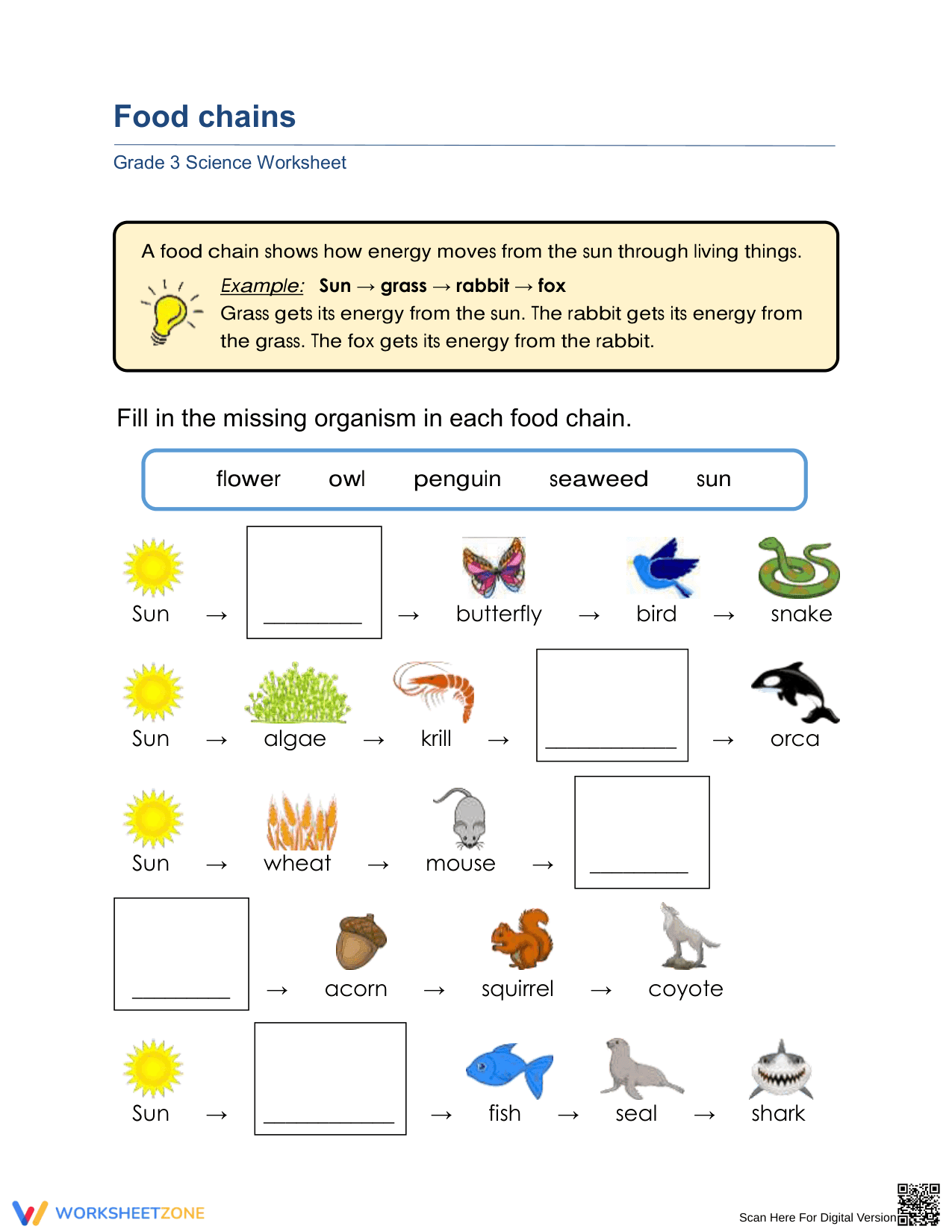
This Grade 3 science worksheet helps students visualize and understand energy transfer in ecosystems. By completing five distinct food chains—ranging from terrestrial to marine environments—students identify the critical role of producers and consumers in maintaining biological balance. This activity reinforces the foundational concept that all living things depend on the sun as their primary energy source for survival.
At a Glance
- Grade: 3 · Subject: Science
- Standard:
3-LS4-3— Construct arguments explaining how organisms survive in habitats via energy dependencies.- Skill Focus: Ecosystem energy flow
- Format: 1 page · 5 problems · Answer key included · PDF
- Best For: Independent practice and formative assessment
- Time: 10–15 minutes
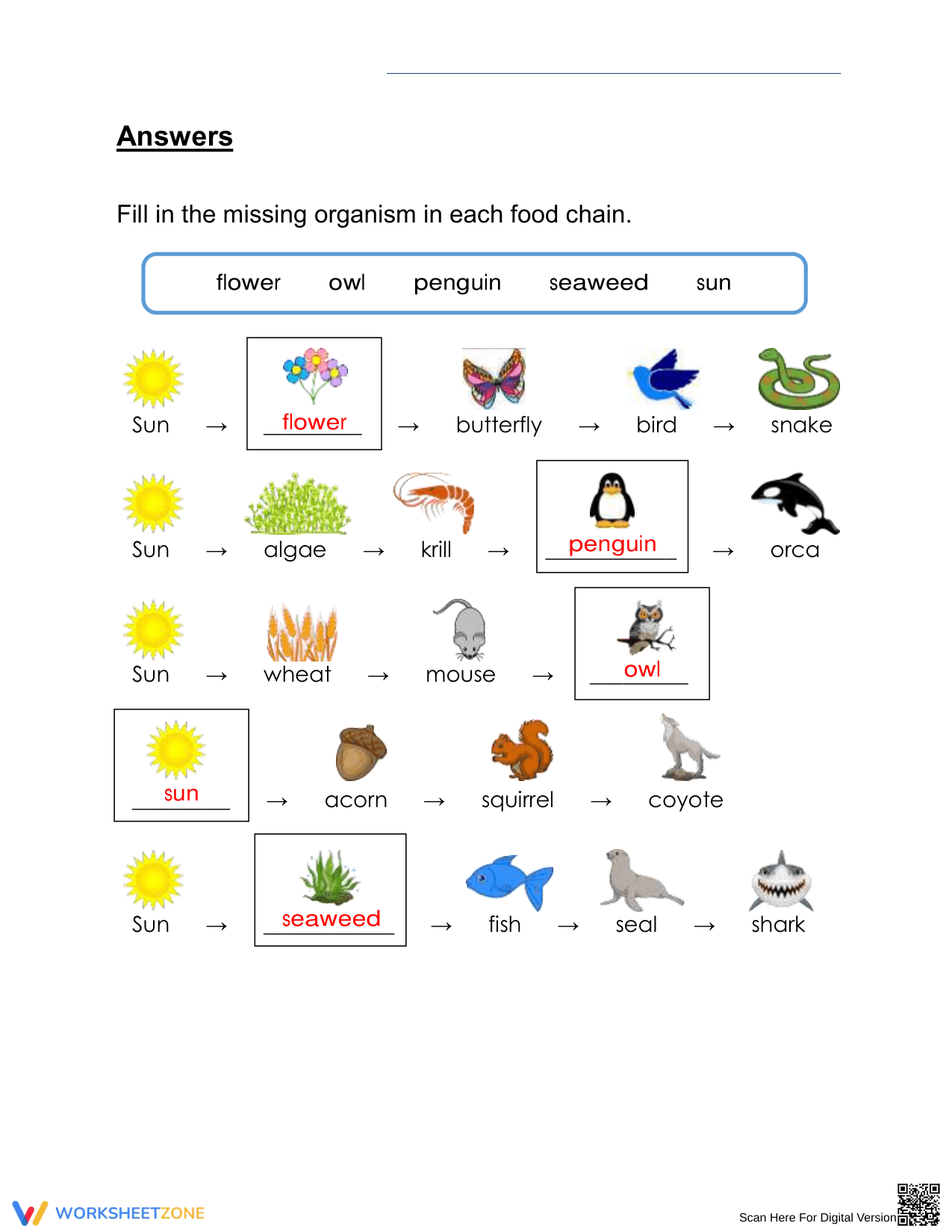
What's Inside: One high-density page containing five interactive food chain diagrams. Each chain features clear illustrations of organisms like butterflies, krill, mice, and orcas, with empty boxes for students to populate. A helpful word bank containing flower, owl, penguin, seaweed, and sun provides necessary support, while a concise definition of energy movement at the top serves as a quick reference. Full answer key is included.
This zero-prep resource is designed for immediate classroom utility. The workflow is simple: Print the PDF (30 seconds), Distribute to students as a do-now or exit ticket (30 seconds), and Review the results using the included answer key (1 minute). Total teacher prep time is approximately 2 minutes, making this an ideal resource for emergency sub plans or quick lesson reinforcement during a busy science unit when time is at a premium.
Standards Alignment: 3-LS4-3 - Students construct an argument that organisms within an ecosystem depend on one another for survival, specifically through energy transfer from sunlight to producers and through various consumer levels. This worksheet provides the visual evidence needed to support these claims. This standard code can be copied directly into lesson plans, IEP goals, or district curriculum mapping tools for easy documentation.
How to Use It: Use this as a follow-up to a lesson on ecosystems to gauge student understanding of terminology like producer and consumer. Teachers can observe student placement of the sun to confirm they understand the origin of energy in most terrestrial and aquatic chains. This is best used during the independent practice phase of a lesson. Expected completion time for the five diagrams is approximately 12 minutes.
Who It's For: Designed for third-grade general education students, this resource is also highly effective for ESL/ELL learners due to the strong visual cues and limited text complexity. It pairs perfectly with an anchor chart on food webs or a shared reading passage about various world biomes like the African savanna, temperate forests, or the vast Arctic oceans.
The 3-LS4-3 standard requires students to interpret interdependencies within ecosystems, which is a foundational skill for understanding biological complexity and environmental science. Research by Fisher & Frey (2014) emphasizes that visual scaffolds like these food chain diagrams significantly reduce cognitive load, allowing students to focus on the conceptual relationship between organisms rather than complex text decoding. This alignment ensures that Grade 3 students develop the mental models necessary for advanced studies in energy cycles and matter transfer. The 5-problem structure provides sufficient data for formative assessment without overwhelming the learner, ensuring that teachers can identify misconceptions early in the instructional cycle. This resource meets the criteria for classroom-ready materials that support high-leverage teaching practices in elementary science by combining clear visuals with standards-aligned content for maximum student impact and engagement while maintaining teacher efficiency.


