


























Views
Downloads


Essential Number 9 Worksheet | Kindergarten Math Practice
Paste this activity's link or code into your existing LMS (Google Classroom, Canvas, Teams, Schoology, Moodle, etc.).
Students can open and work on the activity right away, with no student login required.
You'll still be able to track student progress and results from your teacher account.
This comprehensive Number 9 worksheet helps Kindergarten students master number recognition, tracing, and counting through six engaging activities. Students develop fine motor skills and numerical fluency by interacting with the digit in multiple formats. This resource ensures learners can identify, write, and represent the quantity accurately, providing a solid foundation for early mathematics and number sense.
At a Glance
- Grade: K · Subject: Math
- Standard:
CCSS.MATH.CONTENT.K.CC.A.3— Write numbers from 0 to 20 and represent a number of objects- Skill Focus: Number 9 Recognition & Writing
- Format: 3 pages · 30 problems · Answer key included · PDF
- Best For: Independent math centers or morning work
- Time: 15–20 minutes
What's Inside
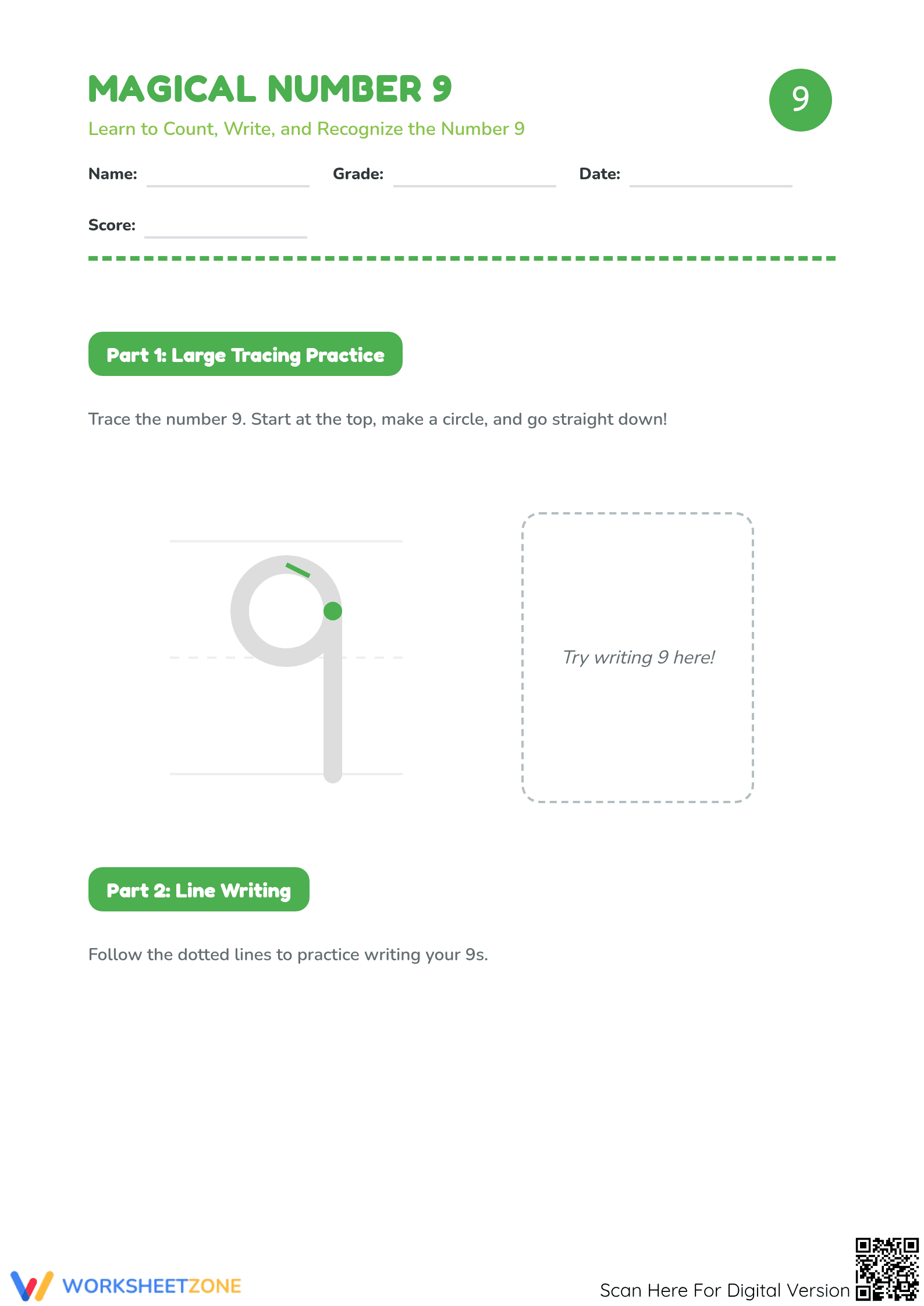
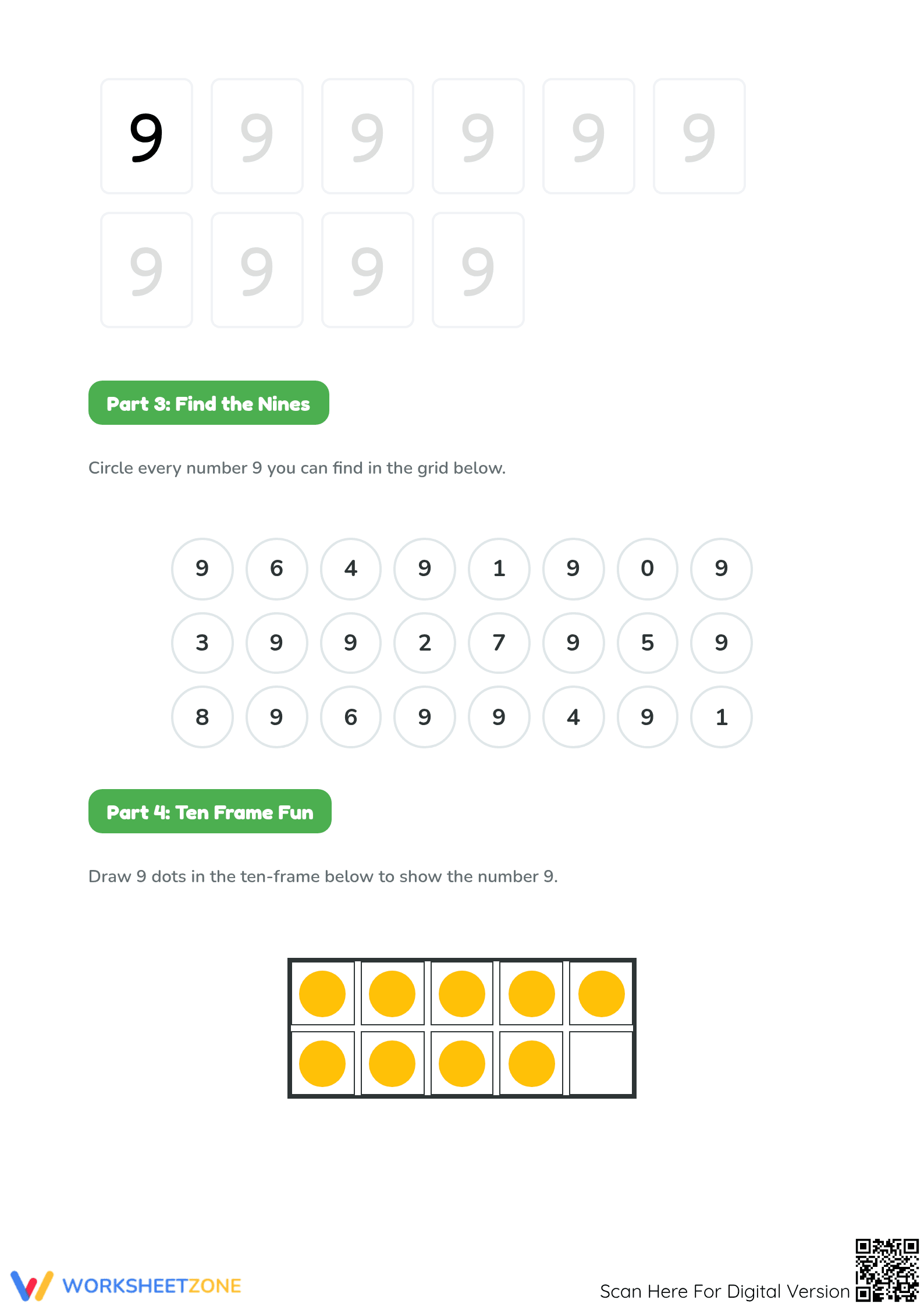
This three-page PDF package contains six distinct sections designed to provide a holistic approach to learning the number nine. It features large tracing guides for directional stroke practice, lined rows for independent writing, a number discrimination grid to sharpen recognition, a ten-frame representation task, a creative drawing space for counting sets, and a numerical sequence completion activity. A full answer key is included for quick grading.
Skill Progression
- Guided practice: Large-format tracing uses visual cues and arrows to teach the correct directional strokes for forming the number nine, reducing frustration for early writers during the initial acquisition phase.
- Supported practice: The worksheet transitions to lined practice and a ten-frame visual, where problems provide structure while requiring students to recall the quantity and symbol with minimal scaffolding.
- Independent practice: Final tasks involve number discrimination and sequence completion, where students apply their knowledge to identify nine among other digits and place it correctly within a counting string.
The resource follows a gradual-release model, moving from high-support tracing to independent identification and sequence application.
Standards Alignment
The primary focus of this worksheet is `CCSS.MATH.CONTENT.K.CC.A.3`, which requires students to write numbers from 0 to 20 and represent a number of objects with a written numeral. Additionally, it supports `CCSS.MATH.CONTENT.K.CC.A.2` through the sequence completion task. Both standard codes can be copied directly into lesson plans, IEP goals, or district curriculum mapping tools.
How to Use It
Use this worksheet during your small-group math rotation after a direct instruction lesson on the number nine. For a formative assessment, observe students during the "Find the Nines" task to see if they can distinguish 9 from 6 or 4. This 3-page set is expected to take between 15 and 20 minutes for a typical Kindergarten student to complete with accuracy.
Who It's For
This resource is designed for Kindergarten students beginning their journey with numbers, but it also serves as an excellent intervention tool for Grade 1 learners who need to reinforce number formation. It pairs naturally with a number line anchor chart or a "number of the day" counting routine using physical manipulatives like counters or bears.
Early numerical mastery is a critical predictor of later mathematical success, as highlighted by the NAEP framework. Research from Fisher & Frey (2014) emphasizes the importance of the gradual release of responsibility, which is mirrored in this worksheet's progression from guided tracing to independent sequence completion. By requiring students to represent the number 9 using ten-frames, tracing, and counting, this resource aligns with best practices in multi-sensory math education. According to the 2024 EdReports analysis of foundational materials, repetitive but varied interaction with a single digit—as seen in the 30 tasks provided here—is essential for developing robust number sense in early learners. This standards-aligned approach ensures that CCSS.MATH.CONTENT.K.CC.A.3 is not just practiced, but mastered through diverse cognitive demands.


