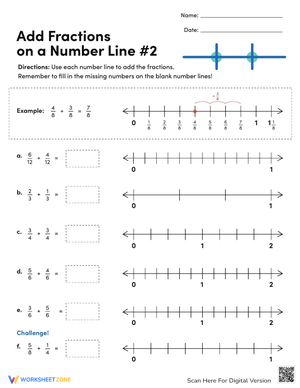
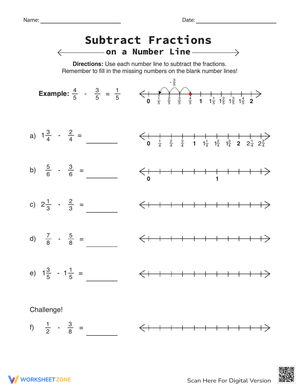
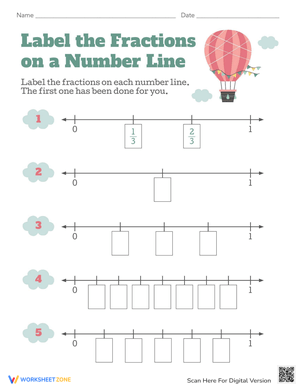
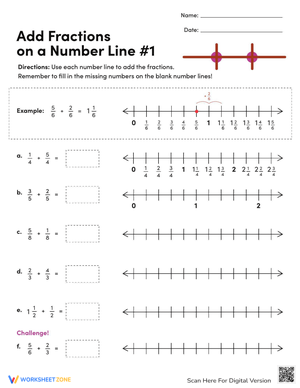
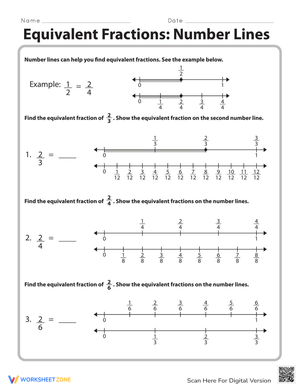
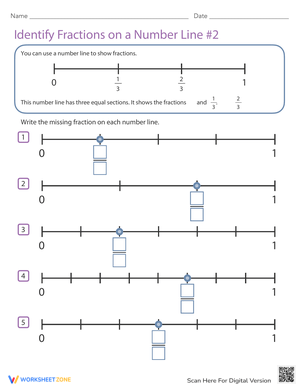
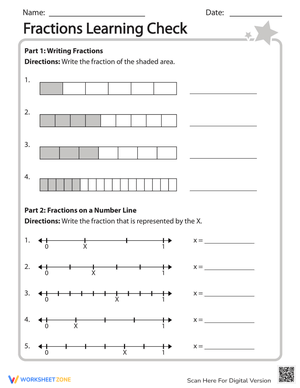
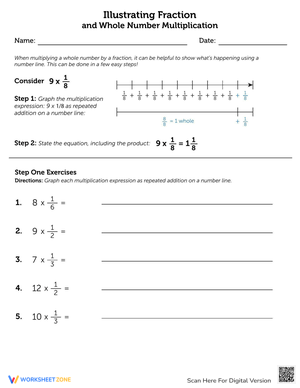
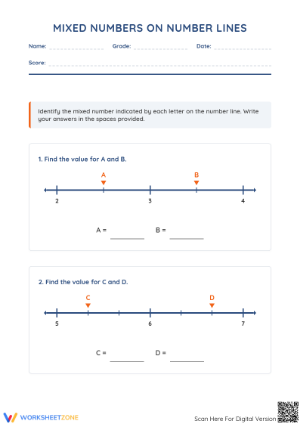
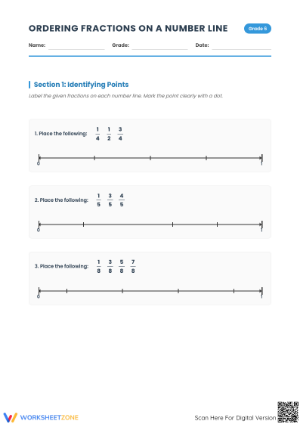
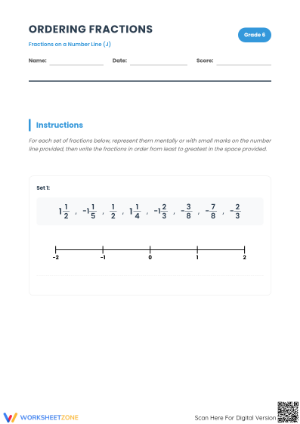
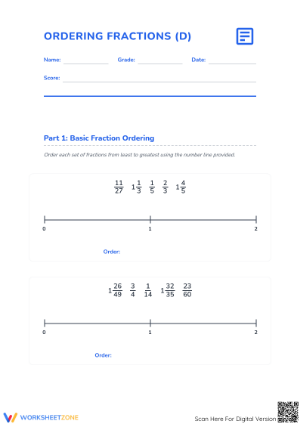
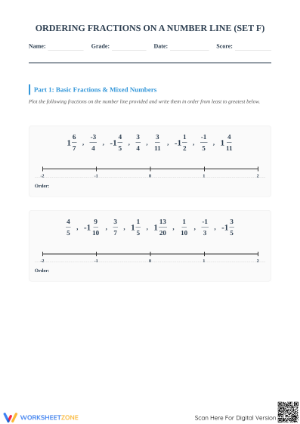
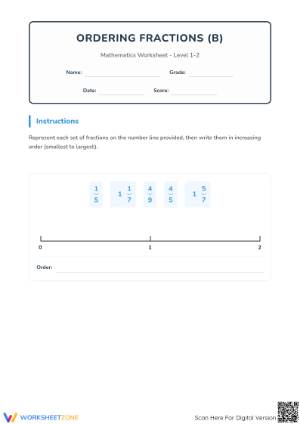
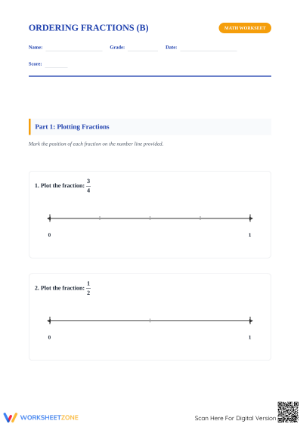
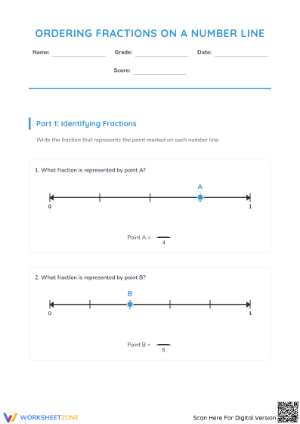
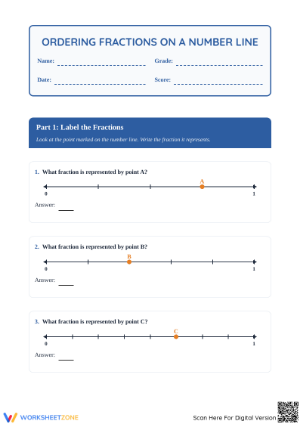
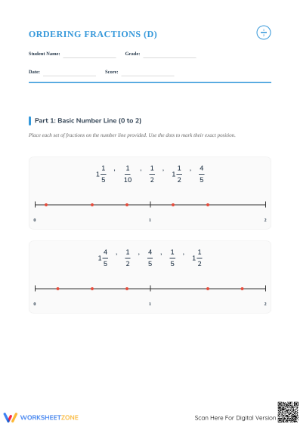
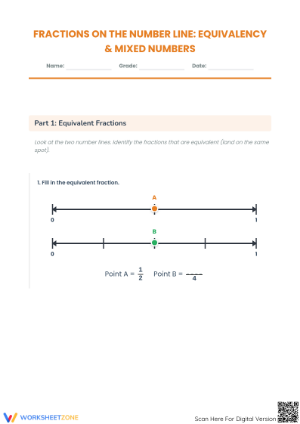
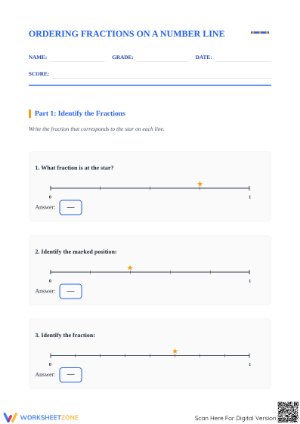
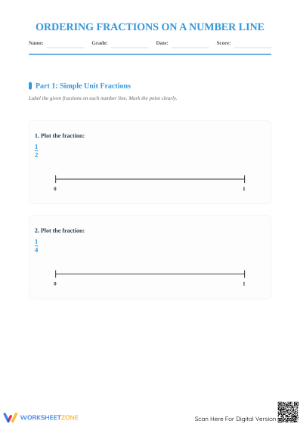
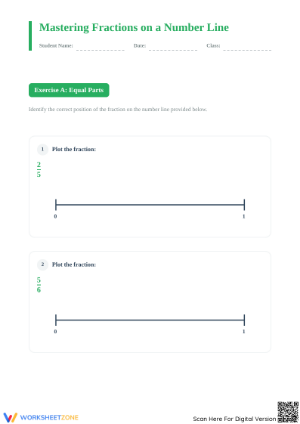
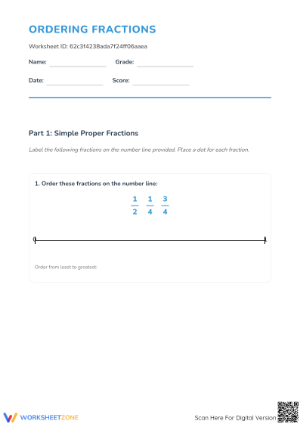
Most students meet fractions through pizza slices and pie charts. That area-model start is useful, but it quietly teaches a limiting idea: a fraction is a piece of a shape, not a number with its own location on a number line. Fractions on a number line worksheets correct that. They ask students to treat 1/4 or 3/8 the way they already treat whole numbers - as a point that lives at a specific spot, with a distance from zero. For grade 3 teachers, this shift is not optional polish. It is the standard.
CCSS 3.NF.A.2 requires grade 3 students to understand a fraction as a number on the number line and represent fractions on a number line diagram. That single sentence reshapes how fraction units should be sequenced. Worksheets built around number lines are not a supplement to area-model practice; they are a required representation students must master alongside it.
Differentiating by Denominator, Not Just by Difficulty Label
Worksheet packets often sort activities into vague tiers like easy, medium, and hard. For fraction number lines, denominator choice is a more precise and more useful differentiation lever than a difficulty label. Halves and fourths are the natural entry point because students can find them by repeated halving, a strategy many already use informally. Thirds and sixths require true equal partitioning without a halving shortcut, which is where genuine misconceptions surface. Eighths combine both demands and work well as a stretch task for students who have shown solid control over fourths.
When you are building small groups for intervention, matching a worksheet's denominator set to a student's specific gap is far more effective than handing out a generically harder page. A student who struggles with thirds does not necessarily need more practice with eighths; they need more practice with thirds, presented several different ways across several short sessions.
Using Worksheets as Quick Formative Checks
Because number line items are compact, they make efficient exit tickets. A single number line with one or two fractions to plot, plus a short justification line, can replace a longer quiz without losing diagnostic value. Look specifically for three common error patterns: uneven spacing between marks, confusing the numerator with a count of marks rather than a count of jumps from zero, and mislabeling the endpoint as 1/b instead of the full value at that position.
Tracking these error types across a class period, rather than just marking items right or wrong, tells you whether to reteach partitioning as a whole class or pull a targeted small group for one specific misconception.
Connecting Number Line Practice to Later Fraction Skills
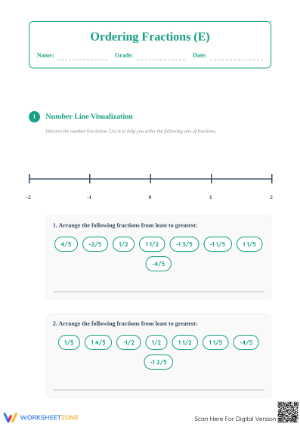
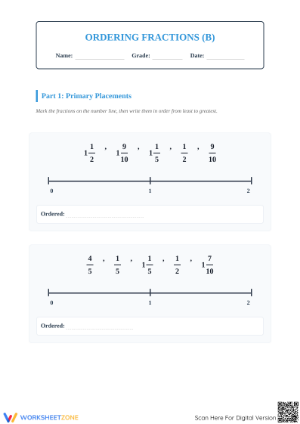
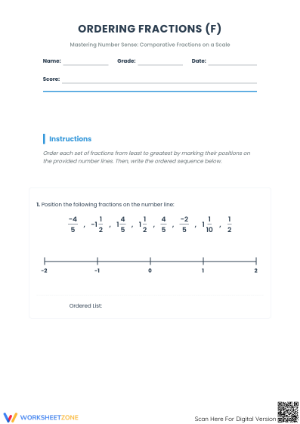
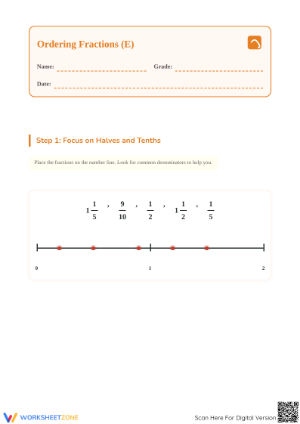
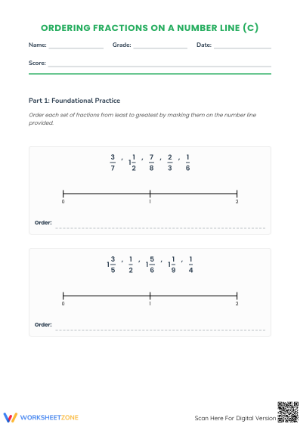
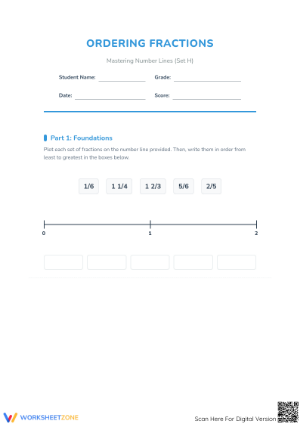
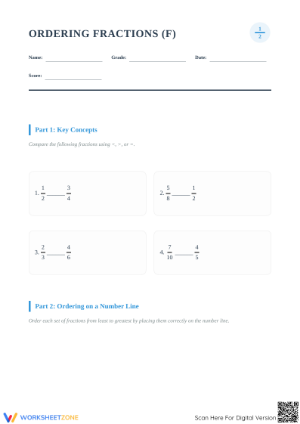
Number line fluency in grade 3 is not an isolated skill; it is the foundation for comparing and ordering fractions, a task that becomes far more efficient once students can visualize relative position rather than relying only on common-denominator procedures. A student who has internalized that 5/6 sits close to 1 and 1/6 sits close to 0 has an intuitive check against later computational errors when comparing or adding fractions. Worksheets that occasionally ask students to plot two fractions on the same line and state which is greater build this bridge directly, even before formal comparison strategies are introduced.
Classroom Implementation
Start a fraction number line unit with blank-interval partitioning practice before any labeling appears on the page; this isolates the spatial reasoning skill from the labeling skill. Use worksheets with denominators from the CCSS grade 3 set - halves, thirds, fourths, sixths, and eighths - and sequence them from halves and fourths toward thirds and sixths, saving eighths for students who need a stretch. Pair every independent worksheet with a brief verbal check for at least one item, since spacing errors are easier to hear explained than to spot from finished work. For intervention groups, trim worksheets down to single-item tasks with generous space for student reasoning, and reserve full-page practice sheets for students who have already demonstrated the underlying strategy. Finally, revisit number line worksheets briefly when introducing comparing fractions, since the visual model built in this unit directly supports that later skill.
Frequently Asked Questions
1. What grade level are fractions on a number line worksheets appropriate for?
They are designed primarily for grade 3, where CCSS 3.NF.A.2 introduces fractions as numbers on a number line. Grade 4 and 5 teachers also use these worksheets for review or remediation when students arrive without a solid foundation in this representation.
2. How do number line worksheets differ from area-model fraction worksheets?
Area-model worksheets ask students to shade or identify parts of a shape, which can be completed through visual estimation. Number line worksheets require exact, equal spacing between marks, which more directly tests whether a student understands a fraction as a precise value rather than an approximate portion.
3. What denominators should be used at grade 3 versus grade 4?
Grade 3 CCSS fraction work is limited to denominators 2, 3, 4, 6, and 8. Worksheets that introduce denominators outside this set are testing beyond the grade 3 standard and are better suited to grade 4 or 5 review and extension tasks.
4. How can teachers use these worksheets for intervention or reteaching?
Trim worksheets to single-item tasks and ask students to explain their spacing reasoning aloud. This format surfaces specific misconceptions, such as confusing numerator counts with mark counts, faster than a full page of silent independent practice.
5. How do number line fractions connect to comparing and ordering fractions later on?
Students who can visualize where a fraction sits relative to 0 and 1 develop an intuitive sense of fraction size that supports later comparing and ordering work, giving them a built-in check against computational errors even before formal comparison strategies are taught.