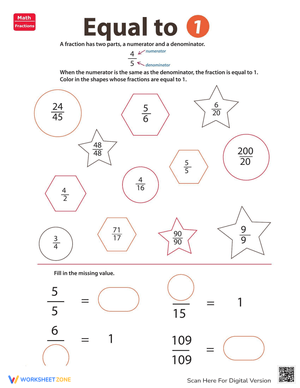
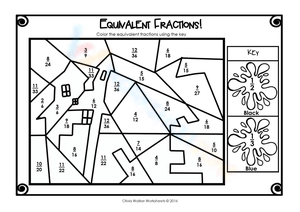
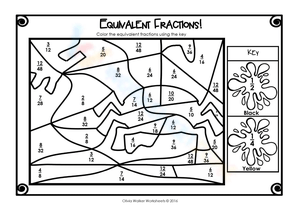
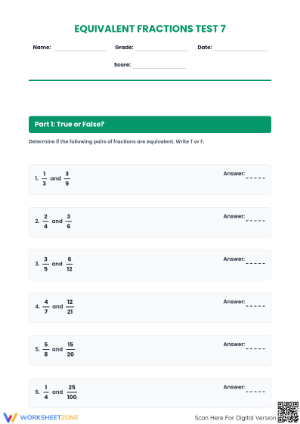
These equivalent fractions worksheets give grades 3–5 teachers a structured set of practice pages that moves students from shaded area models to abstract numerical work — without requiring a lesson rebuild every time the class needs more repetition. Each format in the collection targets a distinct stage of conceptual development, so the stack of pages you print on Monday isn't doing the same instructional work as the one you pull out Thursday.
The Specific Skills Targeted
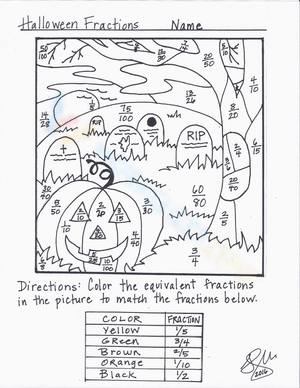
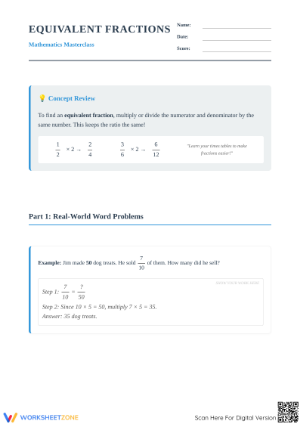
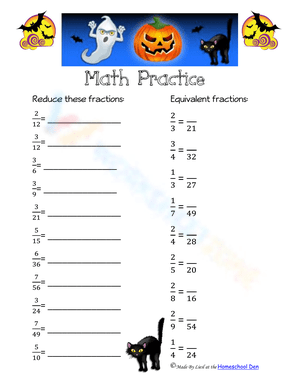
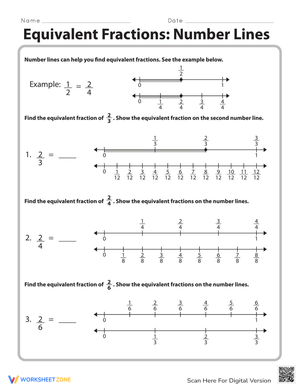
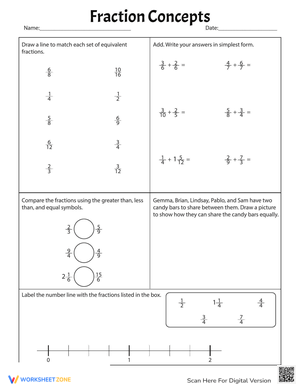
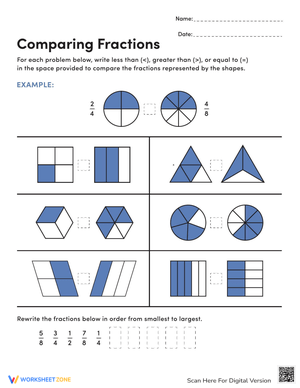
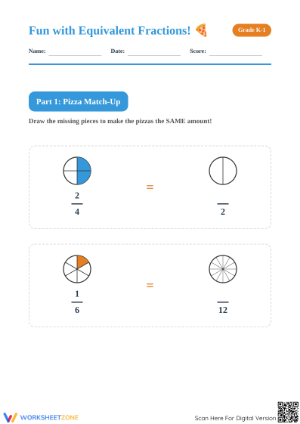
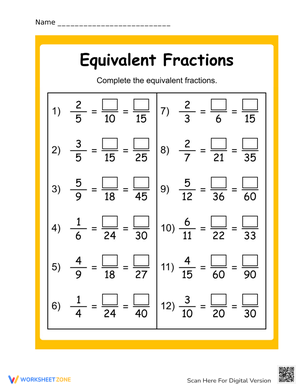
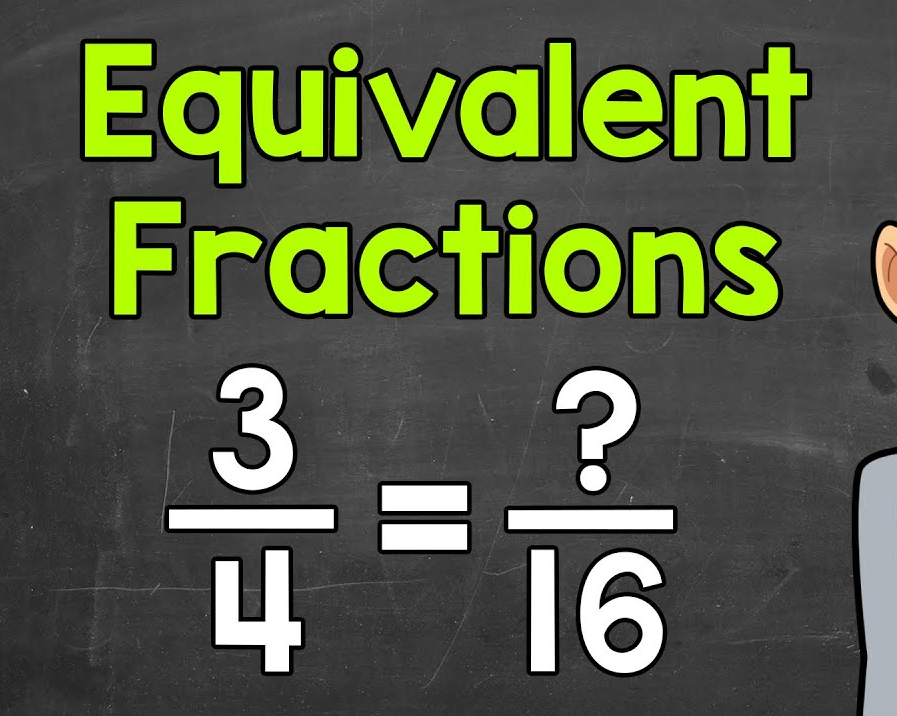
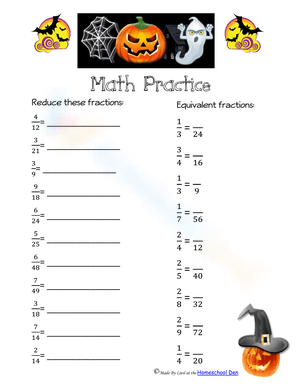
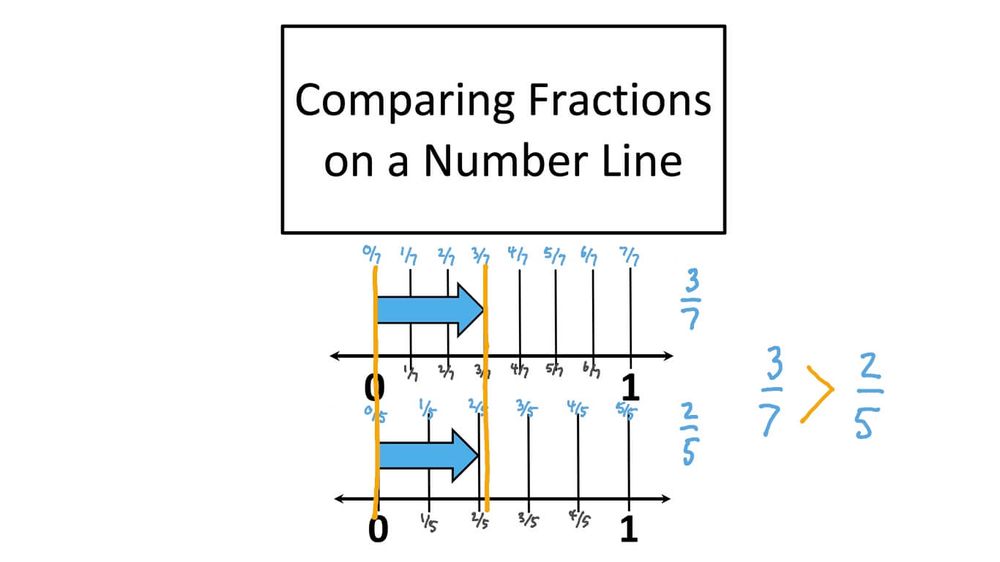
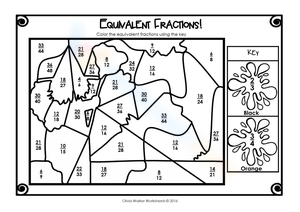
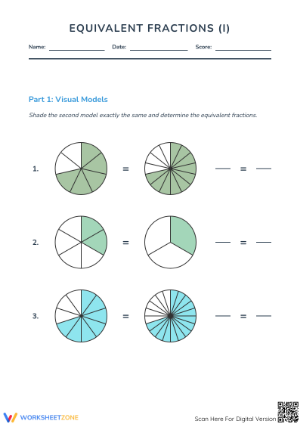
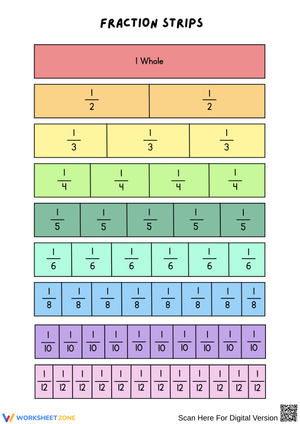
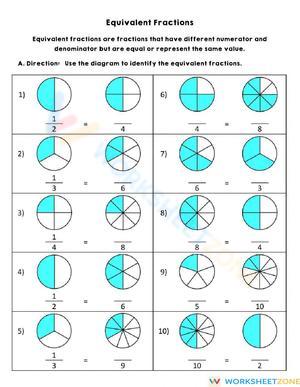
The set covers five problem types, each pressing on equivalence from a different angle. Visual model pages ask students to shade fraction bars or compare pre-drawn area models — this is where grade 3 students begin, because seeing that two differently divided rectangles are equally filled does more work than any rule explanation. Missing-value problems such as 2/3 = ?/9 require identifying the scale factor and applying it consistently; these bridge the visual stage and procedural fluency. Matching exercises pair equivalent fraction cards that students sort into groups, a format that works well in a math center because students pace themselves and a simple recording sheet handles accountability. Number line activities ask students to place fractions and notice when two land on the same point, which ties equivalence directly to measurement — a connection that pays off later when students work with mixed numbers. True/false and error-analysis tasks round out the set: students evaluate a claim like "3/4 = 6/10" and write a sentence explaining the judgment, which surfaces reasoning in a way that a fill-in-the-blank problem never does.
Where This Sits in the Standards
The entry point is 3.NF.A.3, where students explain equivalence through visual fraction models and recognize straightforward cases — 1/2 = 2/4 is the canonical example in the standard itself.
Grade 4 extends this in two directions: 4.NF.A.1 asks students to generate equivalent fractions by multiplying or dividing numerator and denominator by the same nonzero number, and 4.NF.A.2 uses that fluency to compare fractions with unlike denominators. Both skills appear in these worksheets.
By grade 5, the stakes rise: 5.NF.A.1 requires students to add and subtract fractions with unlike denominators, and that procedure depends entirely on the ability to rename fractions as equivalent forms. Students who hit fifth grade without solid equivalent fraction fluency almost always stall at that exact point, which is why thorough practice in grades 3 and 4 is worth the time it takes.
Where Students Struggle Most
The most persistent error is addition-based thinking: a student who sees 1/2 and wants to produce an equivalent fraction adds 1 to both numerator and denominator, writing 2/3. Fraction bars usually correct this when students check their answer visually — 1/2 and 2/3 clearly do not shade the same amount — but students who skip the visual check or who are working procedurally from memory will repeat the error across an entire page. The error-analysis format in this set catches it directly, because students must evaluate whether a given equivalence holds and explain why or why not.
A second pattern shows up specifically on missing-denominator problems: students correctly identify the scale factor for one problem (multiplying by 3 to get 1/4 = 3/12) but then switch to adding in the next when the scale factor is less obvious. This isn't carelessness — it reflects an incomplete understanding of why multiplication is the right operation. A brief verbal requirement helps here. Before moving to the next problem, ask students to write one sentence stating what they multiplied by. That sentence, more than the filled-in answer, tells you whether the student has the concept or is pattern-matching.
How Teachers Use These Pages
The visual model sheets work best as a whole-class introduction — project one on the board, shade the first model together, and then release students to finish independently. That gradual release structure keeps the first encounter with a new denominator from producing a classroom of raised hands all at once.
Missing-value and true/false pages translate naturally into exit tickets. A half-sheet with four problems takes about six minutes at the end of a lesson, and a quick sort of the responses into three piles — got it, almost, not yet — gives enough information to plan the next day without formal grading. The error-analysis format is particularly revealing as an exit ticket after a procedural lesson, because a student who can identify someone else's mistake almost always understands the concept well enough to move forward.
For math centers, laminate the matching and sorting sheets and pair them with a recording sheet students complete each rotation. The answer keys included with each worksheet mean center management doesn't require teacher presence.
Frequently Asked Questions
1. Can these be used for intervention in grades 5 or 6?
Yes. The visual model and missing-value sheets work well as a review sequence for older students who need to close a gap before tackling unlike-denominator addition. The problem types are not visually babyish, so they don't create the motivational friction that sometimes comes with using primary-grade materials for intervention.
2. How do I explain equivalent fractions to a student who keeps adding instead of multiplying?
Go back to the fraction bar before restating the rule. Ask the student to shade 1/2 on one bar and 2/3 on another and tell you whether they look equal. When the visual makes clear they don't, ask what change would make the second bar match the first. That conversation — working backward from the image to the operation — tends to land in a way that re-explaining the multiply-top-and-bottom rule does not.
3. What's the right point in a unit to introduce the missing-value format?
After students can reliably confirm equivalence using area models and fraction bars — typically two or three lessons in — but before they need equivalence as a tool for another skill. Introducing the numerical procedure while students still have visual confirmation available gives them a way to check their work; pulling the scaffold too early leaves them with a rule they can't verify.













 Interactive Worksheet Maker
 Quiz Maker
 Word Search Maker
 Crossword Puzzle Maker
 Word Scramble Generator
 Sentence Scramble Generator
 Handwriting Worksheet Generator
 Name Tracing Generator
 Fill In The Blank Generator