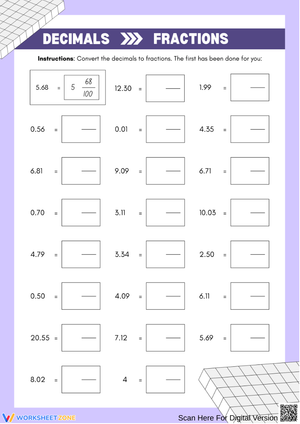
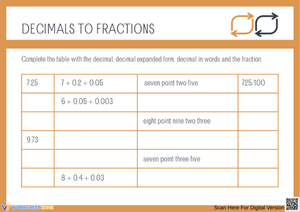
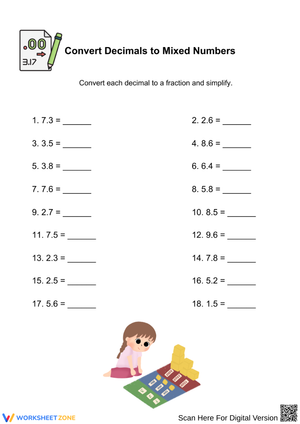
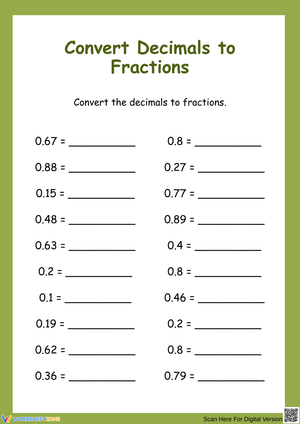
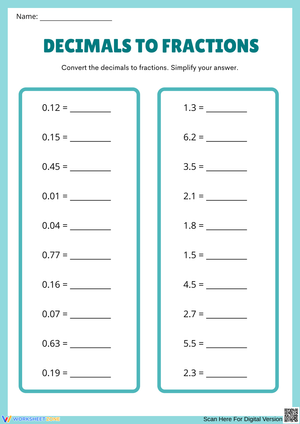
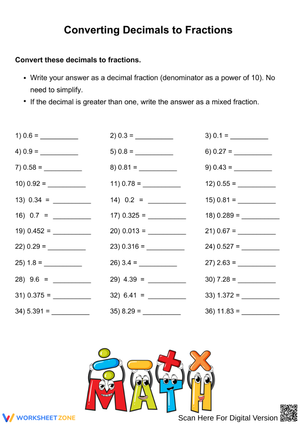
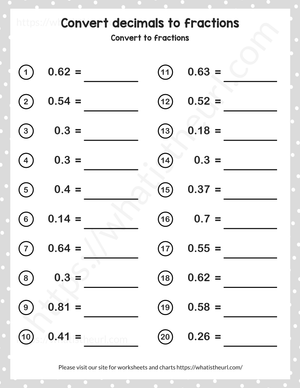
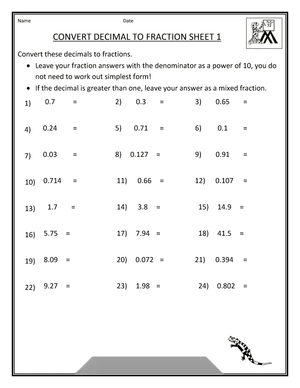
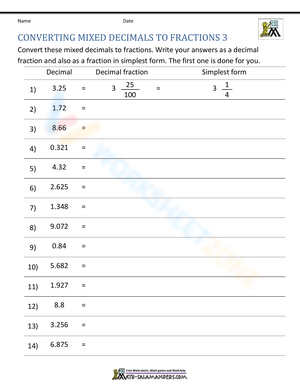
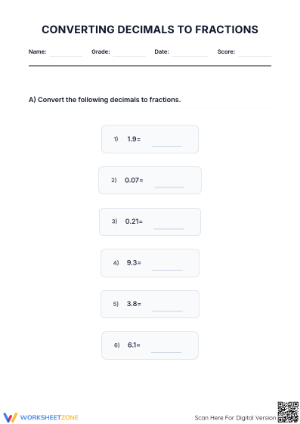
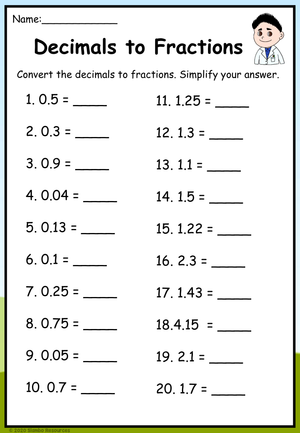
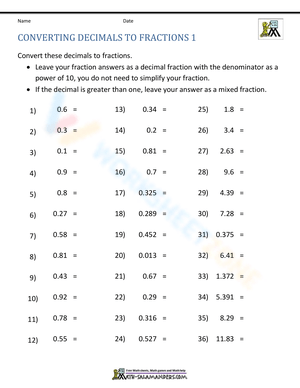
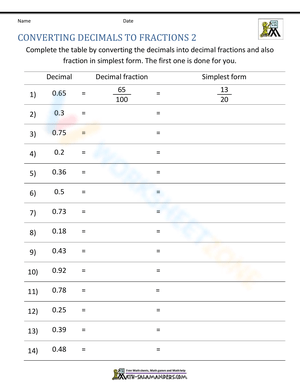
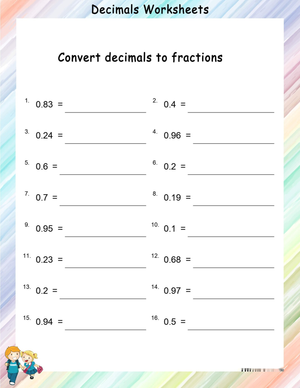
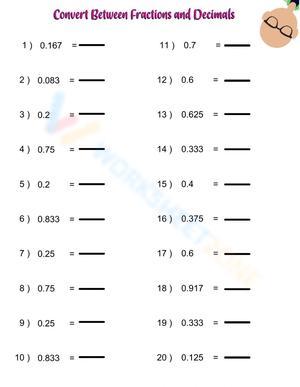
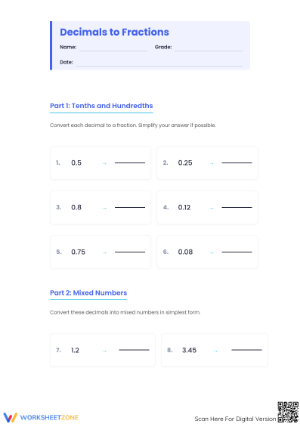
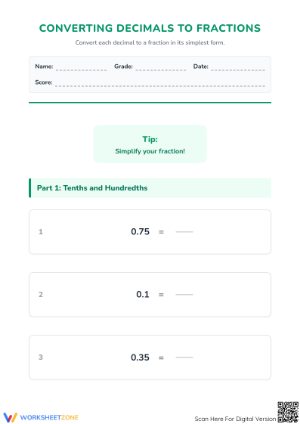
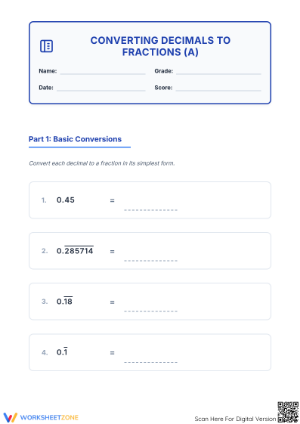
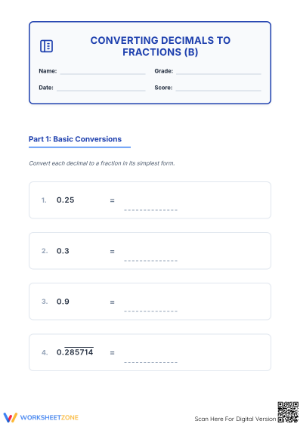
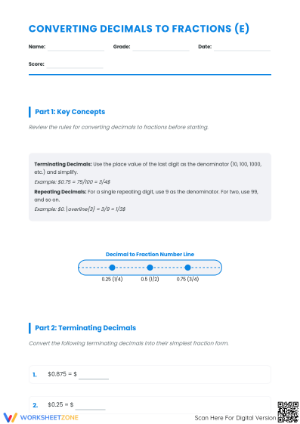
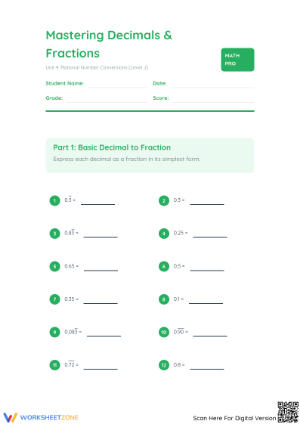
When a fourth grader writes 0.62 as 62/100 without hesitating, you know the place-value model has finally clicked. Converting decimals to fractions worksheets give you a low-prep way to build that fluency across a unit, whether you are introducing the skill for the first time or running a quick review before a state assessment. Because this skill sits at the intersection of place value and fraction sense, it rewards steady, spaced practice more than one big lesson.
These worksheets work well in whole-class instruction, small-group intervention, and independent centers. Grade 4 teachers can use tenths and hundredths sets to build the foundational skill, while grade 5 and 6 teachers can extend into thousandths and simplification with more complex denominators.
How Decimal Place Value Maps Directly to the Denominator
The clearest way to teach this skill is to anchor it in place value language your students already use. Each decimal place corresponds to a specific power of 10, and that power becomes the denominator once the fraction is written.
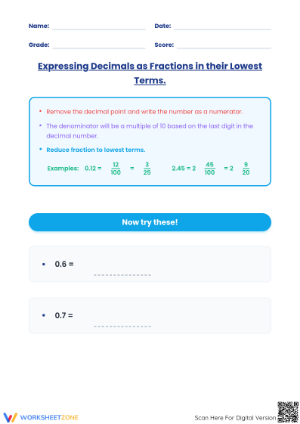
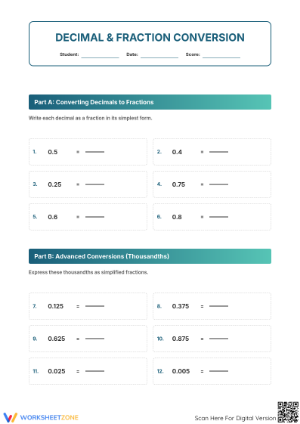
- Tenths place (one digit after the decimal point) becomes a denominator of 10.
- Hundredths place (two digits after the decimal point) becomes a denominator of 100.
- Thousandths place (three digits after the decimal point) becomes a denominator of 1,000.
Once students can name the place value correctly, writing the fraction is mostly a copying task: the digits become the numerator, and the place value name tells them the denominator. Worksheets that isolate this step, before asking students to simplify, are especially useful for students who are still shaky on place value.
CCSS.Math.Content.4.NF.C.6 specifically asks Grade 4 students to use decimal notation for fractions with denominators of 10 or 100, which means a worksheet set that only covers tenths is not sufficient coverage for the standard on its own. Pair tenths practice with a hundredths set, and use CCSS.Math.Content.4.NF.C.5 items, converting 3/10 to 30/100, as a bridge activity before students see decimals at all.
A Step-by-Step Classroom Routine You Can Reuse
Consistency matters more than novelty when students are building a new procedural skill. A simple three-step routine, posted where students can see it, reduces the cognitive load of the conversion task itself.
- Step 1: Identify the place value of the last digit in the decimal.
- Step 2: Write the digits after the decimal point as the numerator, over the matching power of 10.
- Step 3: Simplify the fraction to lowest terms if a common factor exists.
Model this routine with a think-aloud on the first few problems of a worksheet, then release students to work independently on the remainder. Because the routine is the same regardless of whether the decimal has one, two, or three digits, it scales naturally as you move from Grade 4 tenths and hundredths practice into Grade 5 thousandths work.
Common Misconceptions and How Worksheets Can Surface Them
Two errors show up again and again in student work, and both are worth watching for as you circulate during independent practice.
The first is place-value confusion, where a student writes 0.7 as 7/100 instead of 7/10 because they miscount the digits after the decimal point. The second is forgetting to simplify, where a technically correct fraction like 25/100 is left unreduced instead of written as 1/4. A well-designed worksheet mixes both single-digit and multi-digit decimals so these errors surface naturally rather than being avoided by problem design.
When you spot a pattern of place-value errors across several students, that is a strong signal to pull a small group before moving the whole class forward into thousandths or repeating decimals.
Differentiating Worksheet Sets by Grade Level
Not every converting decimals to fractions worksheet belongs in every classroom. Matching the decimal complexity to grade-level expectations keeps practice appropriately challenging without frustrating students who have not yet built the prerequisite skills.
- Grade 4: Focus on tenths and hundredths only, directly supporting CCSS.Math.Content.4.NF.C.6 and CCSS.Math.Content.4.NF.C.5.
- Grade 5: Extend into thousandths, building on CCSS.Math.Content.5.NBT.A.3 work with reading, writing, and comparing decimals to the thousandths place.
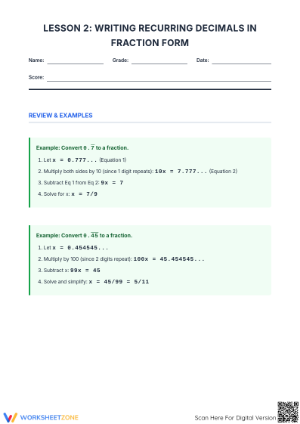
- Grade 6 and beyond: Introduce repeating decimals and rational numbers, including negative values, in line with CCSS.Math.Content.6.NS expectations.
If you teach a mixed-ability classroom, keep two or three worksheet tiers on hand so you can hand a student the right level of challenge without singling anyone out.
Frequently Asked Questions
1. What grade level is converting decimals to fractions typically taught?
Grade 4 is when students first formally convert decimals to fractions with denominators of 10 or 100, per CCSS.Math.Content.4.NF.C.6. Grade 5 extends the skill to thousandths, and Grade 6 introduces repeating decimals and rational numbers.
2. How do these worksheets align with Common Core standards like 4.NF.C.6?
CCSS.Math.Content.4.NF.C.6 requires Grade 4 students to use decimal notation for fractions with denominators of 10 or 100, which is exactly what tenths and hundredths conversion worksheets practice. Pairing them with CCSS.Math.Content.4.NF.C.5 items builds the equivalent-fraction reasoning that supports the conversion.
3. What is the best way to introduce decimal-to-fraction conversion in the classroom?
Start with the three-step routine: identify the place value, write the digits over the matching power of 10, and simplify if possible. Model it explicitly before releasing students to independent practice, and keep the language consistent with how you teach place value elsewhere in the unit.
4. How can teachers help students who struggle with simplifying converted fractions?
Separate the two skills during scoring so you know whether the error is in identifying place value or in simplifying. For students who consistently forget to simplify, add a dedicated mini-lesson on finding common factors before returning to full conversion worksheets.