


























Views
Downloads


Grade 3 Multiples of 10 — Printable No-Prep Worksheet
Paste this activity's link or code into your existing LMS (Google Classroom, Canvas, Teams, Schoology, Moodle, etc.).
Students can open and work on the activity right away, with no student login required.
You'll still be able to track student progress and results from your teacher account.
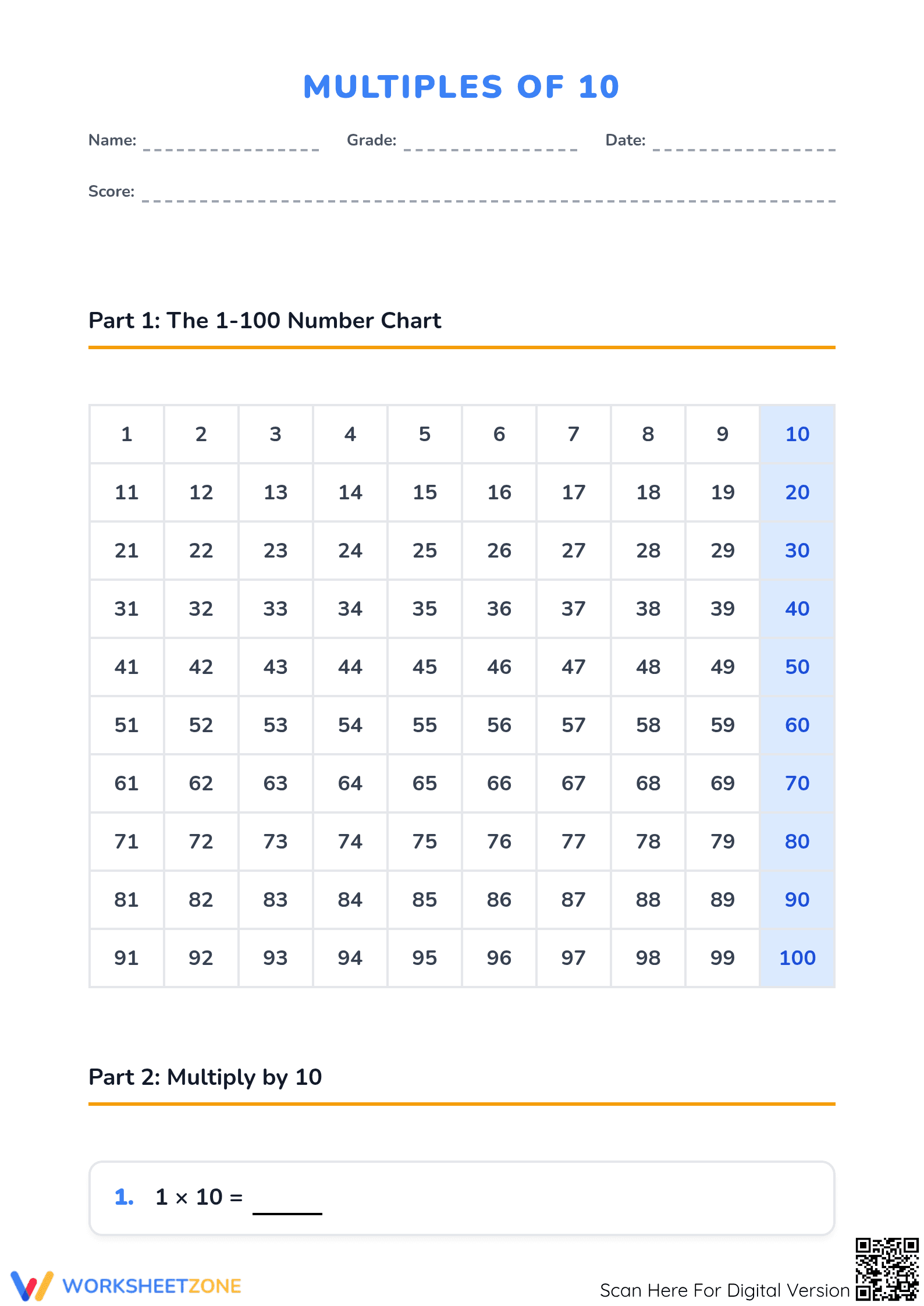
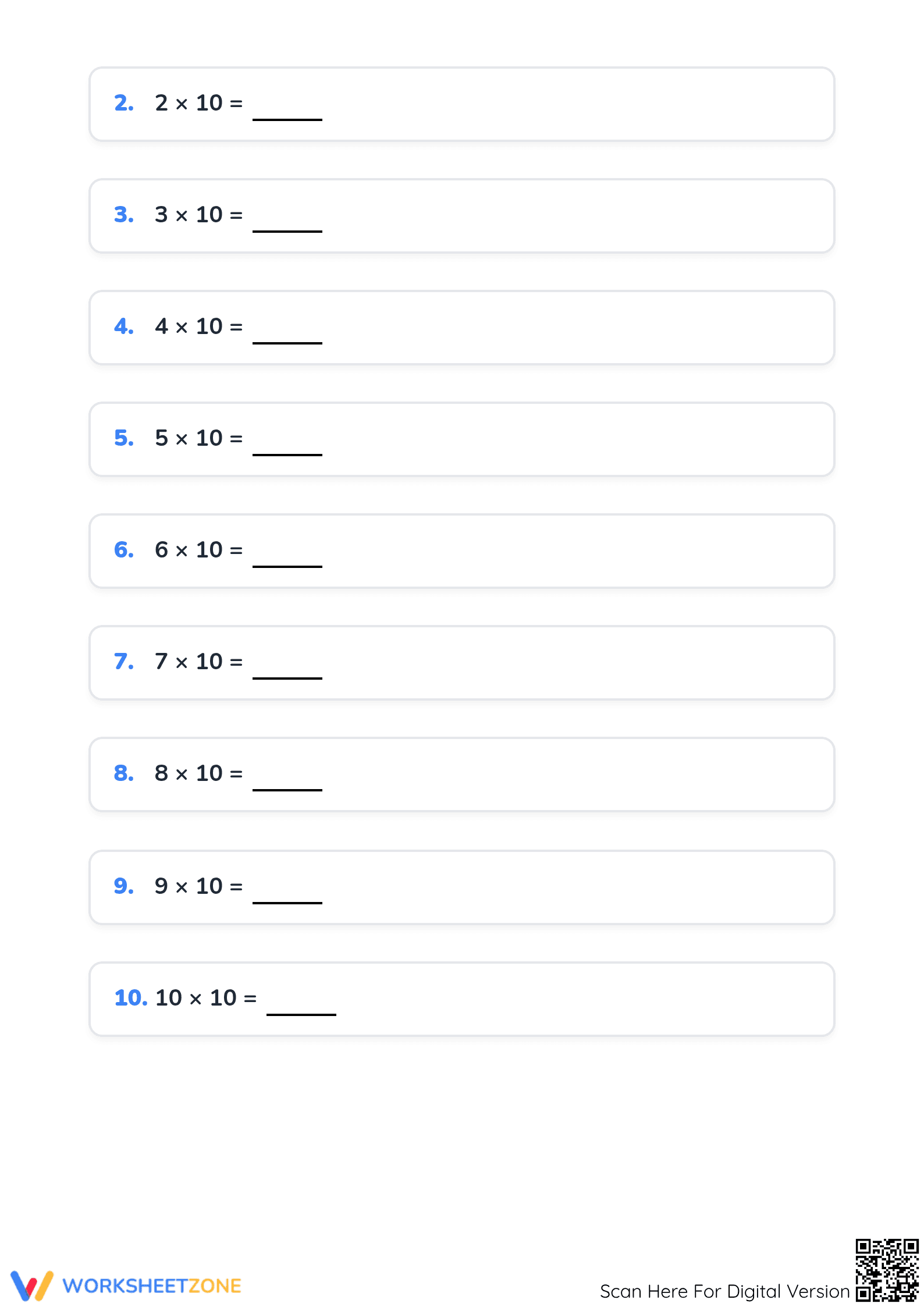
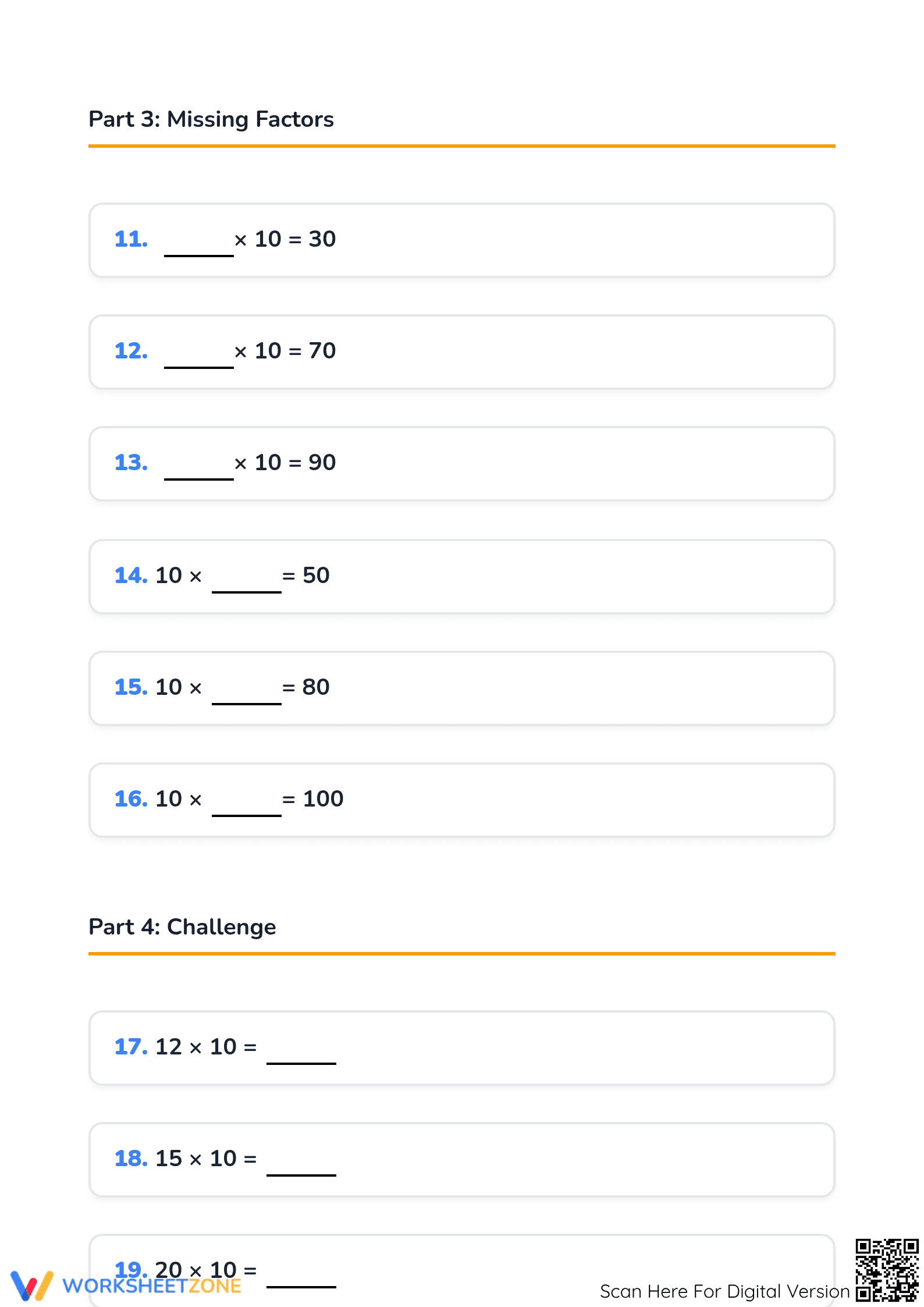
This Grade 3 math worksheet provides targeted practice on identifying and extending patterns with multiples of 10. Students will complete 96 skip-counting sequences, building number sense and a foundational understanding of multiplication. It's a straightforward resource designed to reinforce key arithmetic patterns in a clear, structured format for young learners.
At a Glance
- Grade: 3 · Subject: Math
- Standard:
CCSS.MATH.CONTENT.3.OA.D.9— Identify and explain arithmetic patterns in number sequences.- Skill Focus: Multiples of 10, Skip Counting
- Format: 3 pages · 96 problems · Answer key included · PDF
- Best For: Independent practice, morning work, or homework
- Time: 15–25 minutes
What's Inside
This resource contains a three-page worksheet focused entirely on multiples of 10. Across the pages, there are 96 distinct problems presented as "fill-in-the-blank" number sequences. A complete, one-page answer key is included for quick and easy grading, showing the correct number for every sequence. The layout is clean and organized into lettered sections.
A Zero-Prep Workflow
This worksheet is designed for maximum efficiency. The workflow is simple and requires virtually no teacher preparation.
- Print (1 minute): The file is a ready-to-print PDF containing the 3-page worksheet and 1-page answer key.
- Distribute (2 minutes): Hand out the worksheets to students for immediate use as a bell ringer, in-class assignment, or take-home practice.
- Review (5 minutes): Use the provided answer key to quickly check student work or allow students to self-assess their understanding.
Total teacher time is minimal, making this an ideal resource for substitute plans or supplemental practice when you need a quality activity with no setup.
Standards Alignment
This worksheet is directly aligned with the Common Core State Standard CCSS.MATH.CONTENT.3.OA.D.9, which requires students to "Identify arithmetic patterns (including patterns in the addition table or multiplication table), and explain them using properties of operations." While this worksheet focuses on the identification aspect, it builds the pattern recognition necessary for students to later explain those properties. Both standard codes can be copied directly into lesson plans, IEP goals, or district curriculum mapping tools.
How to Use It
Use this worksheet during your unit on multiplication, number patterns, or place value. It functions perfectly as an independent practice activity after a direct instruction lesson on skip counting by tens. For a formative assessment opportunity, circulate as students work and observe who is counting on their fingers versus who can mentally compute the next number in the sequence. Most students should be able to complete the worksheet in approximately 15 to 25 minutes.
Who It's For
This activity is designed for third-grade students who are developing their understanding of number patterns and multiplication. It is also suitable for advanced second graders ready for a challenge or as a review for fourth graders who need to solidify their base-ten number sense. The worksheet pairs well with a hundreds chart anchor chart, which students can use as a visual aid to track the skip-counting patterns.
Foundational skills in number patterns are a critical predictor of future mathematics achievement. This worksheet provides focused practice aligned to CCSS.MATH.CONTENT.3.OA.D.9, where students learn to identify arithmetic patterns like skip counting. Research highlighted by Fisher & Frey (2014) emphasizes the importance of purposeful independent practice to solidify skills introduced during direct instruction. By completing 96 structured problems, students move from guided recognition to automaticity. The ability to fluently work with multiples of 10 is essential for developing place value understanding and mental math strategies, which are key components of number sense. This targeted practice serves as a concrete application of abstract number theory, giving students the repetition needed to internalize the base-ten system's structure and prepare for more complex multi-digit operations.


