




























0
Views
0
Downloads

0.0
0
Save
0 Likes
Share
Similar Triangles Worksheet
0 Views
0 Downloads

Paste this activity's link or code into your existing LMS (Google Classroom, Canvas, Teams, Schoology, Moodle, etc.).
Students can open and work on the activity right away, with no student login required.
You'll still be able to track student progress and results from your teacher account.
Information
Description
What It Is:
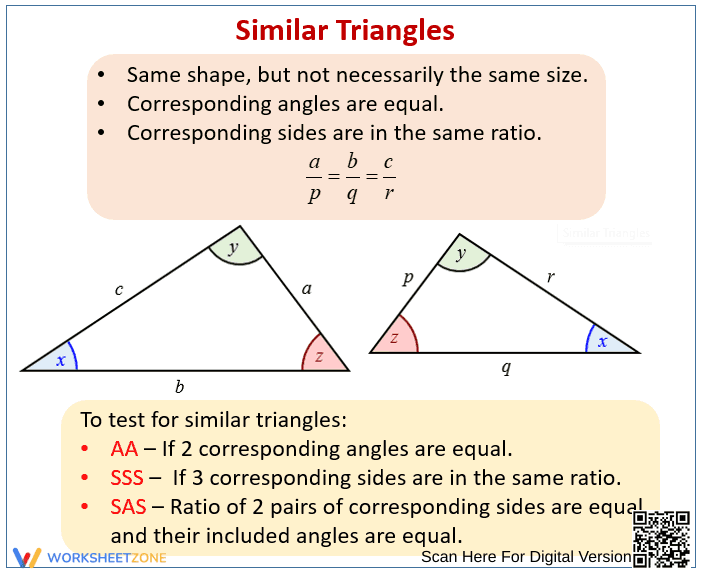
This is an educational worksheet explaining the concept of similar triangles. It defines similar triangles as having the same shape but not necessarily the same size. The worksheet highlights that corresponding angles are equal and corresponding sides are in the same ratio, showing the ratio as a/p = b/q = c/r. It includes diagrams of two similar triangles labeled with sides (a, b, c, p, q, r) and angles (x, y, z). The worksheet also outlines three methods to test for similar triangles: AA (Angle-Angle), SSS (Side-Side-Side), and SAS (Side-Angle-Side).
Grade Level Suitability:
This worksheet is suitable for middle school and high school students, specifically grades 7-10. It introduces geometric concepts of similarity, ratios, and angles which are typically covered in these grades. The complexity of the tests for similarity (AA, SSS, SAS) also aligns with these grade levels.
Why Use It:
This worksheet helps students understand the definition and properties of similar triangles. It provides clear visual representations and explanations of the criteria used to determine if two triangles are similar. Students can learn about corresponding angles, side ratios, and the AA, SSS, and SAS similarity theorems.
How to Use It:
Use this worksheet as an introduction or review of similar triangles. Students can study the definitions and diagrams, then use the AA, SSS, and SAS criteria to solve problems involving similar triangles. The worksheet can be used for independent study, classroom instruction, or as a reference guide.
Target Users:
This worksheet is targeted toward students learning geometry, particularly those studying similar triangles. It is also beneficial for teachers who need a clear and concise resource to explain the concept of similar triangles and the related theorems.
This is an educational worksheet explaining the concept of similar triangles. It defines similar triangles as having the same shape but not necessarily the same size. The worksheet highlights that corresponding angles are equal and corresponding sides are in the same ratio, showing the ratio as a/p = b/q = c/r. It includes diagrams of two similar triangles labeled with sides (a, b, c, p, q, r) and angles (x, y, z). The worksheet also outlines three methods to test for similar triangles: AA (Angle-Angle), SSS (Side-Side-Side), and SAS (Side-Angle-Side).
Grade Level Suitability:
This worksheet is suitable for middle school and high school students, specifically grades 7-10. It introduces geometric concepts of similarity, ratios, and angles which are typically covered in these grades. The complexity of the tests for similarity (AA, SSS, SAS) also aligns with these grade levels.
Why Use It:
This worksheet helps students understand the definition and properties of similar triangles. It provides clear visual representations and explanations of the criteria used to determine if two triangles are similar. Students can learn about corresponding angles, side ratios, and the AA, SSS, and SAS similarity theorems.
How to Use It:
Use this worksheet as an introduction or review of similar triangles. Students can study the definitions and diagrams, then use the AA, SSS, and SAS criteria to solve problems involving similar triangles. The worksheet can be used for independent study, classroom instruction, or as a reference guide.
Target Users:
This worksheet is targeted toward students learning geometry, particularly those studying similar triangles. It is also beneficial for teachers who need a clear and concise resource to explain the concept of similar triangles and the related theorems.


