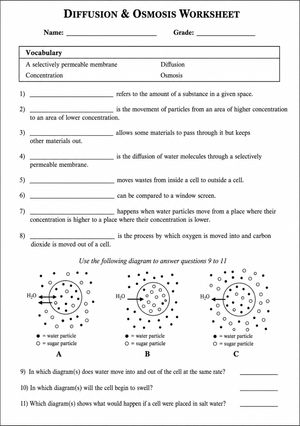
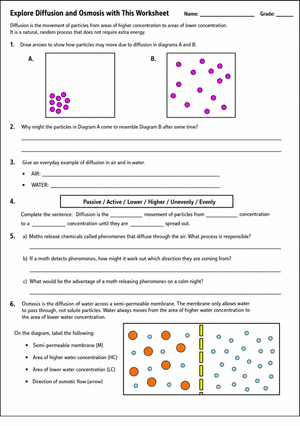
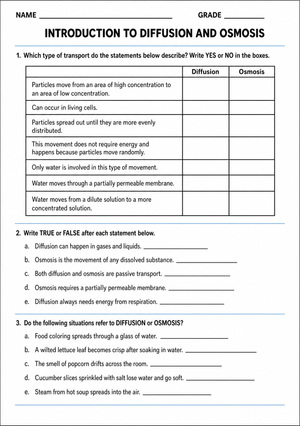
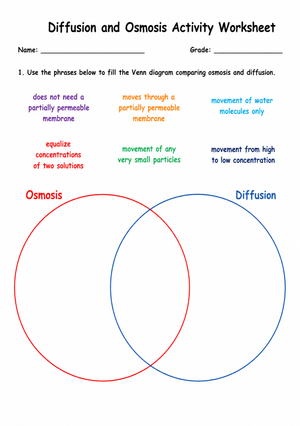
These 8th grade diffusion and osmosis pdf worksheets give science teachers a printable set that moves students past surface-level vocabulary into actual reasoning about particle movement and membrane behavior. Each worksheet combines diagram interpretation with short written explanation, so students do more than match terms to definitions — they trace what moves, predict what changes, and justify their answers using concentration language.
The Specific Concepts Targeted in Each Worksheet
Diffusion and osmosis arrive in 8th grade as part of a broader cell and membrane unit, and the vocabulary load is real: concentration gradient, selectively permeable membrane, hypertonic, hypotonic, isotonic. The worksheets address all of it, but always in service of one driving question — which substance moved, and why. That focus keeps students from treating the topic as a glossary exercise.
Across the set, students practice:
- Identifying which direction particles or water will move based on concentration differences shown in diagrams.
- Distinguishing diffusion from osmosis using parallel examples — food coloring spreading through a beaker versus water crossing a cell membrane.
- Labeling arrows to show movement direction in membrane diagrams.
- Classifying solutions as hypertonic, hypotonic, or isotonic and describing the likely change to cell size.
- Writing short explanations that use concentration gradient vocabulary to justify a prediction or observation.
Questions build from visual reading toward written explanation. Earlier items on each worksheet ask students to label or circle; later items ask them to produce language. That sequence keeps the work accessible at the start while still requiring students to articulate reasoning by the end.
Misconceptions Students Bring to This Topic — and What to Watch For
The most persistent error we see in 8th grade cell transport is this: students understand that osmosis involves a membrane, but they draw the wrong substance moving. Ask a class to show osmosis on a diagram and a notable number will draw glucose or salt particles crossing the membrane rather than water molecules. They hear "selectively permeable" and conclude something is being selected to pass through — and in their mental model, that something is the solute, not the solvent. A worksheet that labels the solute and solvent separately on the same diagram, then asks which one crosses in osmosis, catches that confusion immediately and gives you a clear starting point for correction.
A second stubborn error involves movement direction in tonicity scenarios. Students who correctly understand that water moves from lower solute concentration to higher solute concentration will still write that water moves from the hypertonic solution into the cell — the exact reverse. The language trips them: "hypertonic" sounds like "high water" when it actually means high solute concentration and therefore low water concentration. Side-by-side comparison diagrams — one hypertonic setup, one hypotonic — force students to trace logic rather than retrieve a phrase, which is where the error surfaces and can be addressed directly.
Where These Worksheets Fit in the Teaching Sequence
Most teachers drop one worksheet in before a lab as a prediction activator. Students read two or three setup diagrams, mark what they expect to happen to particle distribution or cell shape, and commit to a reason. That takes about eight minutes and sharpens the post-lab discussion because students have a specific claim to confirm or revise instead of watching passively.
The stronger use, in practice, is immediately after the lab. Post-lab, a three-scenario tonicity worksheet — one hypertonic setup, one hypotonic, one isotonic — asks students to label water movement direction, describe the expected cell-size change, and write one sentence justifying the answer using concentration vocabulary. That single post-lab worksheet reveals more about student understanding than a five-question quiz, because it requires comparison across cases rather than recall of a single example memorized during the procedure.
These 8th grade diffusion and osmosis pdf worksheets also slot cleanly into station rotations. One station handles vocabulary and diagram identification; a second works through real-world scenarios like why a pickle loses water in brine or how a dialysis membrane operates; a third asks students to interpret tonicity for red blood cells placed in saline versus fresh water. Because each worksheet is a standalone printable, teachers can run two or three stations simultaneously without sequencing pages or managing a packet order.
Adjusting the Set for Different Student Readiness Levels
For students who struggle with dense scientific language, the fix is not to reduce the science but to tighten the visual representation. Choose worksheets with diagram-first questions — students identify particle concentration differences before any text prompt asks them to explain. Sentence frames like "Water moved from the ___ solution because..." give students a reasoning structure to work within while still requiring them to produce their own answer. A short vocabulary anchor strip limited to five terms, used consistently across that worksheet, reduces cognitive load without stripping out the scientific language students actually need.
For students ready for extension, the same diagrams support deeper prompts: What would happen if the concentration gradient were reversed? Why does diffusion reach equilibrium while osmosis stops when hydrostatic pressure balances the concentration difference? These questions don't require separate materials — they can be printed as an extension row or written in the margin. A student who finishes the base questions and then explains equilibrium in their own words gives you a clear picture of where mastery actually sits.
The 8th grade diffusion and osmosis pdf worksheets in this set include questions at both levels on each worksheet — some items are label-and-choose, others require written reasoning. That means teachers can assign a single worksheet to the whole class and differentiate by which items they require each student to complete, rather than managing entirely separate printables for each readiness group.
Standard Alignment
These 8th grade diffusion and osmosis pdf worksheets align with NGSS MS-LS1-2, which asks students to develop and use models to describe cell function and the role of cellular structures in supporting life processes. The cell membrane's role in controlling what enters and exits the cell — through passive transport mechanisms like diffusion and osmosis — sits at the center of that standard. Diagram-based worksheet practice directly supports the modeling expectation: students are not just reading about membranes, they are interpreting, annotating, and reasoning about visual representations of substance movement. In most grade 8 sequences, this standard lands mid-unit, after students have studied basic organelle roles and before instruction shifts toward cellular respiration or body system applications. Teachers who use these worksheets at that placement find students arrive at system-level content with a firmer grasp of why membrane behavior matters.
Frequently Asked Questions
Do students need prior knowledge of cell structure before starting?
Students need to know that cells have membranes and understand the general idea of concentration — that some areas can have more dissolved particles than others. They do not need detailed organelle knowledge. If students have completed a basic introduction to cells, they are ready to begin. Teachers who assign these worksheets early in a unit often introduce the concept of selective permeability through the worksheet itself rather than in a separate lesson beforehand.
How do these worksheets get students to distinguish diffusion from osmosis without just asking them to memorize definitions?
Each worksheet presents both processes in the same question set, often using parallel diagrams — one showing dissolved particles spreading through a solution, one showing water crossing a membrane. Students compare the two setups directly, which pushes them to articulate the distinction rather than retrieve a stored phrase. Rote definitions tend to fade between class periods; the visual contrast between the two diagrams stays with students longer and gives them something concrete to reason from during assessment.
Are there items in the set that work for a substitute day?
Worksheets that focus on one or two skills — identifying movement direction, or sorting written scenarios into diffusion or osmosis — work well for sub days because the diagrams provide enough context for students to begin without a live explanation. Worksheets that address tonicity and cell-size change are better reserved for days when the teacher is present. The directional confusion those items surface — students reversing the direction of water movement in hypertonic solutions — needs a quick classroom response, not a note left in sub plans.