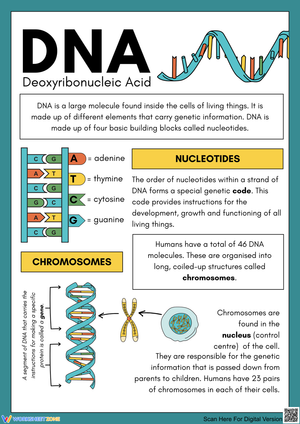
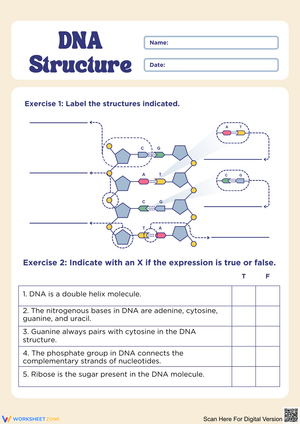
These 8th grade DNA, genes, and chromosomes worksheets address one of the most conceptually demanding shifts in middle school science: the move from describing what traits look like to explaining the molecular structures responsible for them. Each worksheet targets a specific layer of that explanation — structure, function, hierarchy, or variation — so teachers can sequence them across a genetics unit rather than relying on a single catch-all activity.
What's Inside the Set
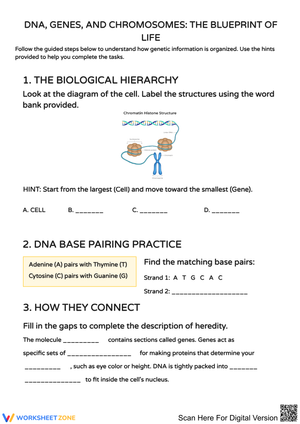
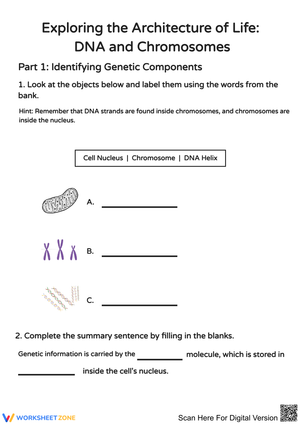
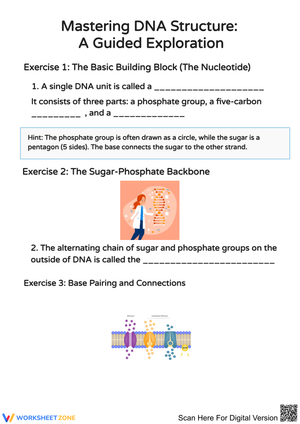
The worksheets cover the core content of an 8th grade genetics unit, moving from cell structure down to the molecular level. Students label diagrams showing how DNA coils around histone proteins to form chromatin, then condenses further into the chromosomes visible during cell division — a distinction that trips up many 8th graders who draw chromosomes as floating X-shapes disconnected from anything else in the cell. Other worksheets ask students to complete complementary DNA base-pair strands, applying the adenine-thymine and cytosine-guanine pairing rules in both directions. Gene-function worksheets connect specific DNA sequences to protein production, and karyotype-reading activities give students practice identifying homologous chromosome pairs and spotting numerical abnormalities.
Vocabulary work runs throughout the set. Rather than simple matching, students encounter terms inside short passage-based exercises that require them to use context to distinguish between related words — chromosome, chromatid, chromatin, and locus appear together in ways that force real discrimination, not just memorization of isolated definitions.
Standard Alignment
These worksheets are built around NGSS MS-LS3-1, which requires students to develop and use models to describe why structural changes to genes located on chromosomes may affect proteins and may result in harmful, beneficial, or neutral effects on the structure and function of an organism. The labeling and diagramming activities directly support the model-building component of that expectation. MS-LS3-2 — which asks students to explain how sexual reproduction produces offspring with genetic variation — is supported by the allele and chromosome-pair activities, particularly the karyotype work and the exercises connecting allele combinations to expressed traits.
State standards that draw from the NRC Framework and Next Generation standards use nearly identical language around heredity and molecular structure at the middle grades, so these worksheets transfer well across NGSS-aligned state curricula without modification.
Mistakes Students Make That These Worksheets Help You Catch
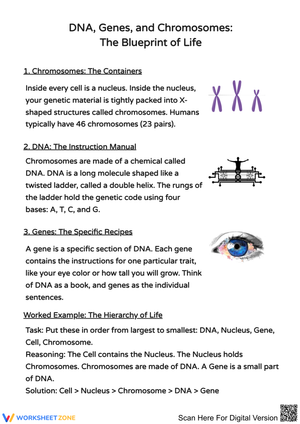
The most persistent error: students treat DNA, genes, and chromosomes as synonyms for the same thing rather than as levels of a hierarchy. A student who can correctly say "genes are on chromosomes" will still draw a chromosome and a gene as two separate floating objects in a cell sketch, with no spatial relationship between them. The labeling worksheets make this confusion visible before the unit assessment.
A second pattern that shows up consistently in student work is misapplying base-pair rules directionally. Students who learn the rules correctly will complete a top strand fine, then reverse the logic when reading the complementary strand bottom-up — writing the complement of the complement instead of simply reading the paired strand in the correct 3' to 5' direction. The base-pairing worksheets include strands that run in both orientations specifically to surface this error.
A third misconception worth watching: students conflate "having a gene" with "expressing the trait." When asked whether a brown-eyed person has a gene for blue eyes, many will say no. Worksheets that address dominant and recessive alleles within the context of the gene structure — rather than as pure Punnett square mechanics — help students build the correct model before high school biology deepens it.
How to Build These Worksheets Into Your Lesson Plans
The hierarchy-and-labeling worksheets work well as the entry task on the first day of the genetics unit — about 12 minutes of structured work that immediately reveals where each student's prior knowledge stops. What students can and can't label on day one tells you more than any pre-assessment multiple-choice item. Keep those completed worksheets; they make a useful before-and-after comparison at the end of the unit.
Base-pairing and DNA structure worksheets fit naturally into the middle of the unit, after direct instruction on the double helix but before students move to transcription and translation. Assign them as guided practice during class so you can catch directional errors in the moment. The karyotype worksheets are best placed after students understand chromosome number and pairing — they work well as a Friday consolidation task or as the structured component of a station rotation, paired with a short video or physical chromosome card sort at adjacent stations.
For review at the end of the unit, the vocabulary-in-context worksheets serve as low-stakes retrieval practice. Students who can place locus, allele, and chromatid correctly inside a reading passage are demonstrating a level of understanding that multiple-choice review doesn't capture.
Adjusting the Worksheets for a Range of Learners
Students who are still building basic science literacy benefit from working with the diagram-and-label worksheets first, with a word bank visible. Providing a completed example of the first item reduces the cognitive load enough that struggling students can focus on the content rather than the format. For the base-pairing worksheets, writing the pairing rules at the top of the page — A-T, C-G — as a reference removes the recall demand and isolates the application skill.
Students who have the foundational vocabulary in place can move to extension tasks: rewriting a short DNA sequence with a single base substitution, then explaining in writing what effect that change might have on the resulting protein. This connects the structural content of the worksheet directly to the MS-LS3-1 modeling expectation without requiring additional materials. For students in the middle, pairing the karyotype worksheet with a structured note-taking template helps them organize observations before drawing conclusions — a scaffold that can be removed once the analysis pattern is familiar.
Frequently Asked Questions
How do I sequence these worksheets if I'm teaching DNA structure and Punnett squares in the same unit?
Teach the structural hierarchy first — nucleus, chromosome, DNA, gene — before moving into how traits are inherited. Students who reach Punnett squares without a stable model of what a gene physically is tend to treat alleles as abstract placeholders rather than alternate versions of a real DNA sequence. The labeling and base-pairing worksheets belong in the first week of the unit; Punnett square practice comes after students can explain what an allele actually is at the molecular level.
Can these worksheets stand alone if a substitute is covering the class?
The passage-based vocabulary worksheets and the diagram-labeling activities work well as self-contained sub plans because students can work through them with a reference diagram and a word bank rather than needing live instruction. The base-pairing worksheets are the exception — they go better with at least a brief explanation of the pairing rules, so include those rules as a printed header or attach a simple reference card if you're leaving them for a sub day.
My students already covered basic genetics in 7th grade. Will this feel redundant?
7th grade genetics instruction typically stays at the trait-and-inheritance level — dominant, recessive, Punnett squares, observable characteristics. These worksheets operate at the structural and molecular level, which is genuinely new territory for most 8th graders regardless of what they saw the year before. The students who are most confident coming in are often the ones who need the hierarchy work most, because they've built an incomplete model — Punnett squares without any understanding of what a gene is or where it sits in a chromosome — and that model has to be rebuilt rather than extended.