8th Grade Integumentary System Review Worksheets for Science Class
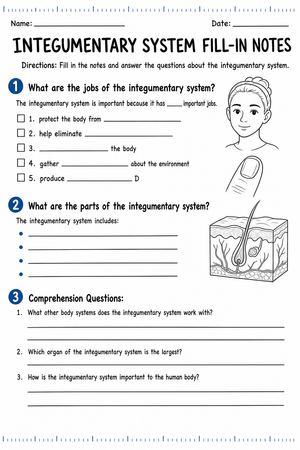
These 8th grade integumentary system review worksheets give middle school science teachers a ready-to-print tool for revisiting skin structure and function before a unit exam, a chapter check, or an assessment block. Each worksheet targets the three main skin layers, the accessory structures—hair, nails, sweat glands, and sebaceous glands—and the core functions the integumentary system performs. That scope fits neatly into a bell ringer, a partner station, or a targeted reteach session without eating into direct instruction time.
The Specific Skills Targeted in Each Worksheet
The content centers on what 8th graders are actually expected to know: the relationship between structure and function inside a body system. That means going beyond vocabulary copying into tasks that ask students to explain why a structure exists, not just what it is called.
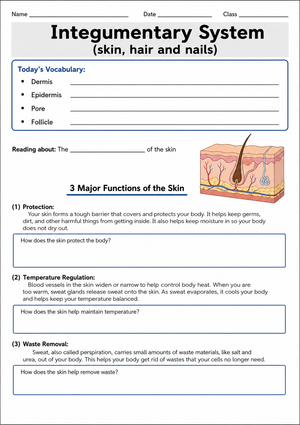
- Labeling the epidermis, dermis, and subcutaneous layer on a cross-section diagram
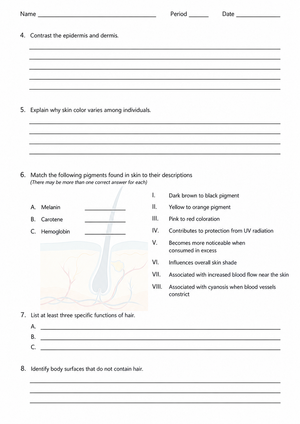
- Matching accessory structures—sweat glands, sebaceous glands, hair follicles, and nails—to their specific roles
- Identifying the integumentary system's major functions: protection from pathogens and UV radiation, sensation, temperature regulation, and water loss prevention
- Applying vocabulary in short-answer items that connect a structure to a real situation—for example, explaining why the body sweats when core temperature rises
- Sorting "structure" from "function" in a way that mirrors the format of most 8th grade unit tests
That last skill matters more than it may appear. In actual student work, the structure-versus-function distinction trips up students who have been staring at skin diagrams all week. They know the word "dermis" but will write it as a function the moment the question changes format. Worksheets that alternate between labeling and explaining surface that confusion before a graded assessment can.
Mistakes Students Make That These Worksheets Help You Catch
The most persistent error is layer-order reversal. Students consistently place the dermis above the epidermis — or more precisely, they argue that the dermis is the outermost layer because "derm" sounds like the root word for skin, while "epidermis" sounds internal. Even students who labeled the cross-section diagram correctly on Monday will swap the two on Thursday when the diagram is gone and the question is text only. A reliable correction is having students say it aloud: "Epi- means on top of. The epidermis sits on top of the dermis." Worksheets that include both a diagram item and a written-explanation item for the same layer catch this reversal before it costs students points on the test.
A second reliable mistake: students name protection as a function and then write "skin" as the explanation — which is circular reasoning that restates the question without answering it. They write "the skin protects the body" with no identification of which structure does the protecting or what it protects against. A well-designed item forces more precision. "Explain how the epidermis defends against UV radiation" draws a different response than "what does skin do?" — and the difference is exactly what 8th grade assessments test.
Oil glands and sweat glands are also chronically confused, and not randomly. Students tend to assign sweat glands to temperature regulation correctly, then default to oil glands for protection, even after instruction has made clear that sebaceous glands primarily lubricate hair and skin rather than serving as a pathogen barrier.
Building These Worksheets Into Your Lesson Plan
The most efficient placement is as a bell ringer the day before a quiz, when students need a low-stakes way to discover what has held and what has faded. That eight-to-ten-minute window at the start of class — before the transition to direct instruction — fits a labeling task plus a short matching set. Students work independently, and the discussion that follows tells you whether to push forward or pause for a five-minute diagram review using a projected image.
- Station rotation during a human body systems unit, paired with a diagram poster so students can self-check labeling before moving on
- Homework after the introductory lesson on skin layers, giving students a structured way to revisit notes before the next class without requiring teacher setup
- Small-group reteaching when a quick formative check shows that a cluster of students still cannot distinguish the three layers or connect glands to functions
- Sub plans — the task is self-contained, and the directions on each worksheet are clear enough that no verbal setup is required
One practical addition: pairing each worksheet with a two-question exit ticket after completion produces cleaner formative data. Ask students to name the layer they feel least confident about and identify one function they had to look up. Those responses take under two minutes to scan and immediately shape the next morning's warm-up.
Adjusting the Worksheets for a Range of Learners
For students who need additional support, the labeling items are the strongest entry point. Providing a word bank alongside the skin-layer diagram removes the retrieval barrier and lets those students focus on placing terms correctly rather than expending energy on spelling. Once they can label reliably, add the matching section. Open-response items come last, after the vocabulary is more secure — not as a reward, but because asking students to write explanations before they can name the structures reliably adds too many demands at once.
Students who move quickly through the standard content can extend into functional reasoning. After completing the matching set, ask them to explain in writing what would happen if sebaceous glands stopped functioning entirely. That conditional thinking is where 8th grade science instruction is headed anyway, since NGSS asks students to argue from evidence about body system interactions. The 8th grade integumentary system review worksheets work at grade level as written, but the open-ended extension keeps stronger students from coasting through content they have already internalized.
For English language learners, the diagram-first items carry the most immediate value. Pairing the cross-section label task with a short bilingual glossary — epidermis, dermis, subcutaneous tissue, sweat gland, sebaceous gland — lets students access the science without English vocabulary becoming the primary obstacle.
Standard Alignment
These worksheets align to NGSS MS-LS1-3, which asks students to use evidence to explain how the body is a system of interacting subsystems composed of groups of cells. In classroom terms, that standard shows up when students must explain how the epidermis, dermis, and accessory structures each contribute to the skin's overall functions — protection, temperature regulation, and sensation — rather than treating each structure as an isolated vocabulary word. The integumentary system unit is often one of the first places 8th graders encounter genuine "system of systems" reasoning, which is why review items that ask students to connect structure to function carry more instructional weight here than pure recall tasks. A worksheet item asking students to explain why the body sweats rather than simply name where sweat glands are located directly targets the reasoning level MS-LS1-3 requires.
Frequently Asked Questions
What does each worksheet cover, and will the content match what I already taught?
Each worksheet covers the three main skin layers, the accessory structures (hair, nails, sweat glands, sebaceous glands), and the integumentary system's major functions: protection, sensation, temperature regulation, and water loss prevention. That content is consistent across most 8th grade life science textbooks, so the review items align with what students have already seen in notes and diagrams. If your unit emphasized a specific application — sun safety, homeostasis, skin cancer basics — the short open-response items are straightforward to supplement or swap.
How is this different from a worksheet that only asks students to define vocabulary terms?
The question-type mix is the core difference. Vocabulary-only worksheets ask students to copy definitions; these ask students to label a diagram, match structure to function, and work through a brief scenario. That distinction matters for test prep because most 8th grade science assessments ask students to apply terms rather than recite them. A student who can write "epidermis: outermost layer of skin" may still miss a question that presents a skin cross-section and asks which layer is directly exposed to the environment — because knowing the definition and reading a diagram are different cognitive tasks.
Are these worksheets focused only on the integumentary system, or do they also review other body systems?
The 8th grade integumentary system review worksheets focus specifically on skin and its accessory structures, not on other body systems. That narrowed scope is intentional. When students prepare for a test that covers multiple systems, a worksheet that tries to address all of them at once tends to be too broad to reinforce anything deeply. Using one focused worksheet per system — then doing cross-system review only at the end of a unit — produces better retention than a sprawling multi-system page.
What is a good extension if students finish the worksheet before the rest of the class?
The most productive extension is asking students to sketch and annotate their own skin diagram from memory, without referencing the worksheet or their notes. Students who genuinely know the content can do this in under five minutes. Students who struggle to place sweat glands or recall which layer appears deepest will immediately spot their own gaps — which is more instructionally useful than handing them a second worksheet in the same format. If the 8th grade integumentary system review worksheets are running as part of a station rotation, the memory-sketch extension works well as the final step before students move on.
Clear All