




























Views
Downloads

Essential Diffusion and Osmosis Worksheet | Grade 8-12

Paste this activity's link or code into your existing LMS (Google Classroom, Canvas, Teams, Schoology, Moodle, etc.).
Students can open and work on the activity right away, with no student login required.
You'll still be able to track student progress and results from your teacher account.
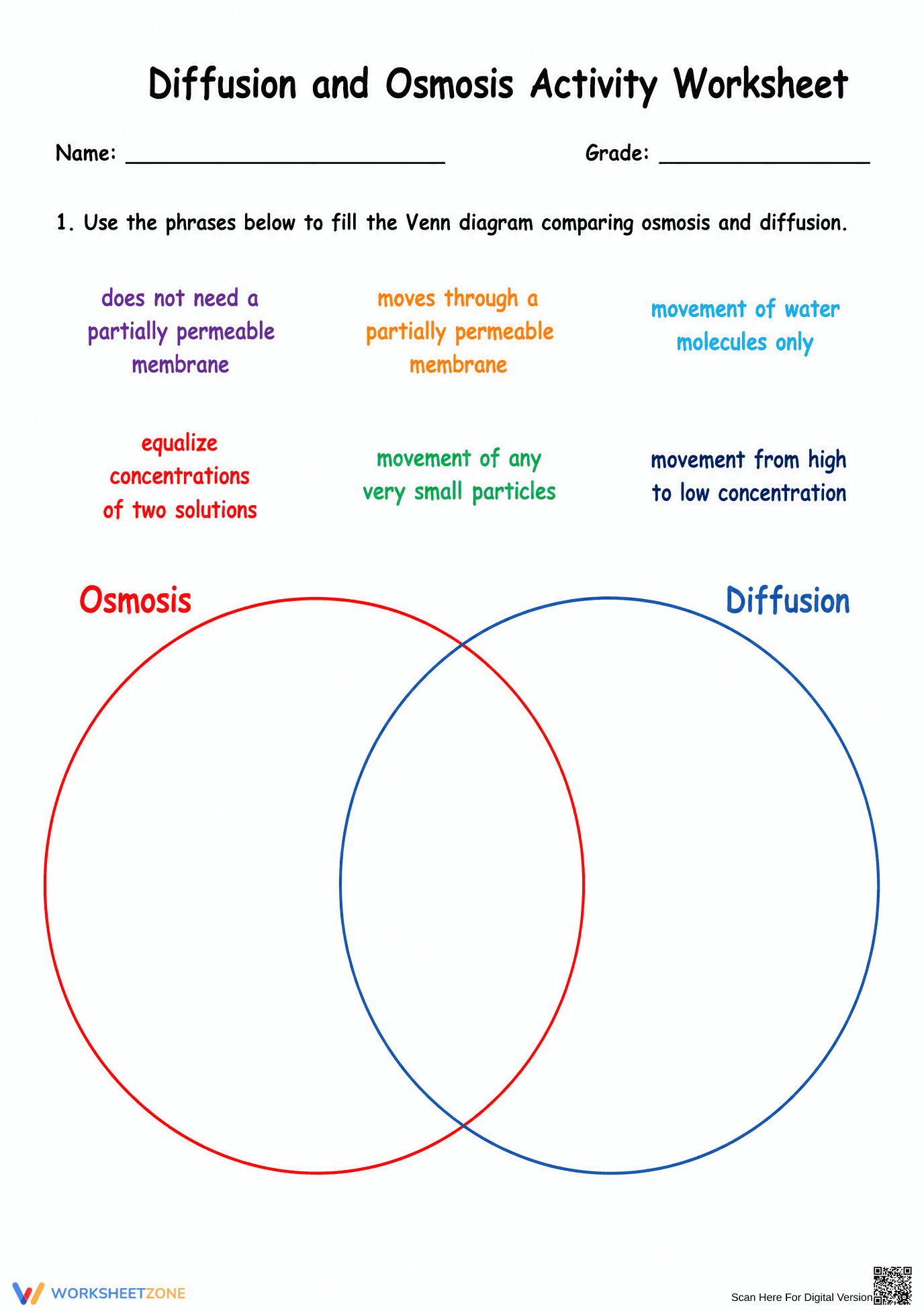
This science worksheet helps students master the fundamental differences between diffusion and osmosis through a structured Venn diagram activity. By categorizing specific transport mechanisms, learners develop a clear conceptual framework for how molecules move across membranes. It is an effective tool for reinforcing cellular biology vocabulary and ensuring students can distinguish between passive transport types.
At a Glance
- Grade: 8-12 · Subject: Biology
- Standard:
MS-LS1-2— Develop and use a model to describe the function of a cell- Skill Focus: Comparing Diffusion and Osmosis
- Format: 1 page · 6 tasks · Answer key included · PDF
- Best For: Quick formative assessment or review
- Time: 10–15 minutes
This single-page PDF features a large, clear Venn diagram designed for visual learners. Students are provided with a word bank containing 6 essential phrases, such as "movement of water molecules only" and "partially permeable membrane." The layout is clean and distraction-free, making it accessible for diverse learners while providing a clear space for students to organize their scientific observations.
- Print: Select the single-page PDF and print enough copies for your class (30 seconds).
- Distribute: Hand out the worksheets as a bell-ringer or exit ticket (1 minute).
- Review: Use the included answer key to conduct a rapid whole-class check or peer-grading session (5 minutes). Total teacher preparation time is under 2 minutes, making this an ideal resource for busy lab days or unexpected sub plans.
This resource aligns with MS-LS1-2, focusing on how the cell membrane acts as a boundary that controls the movement of matter into and out of the cell. It also supports HS-LS1-2 by requiring students to analyze the hierarchical organization of systems. Both standard codes can be copied directly into lesson plans, IEP goals, or district curriculum mapping tools.
Use this worksheet as a formative assessment immediately following a lecture on passive transport. It allows teachers to quickly identify students who confuse the specific requirements of osmosis versus general diffusion. Alternatively, assign it as a collaborative "think-pair-share" activity where students must justify their placement of each phrase based on evidence from their textbook. Expected completion time is 10 to 15 minutes.
This activity is designed for middle and high school biology students, particularly those in Grades 8 through 12. It is highly effective for English Language Learners (ELL) due to the visual nature of the Venn diagram and the concise phrase list. It pairs perfectly with a microscope lab observing onion cells or an anchor chart detailing cellular transport mechanisms.
According to the RAND AIRS 2024 report, visual organizers like Venn diagrams significantly improve the retention of complex biological concepts by reducing cognitive load during the initial acquisition phase. This worksheet targets the MS-LS1-2 standard by requiring students to model the functional differences between diffusion and osmosis, a core competency in cellular biology. By isolating six distinct characteristics—including membrane permeability and solute types—the activity forces students to engage in active retrieval practice. Research from Fisher & Frey (2014) suggests that such categorized practice helps bridge the gap between surface-level vocabulary recognition and deep conceptual understanding. This resource provides a structured environment for students to demonstrate mastery of passive transport, ensuring they can accurately describe how substances move across cell boundaries. It serves as a reliable data point for tracking student progress toward state and national science proficiency benchmarks.


