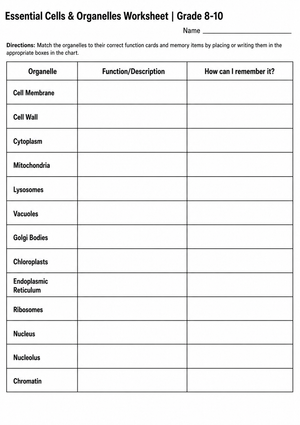
These 8th grade cell organelles worksheets resources give life science teachers a printable practice sequence built around the seven structures students encounter most in middle school biology: nucleus, cell membrane, cytoplasm, mitochondria, chloroplasts, vacuole, and ribosomes. Each worksheet moves students from naming parts to explaining what those parts actually do — which is the gap that tends to show up on unit exams and that most single-format review activities miss.
What's Inside the Set
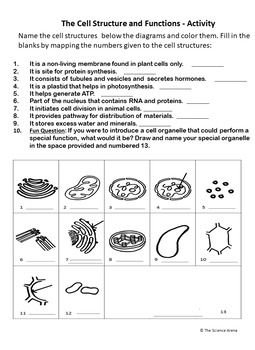
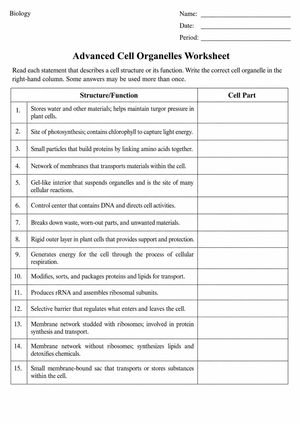
Four task types appear across the worksheets, and the variety is deliberate. Students label cell diagrams — plant and animal versions separately — match each organelle to its function, answer multiple-choice questions that require applying function knowledge to a scenario, and write short constructed responses explaining how two or three organelles work together. That last task is where surface identification skills break down: a student who can label the nucleus in a diagram will still write "the mitochondria makes food" in a sentence, which tells you immediately that naming and understanding function are not the same skill. The written response prompts in each worksheet surface that gap before the quiz does.
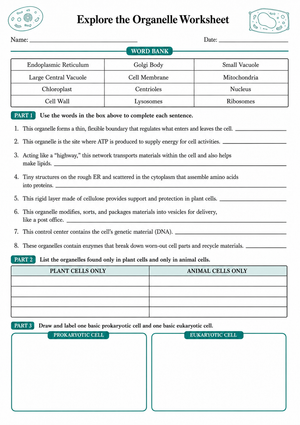
The set also includes a side-by-side plant-versus-animal cell comparison worksheet. Students circle the structures shared by both cell types, mark the plant-only structures, and then explain in writing why a plant cell needs a chloroplast when an animal cell does not. That sequence — label, mark, explain — produces more durable learning than labeling alone because it forces students to apply the reasoning behind the structure, not just recognize it in a diagram.
Where Student Understanding of Cell Organelles Breaks Down
The most persistent error in this unit is function reversal between chloroplasts and mitochondria. Students absorb "chloroplasts make energy" — close enough to true in loose conversation — and then apply it to animal cells, which contain no chloroplasts. A comparison diagram where students must circle plant-cell-only structures catches this in real time: any student who marks a chloroplast in the animal cell column is working from a shortcut, not actual understanding.
The vacuole produces a different kind of confusion. Students learn that plant cells have a large central vacuole and can repeat that fact accurately on a matching section. Then the short-answer prompt asks why — what function does the vacuole serve that makes it so much larger in plant cells? — and they write "because plants are bigger" or leave it blank. The vacuole's role in water storage and cell rigidity is exactly the conceptual connection that gets skipped during fact-list memorization, and it is precisely what the written prompts in each worksheet require students to make explicit.
Ribosomes disappear from student recall consistently. Because they are the smallest structure diagrammed and appear in both cell types, students skip them during labeling and drop them from written summaries. A short-answer question asking which organelle is responsible for protein synthesis — without "ribosome" provided as a selectable option — reliably identifies which students have stopped accounting for ribosomes altogether.
Fitting These Worksheets Into Your Weekly Lesson Sequence
The strongest entry point for the labeling portion of an 8th grade cell organelles worksheets is the second day of the unit, not the first. After one class period of vocabulary introduction, students attempt the diagram before instruction goes deeper. Their errors — blank labels, reversed functions, missing ribosomes — map out where to spend instructional time during the lesson that follows. That 8-minute diagnostic warm-up replaces a formal pre-assessment you would otherwise have to build separately.
- Bell ringer: use only the labeling section; students mark what they recall, and you see the gaps before instruction begins.
- Guided practice: work through the matching section with the class before releasing students to the short-answer portion independently.
- Homework: the full worksheet works well for independent completion after instruction, with the answer key available the next class period for self-correction and revision.
- Exit ticket: pull two or three function-matching questions from any worksheet at the end of a period to check retention before students leave.
- Sub plan: a clearly written worksheet with an answer key gives a substitute a structured 30-minute activity with no verbal setup required.
Teachers who use interactive science notebooks often trim out the diagram section for initial lesson exposure, then return to the complete worksheet when students are assembling test review materials. That reuse pattern is what makes a printable set worth keeping on file — the same resource does multiple jobs across the unit without feeling repetitive to students.
Standard Alignment
These worksheets align to NGSS MS-LS1-2, which asks students to develop and use a model to describe the function of a cell as a whole and the ways parts of cells contribute to that function. At Grade 8, MS-LS1-2 is the instructionally demanding standard — it moves students past identification and into the reasoning behind structure and function. The matching and short-answer sections of each worksheet address that performance expectation directly, rather than stopping at diagram labeling, which satisfies only the surface layer of what the standard requires.
Teachers in Texas-aligned classrooms connect this content to TEKS 8.12(A), which calls for students to examine the structures and functions of cells, including the comparison of plant and animal cells. The plant-versus-animal comparison worksheet is the most frequently used portion of this set in those classrooms because the Texas framework treats that comparison as a Grade 8 expectation, not an enrichment task.
Tailoring the Set for Mixed-Readiness Classrooms
For students still building science vocabulary, the matching section is the right entry point. It places the organelle name next to its function and asks students to draw the connection — no retrieval from nothing required. Multilingual learners benefit from starting with the labeled diagram tasks before moving to written responses, because the visual gives them a concrete anchor for terminology that may be entirely new in English. Adding a word bank to the labeling worksheet is a low-effort adjustment that shifts cognitive load toward the biology rather than the vocabulary retrieval.
Students who demonstrate solid identification skills can extend the short-answer section with an application question written in the margin during circulation: "What would happen to this cell if the mitochondria stopped functioning?" That prompt is not printed on the worksheet, but adding it takes about ten seconds and creates a meaningfully more demanding task without any redesign of the resource itself.
For small-group reteach sessions, working through one organelle per discussion rather than all seven at once reduces memory load and allows for genuine conceptual depth. A single 8th grade cell organelles worksheets can stretch across two reteach blocks used this way — covering three or four organelles in depth the first session and the remainder the second — rather than moving all seven structures through at surface level in one sitting.
Frequently Asked Questions
Which organelles should 8th graders know by name and function?
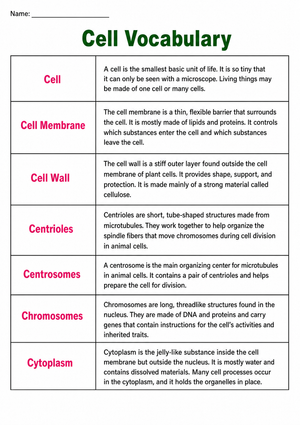
At this grade level, students work with seven core structures: nucleus, cell membrane, cytoplasm, mitochondria, chloroplasts, vacuole, and ribosomes. They should be able to name each one and state its primary job in plain terms — not a technical definition, but a working explanation. The nucleus stores genetic instructions and directs cell activities. Mitochondria release usable energy from food. Chloroplasts carry out photosynthesis in plant cells. That is the depth middle school standards and benchmarks assess, and it is what each worksheet targets.
How do the worksheets handle the plant versus animal cell comparison?
Several worksheets present plant and animal cell diagrams side by side and ask students to identify which structures appear in both, which are plant-only, and which are animal-only. That format pushes students past memorized lists and into pattern recognition. The comparison tasks also surface a core misunderstanding quickly: students who have learned facts about plant cells without grasping why chloroplasts and a cell wall are absent from animal cells reveal that gap the moment they must write an explanation rather than check a box.
Can one of these worksheets serve as a formative assessment?
The function-matching and short-answer sections give you the most diagnostic information. A student who labels the diagram correctly but writes "mitochondria make food" in the short-answer section has given you clear data: they can recognize the structure but have its function confused with chloroplasts. That distinction between identification and understanding is exactly what formative assessment is built to surface, and a well-constructed worksheet does it in under 15 minutes of class time.
Are these worksheets practical for homework without extra teacher support?
Each worksheet in the set includes enough built-in support — labeled reference examples, clear task directions, and pre-indicated organelles on matching tasks — that students can complete them independently at home. For written-response sections, having class notes nearby makes the task more productive. The full 8th grade cell organelles worksheets set works especially well for homework when the labeling worksheet follows classroom instruction and the short-answer portion is assigned the next day, giving students time to consolidate understanding before writing.