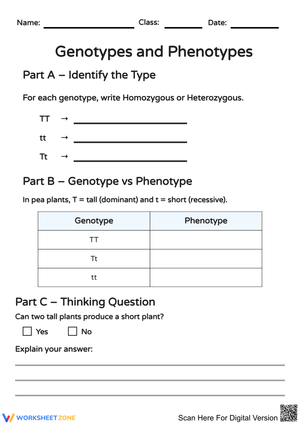
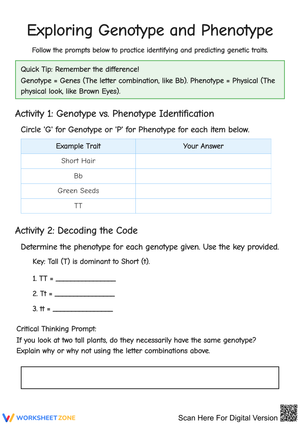
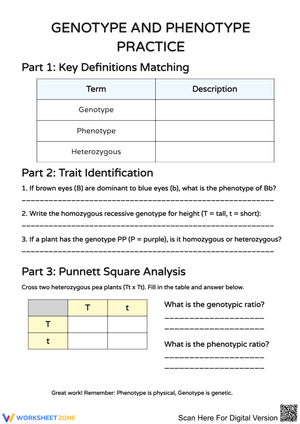
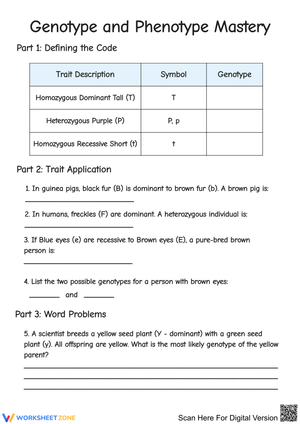
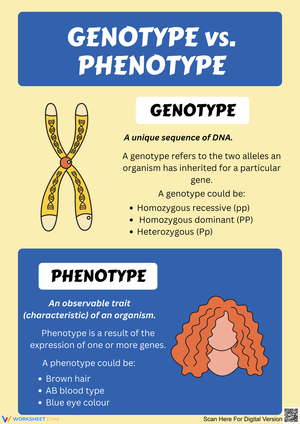
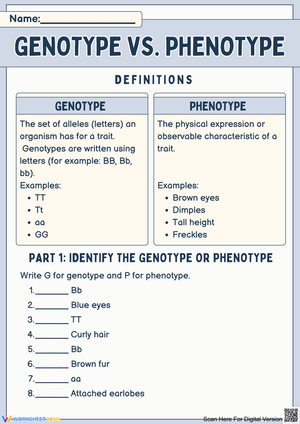
These genotype and phenotype worksheets for 8th grade give students the repeated, structured practice that heredity vocabulary actually requires — not a single definition exercise, but a set of progressively demanding tasks that move from classification to explanation. Each worksheet is a standalone download teachers can slot into whichever part of a unit needs reinforcement.
What's Inside the Set
The core work across these worksheets is sorting and applying — not just copying definitions. Students match allele combinations to observable trait expressions, distinguish inherited characteristics from traits shaped by environment, annotate short passages to identify genotype evidence versus phenotype evidence, and work through basic Punnett square crosses to name both the resulting genotype and what that genotype would look like in an organism. Several worksheets include error-analysis items: students read a deliberately wrong statement — something like labeling "Bb" as a phenotype or calling "brown eyes" a genotype — and rewrite it correctly in science language. That format catches a specific kind of confusion that multiple-choice items often miss.
Constructed-response prompts appear throughout, usually asking for one to three sentences. Even a short explanation like "The genotype is Tt because the organism inherited one dominant and one recessive allele, and the phenotype is tall because the dominant allele is expressed" shows whether a student understands the relationship or has only memorized the labels.
Standard Alignment
These worksheets align to NGSS MS-LS3-1, which asks students to develop and use a model to describe why structural changes to genes — located on chromosomes — may affect proteins and may result in harmful, beneficial, or neutral effects to the structure and function of the organism. At 8th grade, that standard is typically introduced through the genotype-phenotype relationship before instruction moves toward protein synthesis or mutation. These worksheets address the conceptual entry point: establishing that genetic information (genotype) has a direct but not always simple relationship to observable traits (phenotype), and that environmental factors can further shape what is expressed. Teachers who use these as unit introduction materials are building exactly the vocabulary foundation MS-LS3-1 requires before the more mechanistic genetics instruction begins.
Fitting These Worksheets Into Your Lesson Plans
The most efficient use of a single worksheet is as a follow-up to a 10-minute direct instruction opener. Introduce one trait — something familiar like tongue rolling or earlobe attachment — and model exactly how to move from the allele combination to the observable characteristic. Then release students to the worksheet with the instruction to underline any letter combination they see (marking it as genotype territory) before writing an answer. That annotation step alone reduces random switching between categories.
For station rotations, two or three of these worksheets work well at a genetics station alongside a Punnett square manipulative or a trait-card sorting activity. The worksheets are written so students can work independently without additional oral explanation, which matters during the 12-15 minutes most stations actually run. Teachers report using the error-analysis worksheet as a whole-class exit ticket — projecting the same item the class struggled with and working through the correction together in the last five minutes of the period.
The set also fills the Monday-after-a-test gap cleanly. One review worksheet, no setup required, reactivates heredity vocabulary before the unit moves into more complex inheritance patterns like incomplete dominance or codominance.
Mistakes Students Make That These Worksheets Help You Catch
Beyond the category-switching error described above, two other patterns surface regularly. First, students treat "phenotype" as synonymous with "appearance" in a purely cosmetic sense — they'll correctly label eye color as a phenotype but classify blood type as a genotype because it's "invisible." The worksheets include blood type, disease resistance, and enzyme function as phenotype examples precisely to break that assumption.
Second, students who are introduced to heterozygous and homozygous terminology too quickly will use those words as substitutes for phenotype description. They'll write "heterozygous" where the prompt asks for the observable trait. The short-response items in this set ask students to name both the genotype and the phenotype in separate sentences for the same organism, which makes that substitution error visible immediately.
Adjusting the Worksheets Across Ability Levels
For students who struggle with abstract letter notation, the vocabulary-matching and sorting worksheets work as pre-teaching tools before any Punnett square work begins. Running just those two tasks gives students a working mental model of the distinction before the letter-based genetics layer is added.
Students who are ready for more can use the constructed-response items as springboards. Ask them to write a second sentence explaining why two organisms with different genotypes — say, TT and Tt — can share the same phenotype. That question requires genuine understanding of dominant allele expression and gives advanced students something to reason through rather than simply classify.
For intervention groups, consider assigning the error-analysis worksheet first, before any classification tasks. Students who have already been taught the terms but are still mixing them up often respond better to correction tasks than to re-reading definitions. Identifying and fixing a wrong statement is a more active form of processing than re-matching vocabulary they technically already know.
Frequently Asked Questions
Do these worksheets require any prior genetics knowledge, or are they designed as a first introduction?
Several worksheets in the set work as first-exposure materials — they define vocabulary through examples rather than assuming students already know the terms. Others are structured as reinforcement and review, with reduced scaffolding and more independent application. Teachers can sequence them accordingly or use the introductory worksheets for initial instruction and the application worksheets for assessment or homework.
How much class time does a typical worksheet take?
Sorting and vocabulary worksheets generally run 10 to 15 minutes for most 8th graders. Worksheets that include Punnett square items and constructed-response questions take 20 to 25 minutes. The error-analysis format tends to run shorter because students are correcting existing statements rather than generating answers from scratch — though the discussion afterward can extend the time if teachers use it for whole-class review.
Can these be used for students who have already learned Punnett squares but are still unclear on terminology?
Yes, and that's a common use case. Students who can complete a Punnett square mechanically often cannot explain what the resulting genotypes mean in terms of observable traits. The constructed-response and error-analysis worksheets address exactly that gap — they ask for language and reasoning, not calculation.