




























Views
Downloads

Diffusion and Osmosis Worksheet | Grade 7-9 Essential

Paste this activity's link or code into your existing LMS (Google Classroom, Canvas, Teams, Schoology, Moodle, etc.).
Students can open and work on the activity right away, with no student login required.
You'll still be able to track student progress and results from your teacher account.
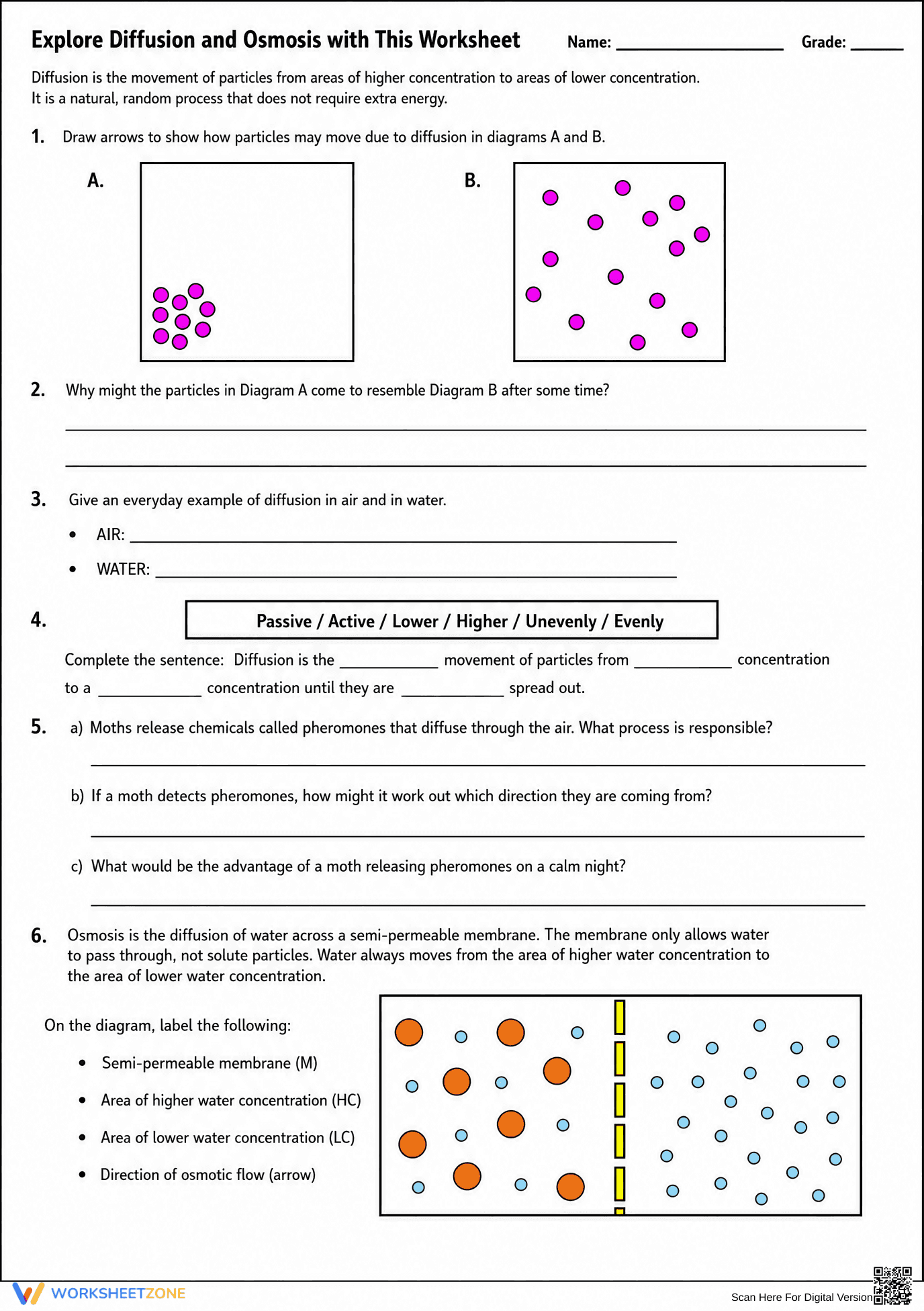
This Grade 7-9 science worksheet provides a comprehensive introduction to passive transport through diffusion and osmosis. Students analyze particle movement, apply concepts to biological scenarios like pheromone dispersal, and label complex diagrams. It ensures learners grasp how substances move across membranes to maintain cellular equilibrium.
At a Glance
- Grade: 7-9 · Subject: Biology
- Standard:
MS-LS1-2— Model how cell parts contribute to function through substance transport- Skill Focus: Passive Transport Mechanisms
- Format: 1 page · 10 tasks · Answer key included · PDF
- Best For: Middle school life science introduction
- Time: 20–30 minutes
This single-page PDF features six structured sections, including visual particle models, short-answer application questions, and a vocabulary-building word bank. It includes a detailed diagram of a semi-permeable membrane for osmosis labeling and a unique section on moth pheromones to illustrate diffusion in nature. A full answer key is provided for quick grading and immediate student feedback.
This resource is designed for a zero-prep classroom experience. Teachers can print the single-page PDF in under 1 minute. Distribution takes seconds, and the self-explanatory diagrams allow students to work independently. Reviewing the 10 tasks as a whole class takes approximately 5 minutes, making it an ideal sub plan or warm-up for a biology unit.
The worksheet aligns with `MS-LS1-2`, requiring students to develop and use a model to describe the function of a cell and how parts contribute to that function. By modeling the movement of water and solutes, students demonstrate understanding of membrane permeability and concentration gradients. Both standard codes can be copied directly into lesson plans, IEP goals, or district curriculum mapping tools.
Use this worksheet during the "Explain" phase of a 5E lesson cycle after a brief demonstration of food coloring in water. It serves as an excellent formative assessment to check for misconceptions about concentration gradients. Expect students to complete the labeling and application questions within 25 minutes during independent practice or as a homework assignment.
This resource is tailored for middle school life science students and early high school biology learners. It provides scaffolding for English Language Learners through the included word bank and visual diagrams. Pair this with a microscope lab observing onion cells in salt water for a complete lesson on cellular transport and homeostasis.
According to the RAND AIRS 2024 report, high-quality science materials must integrate visual modeling with conceptual application to improve long-term retention of abstract biological processes. This worksheet addresses the MS-LS1-2 standard by requiring students to translate abstract definitions of diffusion and osmosis into concrete diagrammatic representations. Research from Fisher & Frey (2014) emphasizes that "gradual release" in science instruction is most effective when students are provided with structured scaffolds, such as the word banks and guided labeling tasks found in this 10-problem set. By connecting microscopic particle movement to macroscopic examples like moth pheromones, the resource helps students build a mental model of passive transport that persists beyond the initial lesson. This alignment ensures that 100% of the tasks directly support mastery of cellular transport mechanisms and membrane function.


