These nervous system printable worksheets for 8th grade give life science teachers a structured set of resources that moves students from basic identification toward the functional reasoning middle school assessments require. The set addresses neuron structure, signal pathways, the central and peripheral nervous system, and reflex arcs — the content clusters where student gaps most often appear before a unit test.
The Specific Content Each Worksheet Targets
At this grade level, students are expected to explain what nervous system structures do, not just recognize their names on a diagram. Each worksheet addresses one of four content areas:
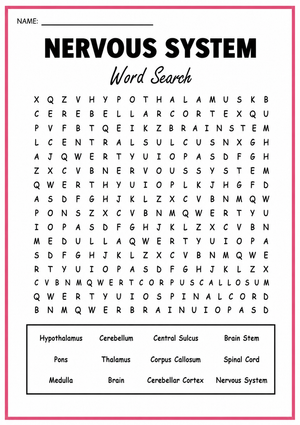
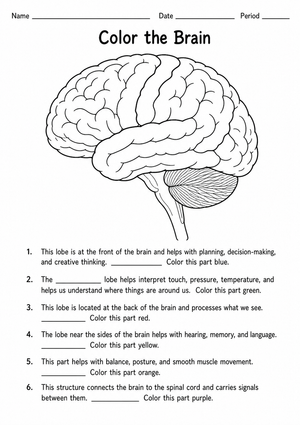
- Brain regions and functions: cerebrum, cerebellum, and brain stem, with written tasks that ask students to connect each region to a specific body function
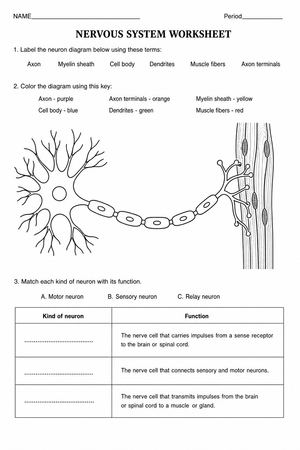
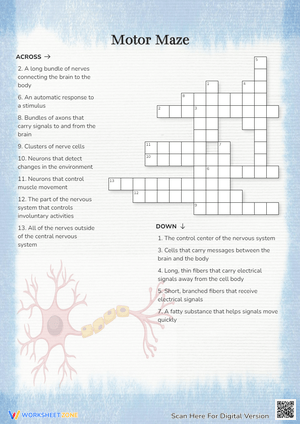
- Neuron structure and signal transmission: dendrites, axon, cell body, and myelin sheath, paired with arrow-direction tasks that trace how an impulse travels from one neuron to the next
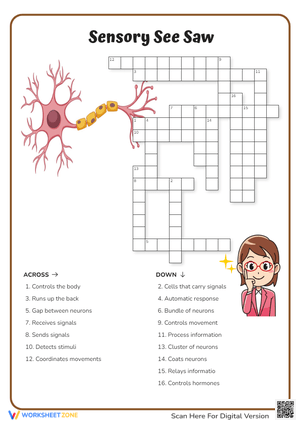
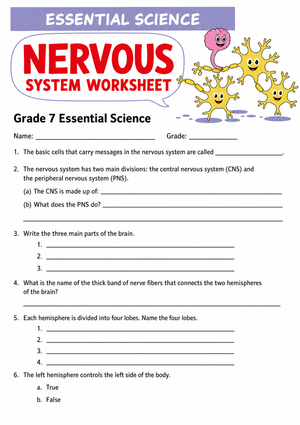
- Central vs. peripheral nervous system: sorting, labeling, and compare-and-contrast tasks that require students to place each organ or nerve into the correct division and explain the placement
- Reflex pathways and sensory responses: step-by-step reflex arc diagrams with explanation questions about why the spinal cord, not the brain, handles automatic responses
When teachers search for nervous system printable worksheets for 8th grade, labeling tasks are the easiest to find — but labeling alone rarely reveals whether a student understands function or matched a term to a shape by memory. Pairing each diagram with one sentence of functional explanation raises the cognitive demand without adding significant time to the task, and that explanation step is exactly where genuine understanding — or its absence — first becomes visible on paper.
Errors That Surface in Student Work Before the Test
The most persistent misconception at this level is placing the spinal cord in the peripheral nervous system. Students who have encountered "spinal cord" in casual contexts tend to group it with "nerves" — things they imagine existing outside the brain. That classification error stays hidden until a sorting task makes it concrete. A two-column chart where students classify each structure as central or peripheral exposes this before the test, when reteaching is still possible.
A second pattern involves confusing location with function. Students can accurately point to the cerebellum on a diagram and still write "controls thinking" in the function column because the shorthand "brain = thinking" overrides the specifics. The cerebrum handles higher-order cognition; the cerebellum manages coordination and balance. One worksheet that asks students to match concrete everyday tasks — "lets you stay upright when you trip," "helps you solve a word problem" — to the correct brain region does more to correct this than restating the distinction during lecture.
Neuron labeling produces a third cluster of mistakes. Students frequently swap the dendrite and axon labels, but the more telling error is leaving the myelin sheath completely blank even after direct instruction. The myelin sheath is harder to anchor to a visible diagram feature than the cell body is, so it fades faster. Adding an arrow task alongside the labeling — draw the signal direction from dendrite through cell body to axon tip — helps the structure and function stay connected in a way that the label alone does not achieve.
Building These Worksheets Into the Unit Without Losing Instructional Time
The labeling and vocabulary worksheets belong early, before students have met the content in formal terms. Dropping one at the start of the unit — even as a five-minute warm-up — surfaces whatever prior knowledge students carry from earlier body system work without frontloading so many new terms that they shut down. The central-versus-peripheral compare-and-contrast worksheet lands better on day three or four, after at least one direct instruction session on each division.
The reflex arc worksheet has a natural home right after a class demonstration — the moment students watch their own knee respond before they can stop it. Students in that state are far more ready to trace a signal through a diagram than they were twenty minutes earlier. That worksheet asks students to label each stop in the arc and write one sentence explaining why the spinal cord handles the reflex rather than waiting for the brain. The explanation step reveals clearly whether students understand the arc or have only memorized label positions.
For nervous system printable worksheets for 8th grade to work reliably as sub plans, the directions need to be self-contained and the diagrams need to be annotated clearly enough for a student to orient independently. A worksheet that opens with a labeled reference diagram and ends with three or four short-answer questions covers both. Students who missed a key lesson can complete it without a teacher present, and the finished worksheet tells you quickly where gaps remain when they return.
Standard Alignment
These worksheets align with NGSS MS-LS1-3, which asks middle school students to use evidence to explain how the body operates as a system of interacting subsystems made up of specialized cells. The nervous system is one of the clearest contexts for that standard: neurons are specialized cells, the CNS and PNS are distinct subsystems, and any coordinated response depends on interaction across both. Students working toward MS-LS1-3 need to articulate the logic of that interaction — not just identify components — and the short explanation tasks in this set are written to that expectation.
This standard typically appears in the third quarter of 8th grade, after cell biology and before genetics. That placement matters developmentally. Students at this point in the K–8 life science progression have enough system-level thinking to move from "neurons are cells" to "neurons transmit signals because of how they're structured" — which is the shift MS-LS1-3 actually requires. Students who worked through cell specialization earlier in the year can connect neuron structure to that prior knowledge, which reduces the time needed on cell-level review and leaves more room for the reasoning the standard demands.
Adjusting the Set for Different Learners in the Same Room
For students still building science vocabulary, the diagram-first tasks offer an accessible entry point before any reading-heavy content is introduced. A student who struggles with academic English can correctly label a neuron diagram through visual recognition and then attempt the function sentence with a word bank in hand. Removing the word bank for students who are ready for a higher challenge shifts the same task upward without requiring a separate resource.
Students who move through core tasks quickly benefit from extension questions that require cross-structure reasoning: what happens to voluntary movement if the cerebellum is damaged? How does the reflex arc protect the body in situations where sending a signal all the way to the brain would take too long? Those questions push MS-LS1-3 thinking past identification and into analysis without adding new vocabulary demands. One honest limitation: the written-response tasks will frustrate students who are significantly behind in written language production without sentence-frame support — the visual tasks remain accessible, but the explanation sections need that adjustment to give those students a workable entry point.
Frequently Asked Questions
Can individual worksheets be used out of sequence, or do they need to follow a specific order?
Each worksheet stands alone — there is no assumed prior completion of another worksheet in the set. That said, introducing the central-versus-peripheral sorting worksheet before the reflex arc worksheet tends to produce stronger student explanations on the reflex page, because students already have the CNS/PNS framework in place when they need it.
How much class time does each worksheet typically require?
Most are structured for 10 to 15 minutes of focused independent work. The reflex arc and neuron structure worksheets run closer to 15 minutes because the explanation steps take longer than straight labeling. If time is tight, the diagram portion works as the in-class task and the written explanation can shift to homework without losing coherence.
Are these resources useful for reteaching after a quiz?
Using nervous system printable worksheets for 8th grade as targeted reteaching tools — one at a time, matched to a specific gap — produces faster correction than re-teaching the full unit. If quiz data shows most errors centered on the central-versus-peripheral distinction, assign that worksheet specifically rather than re-covering everything. Students who already understand neuron structure do not need to sit through it again.
Do these worksheets work for students who missed the nervous system lesson?
They work well as independent make-up resources when directions are self-contained and diagrams are annotated clearly enough for a student to read without a teacher present. A worksheet that pairs a fully labeled example with a blank practice version gives absent students a reference to work from, which keeps the task productive rather than a guessing exercise.












 Interactive Worksheet Maker
 Quiz Maker
 Word Search Maker
 Crossword Puzzle Maker
 Word Scramble Generator
 Sentence Scramble Generator
 Handwriting Worksheet Generator
 Name Tracing Generator
 Fill In The Blank Generator