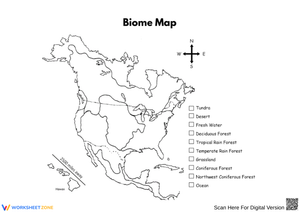
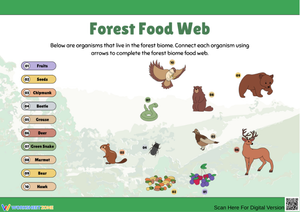
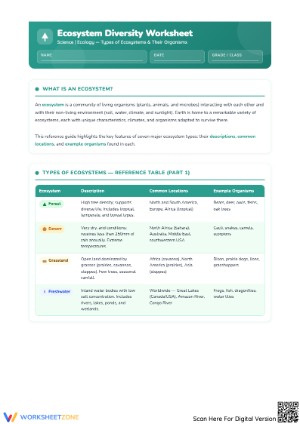
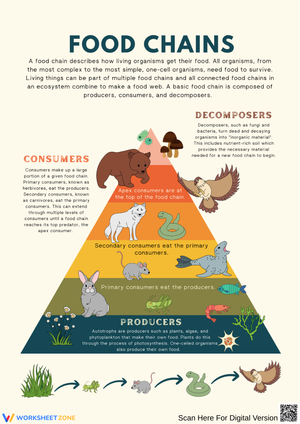
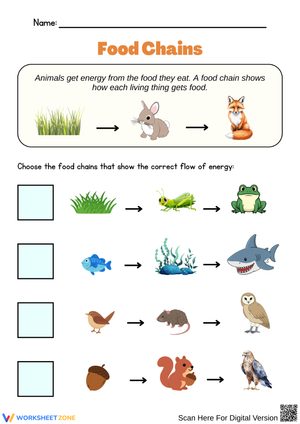
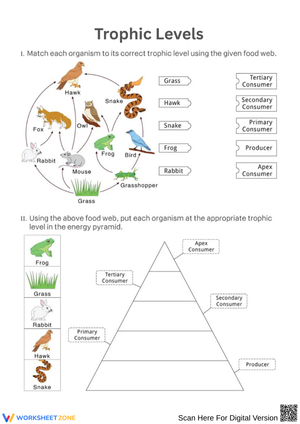
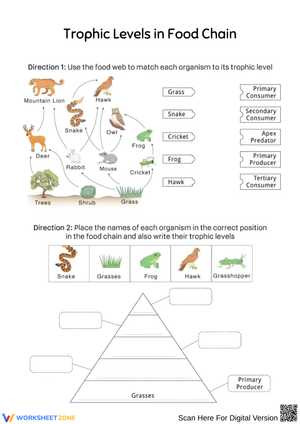
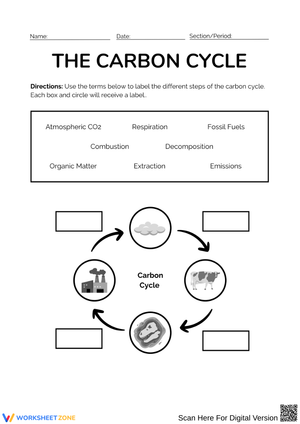
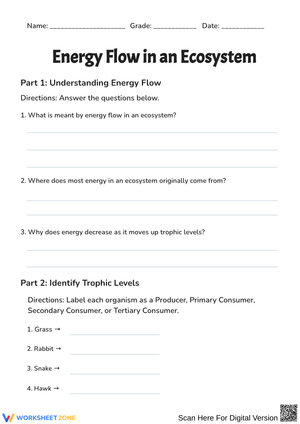
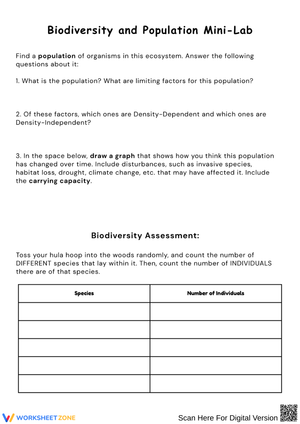
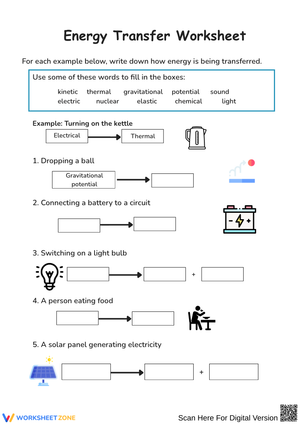
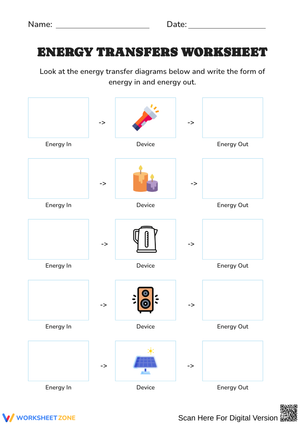
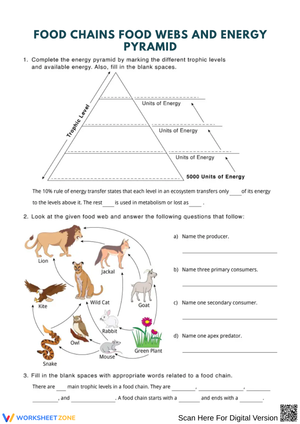
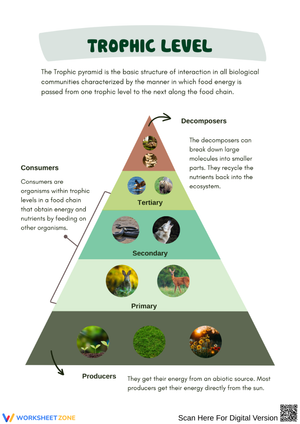
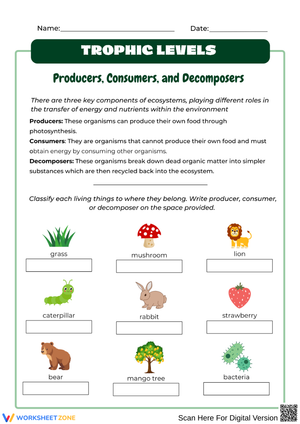
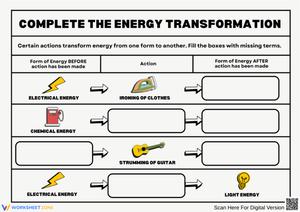
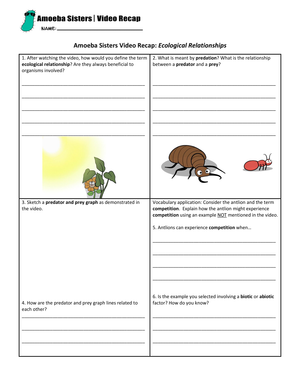
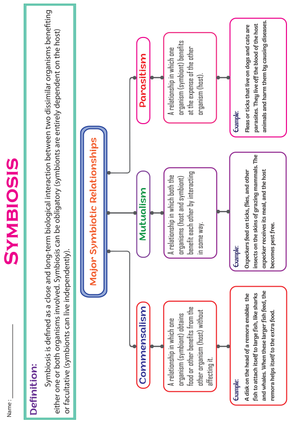
These 8th grade ecosystem worksheets resources give middle school science teachers a set of printable materials built around the four tasks that anchor Grade 8 life science instruction: sorting biotic and abiotic factors, modeling feeding relationships, tracking energy transfer, and analyzing how a population responds when something in its ecosystem changes. Each worksheet addresses one of those tasks directly, which keeps the material focused and makes student errors easier to read at a glance.
What the Set Covers and How the Work Is Sequenced
The resources move from identification toward explanation, following the same arc that most Grade 8 units progress through. Students begin by classifying organism roles and sorting environmental conditions, then diagram and extend food chains into full food webs, and eventually reason through cause-and-effect chains involving population shifts and resource limits. That progression is intentional — recognition tasks early in the set establish shared vocabulary; the later worksheets use that vocabulary to ask students to predict and explain.
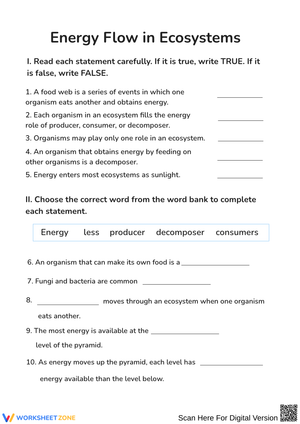
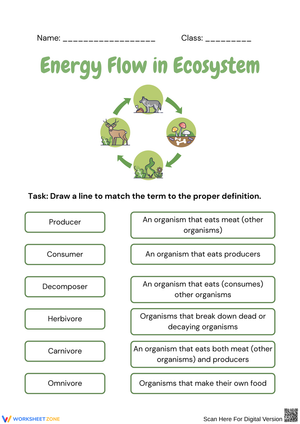
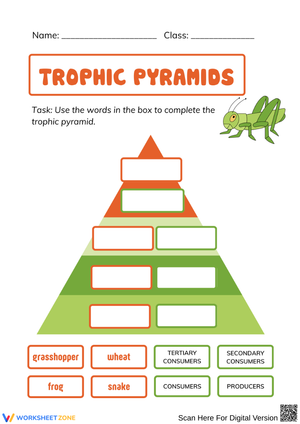
- Classifying producers, consumers, and decomposers in given ecosystems
- Sorting biotic factors from abiotic factors with specific examples drawn from familiar environments
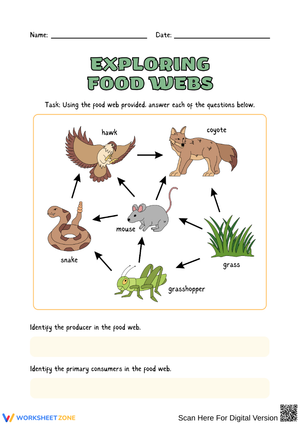
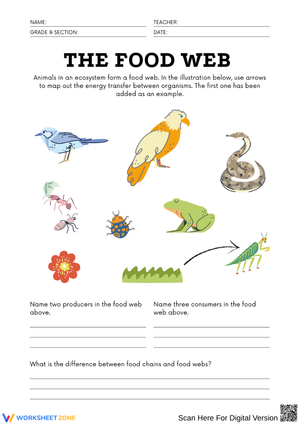
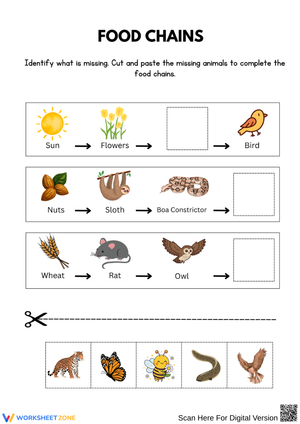
- Reading food chains and building them into multi-level food webs with correct arrow direction
- Predicting population changes when a predator declines, a prey species increases, or a resource is removed
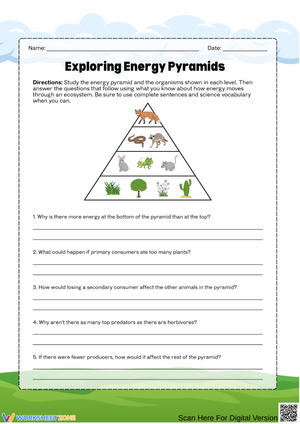
- Writing short evidence-based explanations about competition, carrying capacity, and limiting factors
The short-response tasks in the later worksheets are where you learn the most about student understanding. A student who genuinely grasps interdependence will trace two or three connected effects in an answer; a student who only recalls definitions will write one flat sentence. That difference is hard to detect from a multiple-choice score, but it shows up immediately in written work.
Student Errors Worth Anticipating Before You Hand These Out
The food web arrow direction error is the most common and the most instructive. Students draw arrows pointing from prey to predator — they read the arrow as showing who eats whom rather than where energy travels. You will see this on nearly every first attempt. A quick convention reminder before distributing the food web worksheet, paired with a small note in the corner that reads "arrows follow the energy," reduces the error rate on the first pass, though you will still need to catch and correct it for several students during independent work.
Abiotic factor identification produces a different but equally predictable mistake: students classify sunlight as biotic because they associate it with plant growth and life. That conflation is worth a direct two-minute discussion before the sorting worksheet — the cell-based definition of living things rules out sunlight, water, and temperature. Two minutes spent on that distinction saves a full round of re-teaching afterward.
Population scenario tasks surface a third pattern. When students read that a hawk population has declined, most conclude the rabbit population will increase — and stop there. They miss the downstream consequence: more rabbits eventually strain the plant population, which then limits rabbit numbers in turn. The short-response format on these worksheets exposes that incomplete reasoning because a one-step answer does not satisfy the prompt.
Standard Alignment
These 8th grade ecosystem worksheets materials connect most directly to MS-LS2-2, which asks students to construct an explanation about how predation, competition, and cooperation affect population dynamics, and to MS-LS2-3, which calls for developing models that describe cycles of matter and energy flow in ecosystems. Both performance expectations require students to work with relationships and processes — not definitions in isolation. The explanation and prediction tasks in this set practice exactly the type of reasoning those standards demand. Teachers using these resources alongside unit assessments will find that the short-response prompts parallel the style of questions that MS-LS2 assessments typically require, making the set useful for both instructional practice and pre-assessment review.
Where These Worksheets Fit in Your Planning Week
The most reliable placement is after direct instruction, not before it. Assigning a food web worksheet as a cold bell ringer on day one of the unit, before any model has been shown, produces stalled students and a room full of incorrectly drawn arrows. A two-minute think-aloud projected on the document camera — tracing one predator-prey relationship before releasing students to work independently — consistently produces better outcomes than sending students straight to the worksheet without a reference point.
For station rotations, the different worksheets map cleanly onto different levels of complexity. One station handles vocabulary and organism role sorting, another focuses on food web diagramming, and a third uses the population scenario prompts. That setup lets you pull a small group for reteaching while other students stay on task, without requiring you to write entirely separate materials for each group.
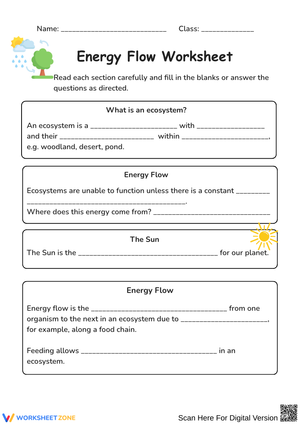
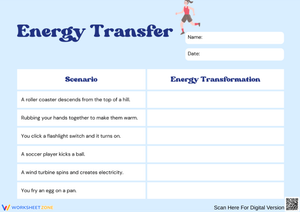
- Bell ringer following whole-group instruction on feeding relationships or energy transfer
- Station task sorted by concept: vocabulary, diagram, or written explanation
- Exit ticket collected at the end of a period to identify students who need intervention before the next class
- Substitute lesson plan organized in sequence, requiring no additional preparation or verbal instructions
- Spiral review check, run two weeks after initial instruction to assess retention of systems thinking
That last use — spiral review — matters more than it tends to get credit for. Ecosystem vocabulary sticks longer in student memory than ecosystem reasoning does. Running a population scenario worksheet ten days after the initial lesson tells you whether students can still trace a multi-step cause-and-effect chain or whether they have dropped back to single-variable thinking. That information shapes the next unit's pacing in a way that chapter test scores rarely do.
Adapting the Resources Across a Range of Student Readiness Levels
Students who need additional support do better on the food web tasks when they can reference a completed vocabulary worksheet while working. Allowing that reference removes the need to hold all terminology in working memory simultaneously and lets students focus on the relational reasoning the task actually targets. Another option is to pre-fill the producer and apex predator positions on the food web before distributing it, converting the task from full construction to guided completion.
Students ready for additional challenge benefit from extending the population scenario tasks: after writing their cause-and-effect explanation, they redraw the food web to reflect the changes they described. That two-part requirement — written chain of effects plus updated diagram — demands both verbal and visual reasoning, and the two representations together frequently reveal gaps that neither alone would surface. Even in advanced sections where ecosystem basics are already familiar, 8th grade ecosystem worksheets tasks can be modified by substituting a real-world ecosystem the class has studied for the generic scenario, asking students to apply the same analytical frame to a context they have examined in depth.
Frequently Asked Questions
What background knowledge do students need before the worksheets will be productive?
Students should know the core vocabulary — ecosystem, organism, population, community, producer, consumer, decomposer — and be able to read a simple food chain before the food web tasks. Without those foundations in place, the food web and scenario worksheets produce confusion rather than useful struggle. A short vocabulary warm-up or a completed reference sheet before the first session prevents most of the derailment that happens in the opening ten minutes when students are guessing at terms.
Can these be used for formative assessment, or are they better suited for review?
Either, depending on placement. A sorting worksheet used early in a unit gives immediate diagnostic information — which students already understand organism roles and which need another round of instruction. The same worksheet used in a review week becomes a retrieval check. The short-response prompts work especially well as formative checkpoints because the written answer reveals reasoning, not just whether a student guessed correctly on a multiple-choice item.
How do these materials work for students with IEP or 504 accommodations?
The focused format of each worksheet — one concept per task — makes accommodation manageable. Teachers can reduce the number of items, allow extended time on explanation tasks, or pair a student with a reading support partner for the scenario sections. The 8th grade ecosystem worksheets set does not assume a uniform reading level across every task, but the scenario prompts do require grade-level reading comprehension, so that is worth checking against individual student plans before assigning those worksheets for independent completion.












 Interactive Worksheet Maker
 Quiz Maker
 Word Search Maker
 Crossword Puzzle Maker
 Word Scramble Generator
 Sentence Scramble Generator
 Handwriting Worksheet Generator
 Name Tracing Generator
 Fill In The Blank Generator