These 8th grade circulatory system printable worksheets give life science teachers a focused, print-and-use set built around the skills students need before any body systems assessment — labeling the heart, sequencing blood flow, distinguishing vessel types, and explaining the circulatory-respiratory connection. Each worksheet targets a distinct layer of understanding, which means teachers can assign them at different instructional moments rather than saving everything for end-of-unit review.
The Specific Concepts Students Work Through
The set moves students from identification toward explanation. That progression matters at Grade 8 because labeling the four heart chambers is a different cognitive task from tracing why oxygen-poor blood travels to the lungs before the left side of the heart sends it out to the body. Both tasks show up on assessments, and students who have practiced only one type are often caught off guard by the other.
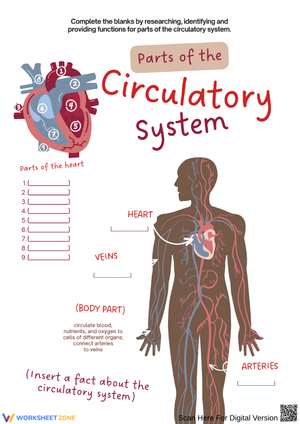
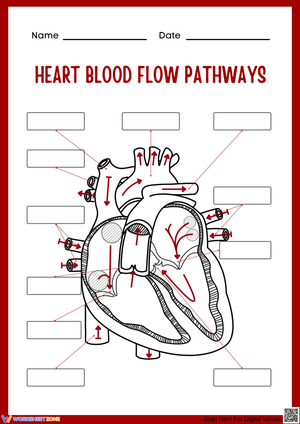
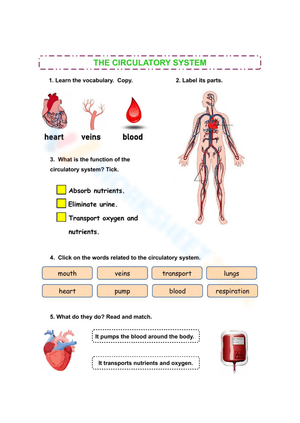
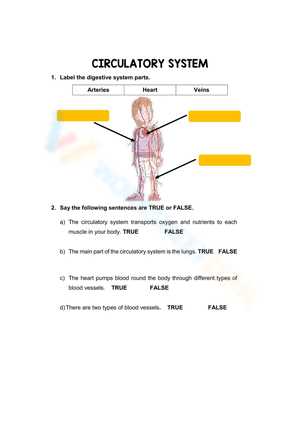
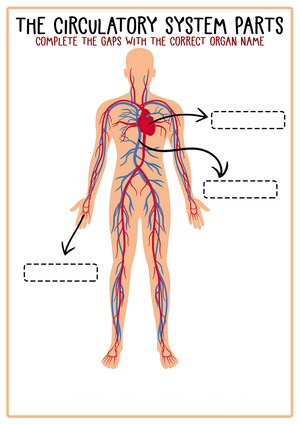
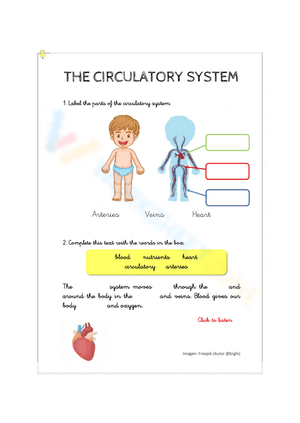
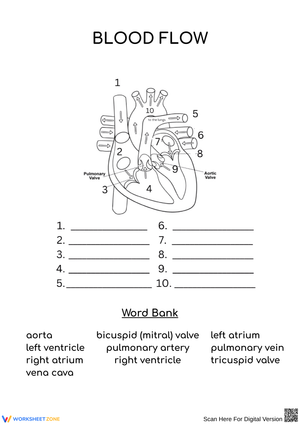
- Identifying the four chambers, valves, and major vessels on a heart diagram
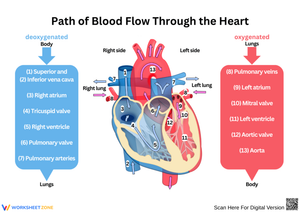
- Sequencing the full blood-flow pathway through both the pulmonary and systemic circuits
- Distinguishing arteries, veins, and capillaries by wall structure and directional function
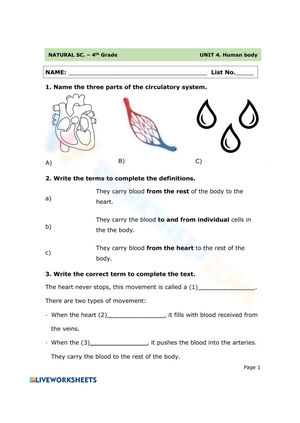
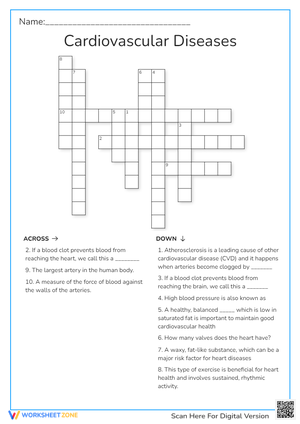
- Matching blood components — plasma, red blood cells, platelets, hemoglobin — to their specific transport roles
- Explaining how gas exchange at the capillary level connects the circulatory and respiratory systems
- Interpreting a labeled diagram to explain why a structure or pathway matters, not just what it is called
That last skill is where Grade 8 instruction often stalls. Students can describe the heart as a pump in general terms but struggle to explain what happens to blood composition between leaving the left ventricle and returning to the right atrium. Getting that conversation into the middle of the unit — not just the review day — is where these worksheets earn their place.
Student Errors That Come Up Reliably in This Unit
The most persistent confusion is about which side of the heart handles which type of blood. A student will correctly label the right and left ventricles, then draw blood flowing from the right side directly to the body — skipping the lungs entirely. The vocabulary is in place, but the two-circuit structure is not. A blood-flow sequencing worksheet that asks students to mark whether blood is oxygen-rich or oxygen-poor at each step makes that error visible in the first ten minutes of a lesson, well before the test.
Blood vessel misconceptions are almost as predictable. Students learn "arteries carry blood away from the heart" as a rule and apply it without exceptions. When shown the pulmonary artery on a diagram, many will mark it as carrying oxygen-rich blood because arteries always do — missing that the pulmonary artery is the case that breaks the rule, carrying oxygen-poor blood toward the lungs. Worksheets that ask students to annotate vessels with both direction and oxygen content address this directly, before it becomes a test-day surprise.
Lesson-Planning Notes for Getting the Most From This Set
Labeling worksheets work well at the start of a body systems sequence, when students need to build a mental map of the heart before discussing what moves through it. Sequence worksheets belong in the middle of the unit, after students have seen the full circuit in a diagram or model but before they explain it independently. Short-answer worksheets fit near the end, when students should be producing precise sentences about why a structure or pathway matters — not just naming it.
These 8th grade circulatory system printable worksheets hold up equally well in the ten minutes before a pulse-rate lab, when students need a focused content anchor before moving to hands-on work. That short window is easy to fill with a heart-labeling task or a vocabulary-matching exercise — something with a clear stopping point that does not require teachers to interrupt mid-thought to transition.
A reliable small-group move: after a quick formative check shows that several students are collapsing the pulmonary and systemic circuits into one loop, pull that group for ten minutes with one sequence worksheet and work through it aloud. The worksheet gives the group a concrete task to anchor the conversation, and the written record shows immediately where the pathway breaks down for each student.
Standard Alignment
MS-LS1-3 — From Molecules to Organisms: Structures and Processes — asks students to use argument supported by evidence for how the body is a system of interacting subsystems composed of groups of cells. For the circulatory system, that means instruction cannot stop at part identification. Students must explain how the heart, blood vessels, and blood work with the respiratory system to move oxygen and remove waste. A labeling-only worksheet addresses almost none of this standard. A worksheet that pairs diagram interpretation with written explanation of system interaction addresses most of it. That distinction should drive which worksheet types teachers reach for at which point in the unit.
Differentiating These Worksheets Across Ability Levels
On labeling worksheets, providing a word bank lowers the retrieval demand and lets students focus on placing structures correctly. Removing the word bank raises the demand without changing the task format. On diagram worksheets, teachers can ask advanced students to add annotations explaining the function of each labeled structure — turning a recognition task into an explanation task with no additional prep.
These 8th grade circulatory system printable worksheets work well in tiered partner tasks. One student traces the full blood-flow pathway in writing while a partner who needs more support follows a partially completed pathway and fills in the missing steps. Both students are working on the same concept at a level that reflects where they actually are. Pairing students for an oral comparison step — each student explains one answer aloud — keeps the cognitive work active for both and surfaces disagreements worth discussing.
Frequently Asked Questions
What specific skills should students practice in circulatory system worksheets at Grade 8?
Students should practice heart anatomy labeling, blood-flow sequencing through both the pulmonary and systemic circuits, blood vessel identification by type and function, core vocabulary matching, and written explanation of system interactions. The sequencing task is the most revealing — it shows whether students understand the pathway as a process or have only memorized isolated terms.
How do these worksheets function as formative assessment tools?
Adding one written explanation prompt to any worksheet — "describe the path blood takes from the right ventricle in four steps" — turns it into a formative check. What students write shows whether the confusion is about vocabulary, pathway order, or system interaction, which tells the teacher exactly what to address before moving on.
What topics belong in a Grade 8 circulatory system unit?
A solid unit covers heart anatomy, the distinction between pulmonary and systemic circulation, blood vessel types and their functions, blood components and their transport roles, and the connection to the respiratory system through gas exchange. Students who leave Grade 8 without a clear picture of the two-circuit structure tend to carry that gap into high school biology, where more complex physiology builds on it.
How does this set connect to the body systems standard MS-LS1-3?
The standard asks students to construct arguments, with evidence, that the body is a system of interacting subsystems. These 8th grade circulatory system printable worksheets address that demand directly by asking students to trace blood movement, annotate diagrams with function, and explain how the circulatory and respiratory systems depend on each other — not just name the parts of each.












 Interactive Worksheet Maker
 Quiz Maker
 Word Search Maker
 Crossword Puzzle Maker
 Word Scramble Generator
 Sentence Scramble Generator
 Handwriting Worksheet Generator
 Name Tracing Generator
 Fill In The Blank Generator