


























Views
Downloads

Diffusion and Osmosis Worksheet | Grade 7-9 Essential
Paste this activity's link or code into your existing LMS (Google Classroom, Canvas, Teams, Schoology, Moodle, etc.).
Students can open and work on the activity right away, with no student login required.
You'll still be able to track student progress and results from your teacher account.
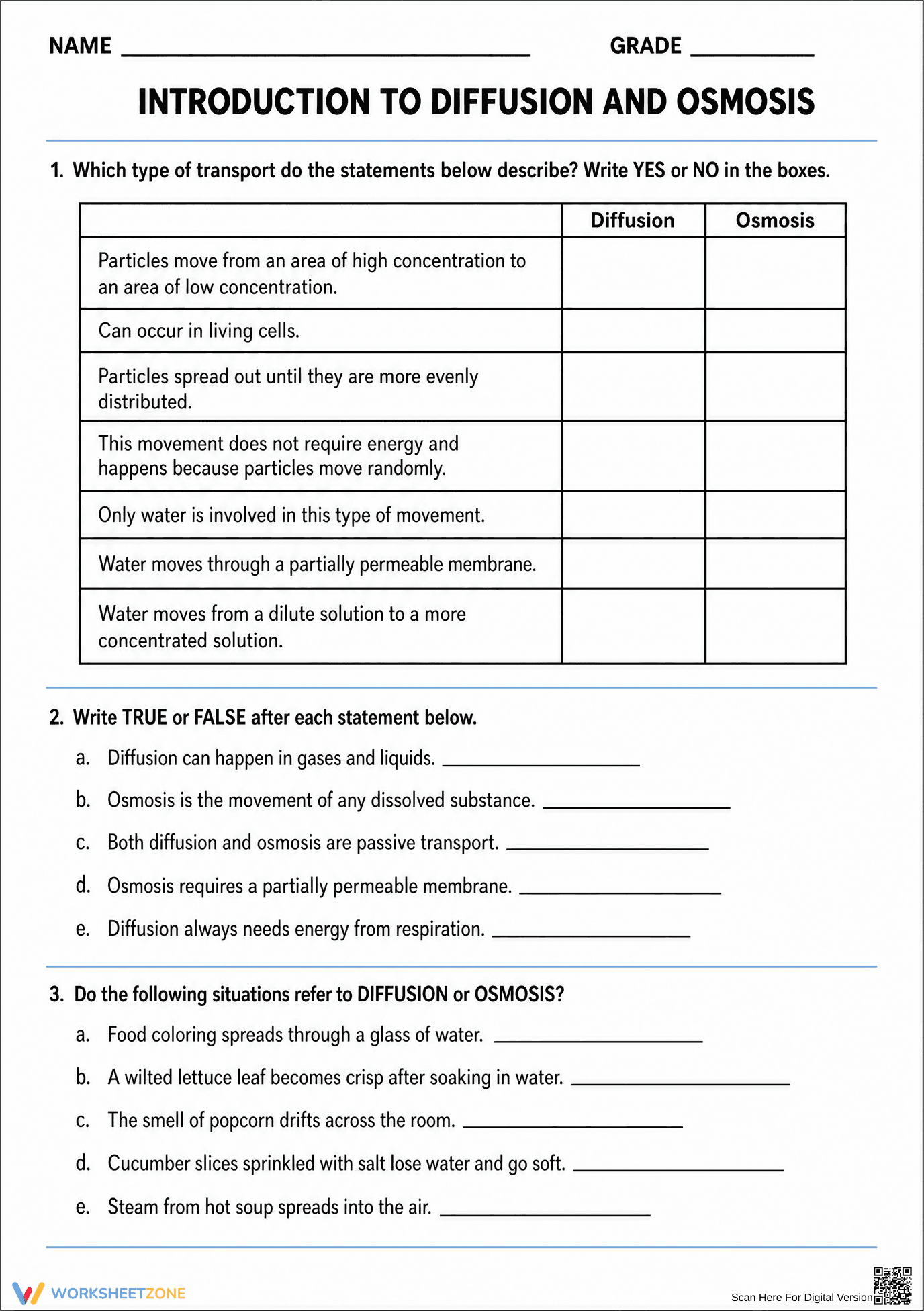
This biology worksheet provides a structured approach to mastering the fundamental concepts of passive transport. Students will differentiate between diffusion and osmosis by analyzing molecular movement, concentration gradients, and membrane permeability. By applying these principles to real-world scenarios, learners develop a concrete understanding of how substances move within biological systems.
At a Glance
- Grade: 7-9 · Subject: Biology
- Standard:
MS-LS1-2— Describe how the parts of cells contribute to the function of the whole- Skill Focus: Passive Transport Mechanisms
- Format: 1 page · 17 problems · Answer key included · PDF
- Best For: Independent practice or formative assessment
- Time: 20–30 minutes
What's Inside
This single-page PDF features 17 targeted questions organized into three distinct sections. It begins with a comparison table requiring students to identify characteristics of diffusion and osmosis. The second section utilizes five true-or-false statements to clarify common misconceptions. Finally, five application-based scenarios challenge students to categorize real-world examples, such as food coloring spreading in water or wilted lettuce becoming crisp.
Zero-Prep Workflow
This resource is designed for immediate classroom implementation with a total teacher prep time of under 2 minutes. Step 1: Print the single-page PDF (1 minute). Step 2: Distribute to students for 20 minutes of focused work. Step 3: Review the 17 answers in under 5 minutes using the provided key. Because the layout is intuitive, it functions perfectly as a sub plan or a quiet independent activity.
Standards Alignment
This worksheet aligns with `MS-LS1-2`, focusing on how cell membranes regulate the movement of materials to maintain homeostasis. By distinguishing between the movement of water and other solutes, students demonstrate an understanding of cellular boundaries. Both standard codes can be copied directly into lesson plans, IEP goals, or district curriculum mapping tools.
How to Use It
Use this worksheet as a formative assessment immediately following a lecture on cellular transport to gauge student comprehension. Alternatively, assign it as a homework task to reinforce the day's lesson. Teachers should observe students during the scenario section to ensure they can identify the specific role of water in osmosis versus general particle movement in diffusion.
Who It's For
This resource is ideal for middle school life science students or high school biology learners requiring a refresher on transport mechanisms. It supports diverse learners through clear categorization tasks and can be paired with a digital simulation or a "naked egg" lab experiment to provide a hands-on connection to the theoretical concepts.
This MS-LS1-2 aligned resource focuses on the critical biological skill of distinguishing between diffusion and osmosis, a foundational concept for understanding cellular homeostasis and systemic physiology. According to the RAND AIRS 2024 report, structured practice that requires students to categorize scientific phenomena—such as the 17 tasks provided here—significantly improves long-term retention of abstract biological processes. By moving from theoretical definitions in the comparison table to practical application in the scenario section, the worksheet follows a scaffolded approach that aligns with the Fisher & Frey (2014) gradual release of responsibility model. This ensures that students not only memorize definitions but also develop the analytical capacity to recognize these processes in nature. The inclusion of a clear answer key facilitates rapid feedback, which is a high-leverage instructional practice identified by EdReports 2024 for improving student outcomes in secondary science education.


