


























Views
Downloads
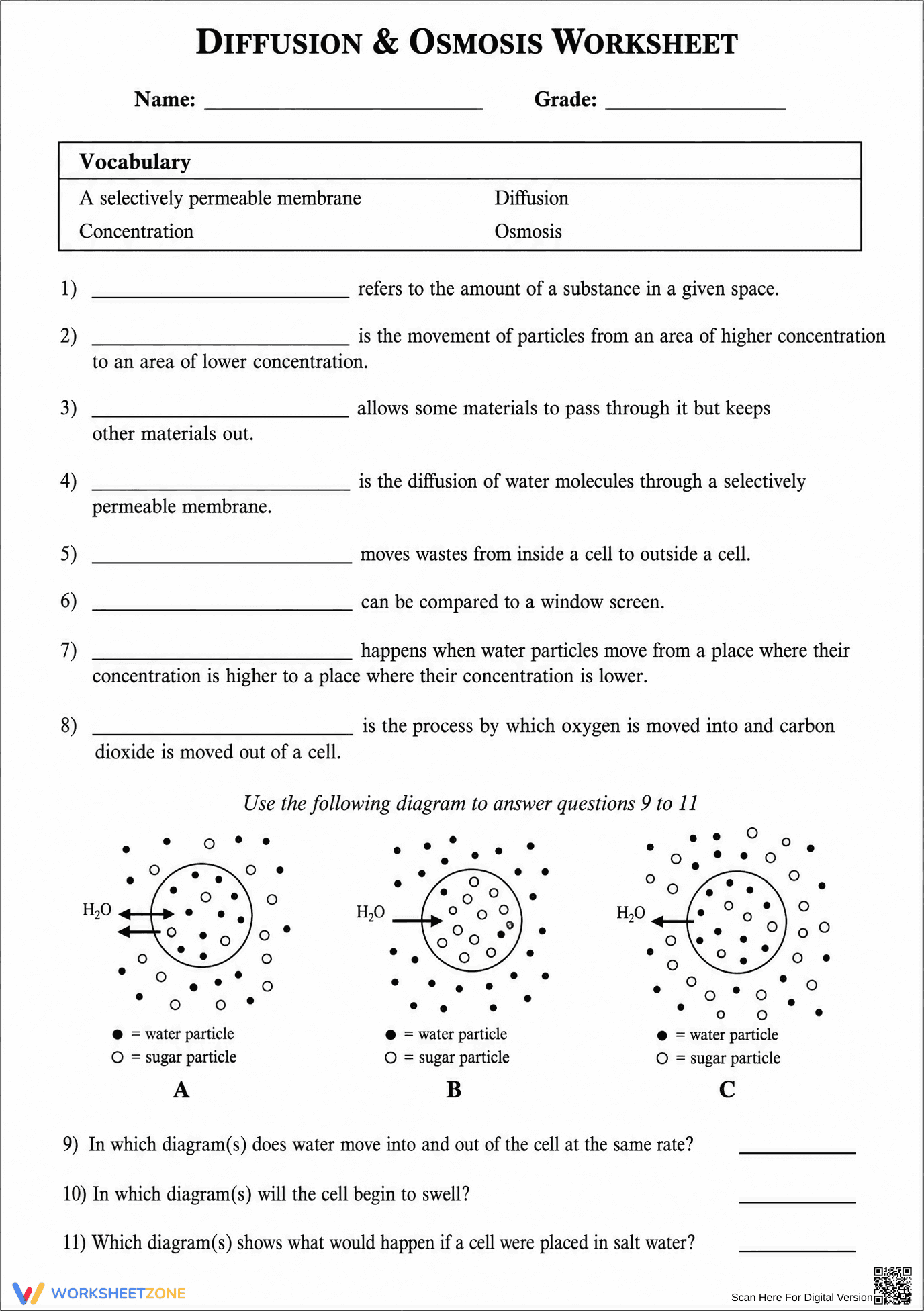

Grade 8 Diffusion & Osmosis — Printable No-Prep Worksheet
Paste this activity's link or code into your existing LMS (Google Classroom, Canvas, Teams, Schoology, Moodle, etc.).
Students can open and work on the activity right away, with no student login required.
You'll still be able to track student progress and results from your teacher account.
This Grade 8 science worksheet provides a clear framework for understanding passive transport within biological systems. Students identify key mechanisms of molecular movement, including diffusion and osmosis, through vocabulary application and visual analysis. By completing these exercises, learners develop a concrete grasp of how substances cross selectively permeable membranes.
At a Glance
- Grade: 8 · Subject: Science
- Standard:
MS-LS1-2— Describe how cell parts contribute to overall cellular function- Skill Focus: Diffusion and Osmosis
- Format: 1 page · 11 problems · Answer key included · PDF
- Best For: Independent practice or quick formative assessment
- Time: 15–20 minutes
The resource features a structured layout starting with a vocabulary bank containing four essential terms: selectively permeable membrane, concentration, diffusion, and osmosis. The first eight questions utilize a fill-in-the-blank format to reinforce definitions and conceptual relationships. The final three questions require students to analyze distinct diagrams depicting water and sugar particle movement to predict cellular changes and identify equilibrium states. A complete answer key is included for easy grading.
This worksheet is designed for a zero-prep classroom workflow. First, print the single-page PDF in under one minute. Next, distribute the copies to students, which takes mere seconds. Finally, review the 11 answers as a whole class in about five minutes. Because the vocabulary is provided directly on the page, students can begin working immediately without external references. Total teacher preparation time is under two minutes, making this an ideal sub plan, warm-up activity, or exit ticket for a biology unit.
Aligned to MS-LS1-2, this worksheet focuses on the movement of matter into and out of cells. It specifically addresses the requirement for students to understand how the cell membrane acts as a boundary and regulates internal environments. The inclusion of diagram analysis supports the science and engineering practice of developing and using models. Both standard codes can be copied directly into lesson plans, IEP goals, or district curriculum mapping tools.
Use this worksheet during the "Explain" or "Evaluate" phase of a 5E lesson cycle. It serves as an excellent formative assessment after a lab simulation involving iodine and starch or osmosis in eggs. Teachers should observe students during the diagram section to ensure they correctly identify the direction of water flow based on solute concentration. Expected completion time is approximately 15 to 20 minutes for most middle school learners.
This resource is tailored for middle school life science students and early high school biology learners. It provides necessary scaffolding for English Language Learners through the provided word bank and visual aids. It pairs naturally with a digital simulation of molecular motion or a physical anchor chart illustrating hypertonic, isotonic, and hypotonic environments.
According to the RAND AIRS 2024 report, the integration of visual models with technical vocabulary significantly improves retention of abstract biological concepts in middle school learners. This worksheet addresses the MS-LS1-2 standard by requiring students to interpret how a selectively permeable membrane regulates the internal environment of a cell. By distinguishing between the general movement of particles in diffusion and the specific movement of water in osmosis, students build the foundational knowledge necessary for more complex topics like active transport and cellular respiration. Research emphasizes that check-for-understanding tasks, such as the 11 problems provided here, are vital for identifying misconceptions before they become ingrained. This printable resource ensures that students can demonstrate mastery of passive transport through both linguistic and spatial reasoning, providing a comprehensive snapshot of student proficiency for data-driven instruction.


