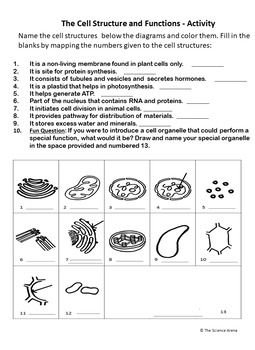
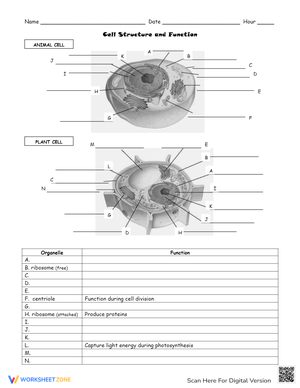
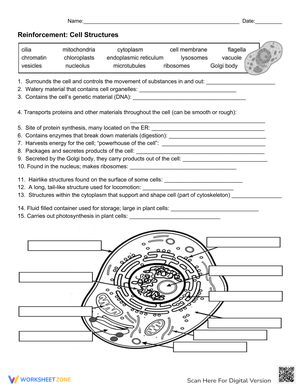
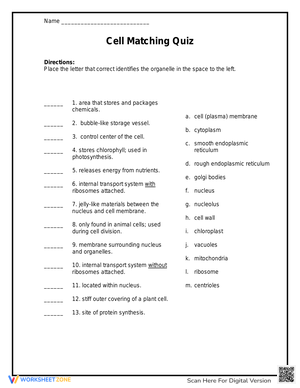
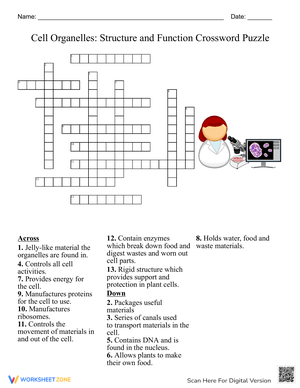
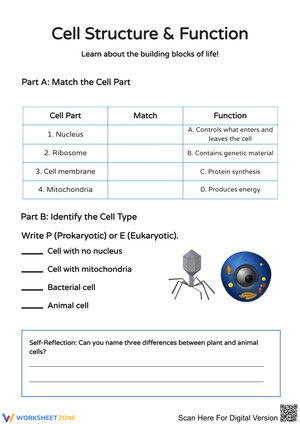
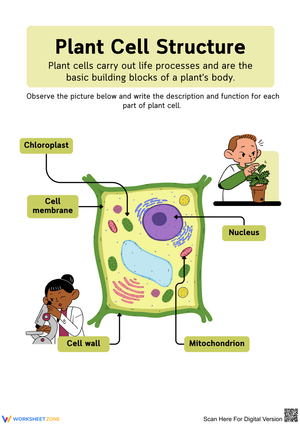
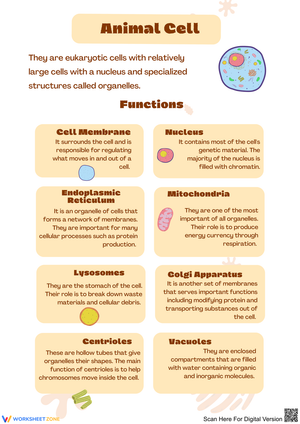
8th grade cell structure and function worksheets give teachers a ready-to-use set of resources for one of the core demands in middle school life science: helping students connect organelle names to specific cellular jobs and carry that understanding into plant-versus-animal cell comparisons. Each worksheet targets a different layer of that skill — labeling, matching, sorting by cell type, and writing short explanations — so teachers can use individual worksheets across a unit rather than burning through the entire set in a single class period.
Organelle Knowledge These Worksheets Build
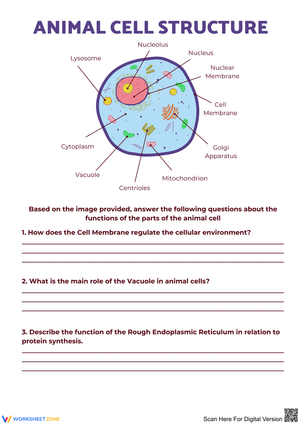
At the 8th grade level, students need a clean, accurate model of the organelles most likely to appear on quizzes, unit tests, and cumulative reviews. The worksheets keep that scope tight. Tasks center on the cell membrane, cytoplasm, nucleus, mitochondria, vacuole, cell wall, and chloroplasts — the structures that show up repeatedly across Grade 8 life science and that students must distinguish by both name and function.
Task types across the worksheets move students through a clear progression:
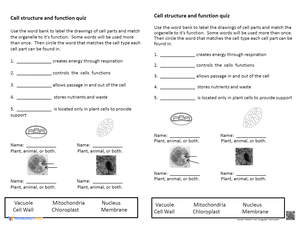
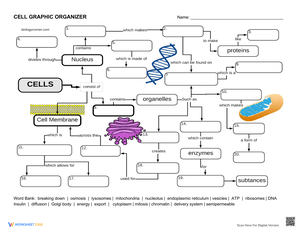
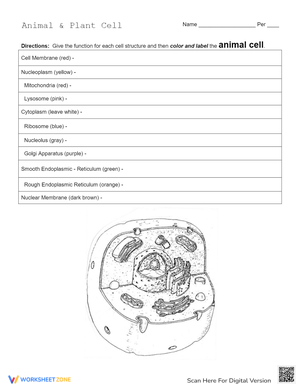
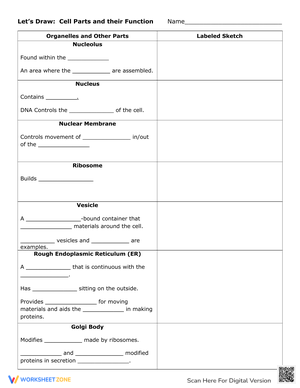
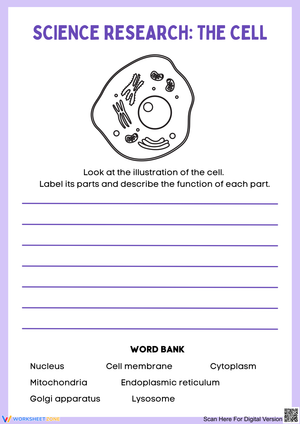
- Label a cell diagram using a word bank, forcing recognition before free recall.
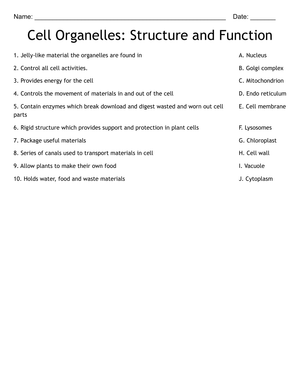
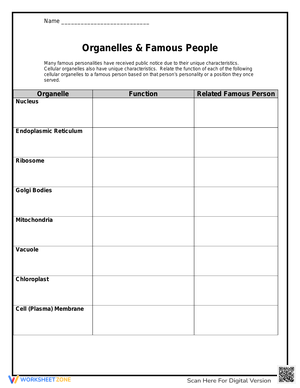
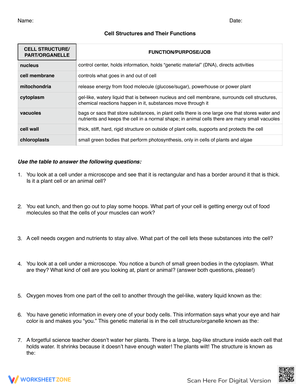
- Match each organelle to a plain-language description of its job in the cell.
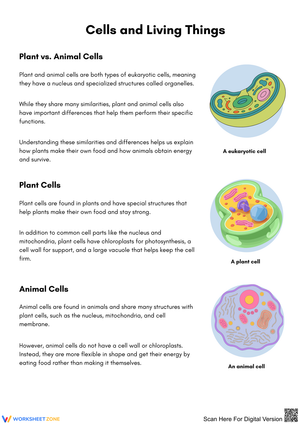
- Sort structures into shared (both cell types) versus plant-only categories.
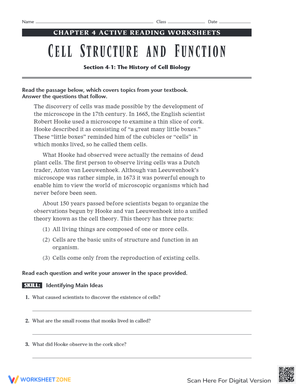
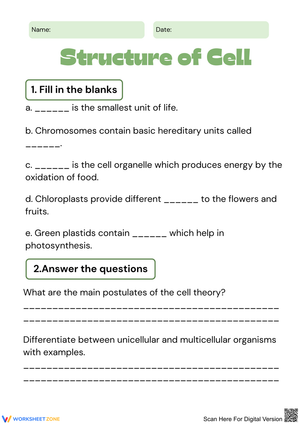
- Write a brief explanation of why a specific organelle matters for cell survival.
- Compare plant and animal cells using short-answer frames that require more than one-word responses.
One useful anchor for plant cell work: OpenStax Biology 2e (Section 4.3, Eukaryotic Cells) identifies three structures that distinguish plant cells — the cell wall, chloroplasts, and the large central vacuole. That three-part checklist gives students a concrete recall target and gives teachers a clean correction point when students try to add too many items to the plant-only column during sorting tasks.
Where Students Go Wrong With Cell Structure — and How to Catch It Early
The most persistent confusion in Grade 8 cell units is between the cell membrane, the cell wall, and the cytoplasm. Students treat these as interchangeable boundary terms. A telling pattern shows up in returned work: a student correctly labels the nucleus and mitochondria, then writes "cell wall" next to the animal cell's outer boundary — because any outer layer reads as "the wall" to a student who hasn't separated those concepts explicitly. A well-sequenced worksheet exposes this error fast, especially when it asks students to label an animal cell diagram where no cell wall is present. The blank line next to the outer boundary forces a decision, and the decision reveals the misunderstanding.
A second error involves mitochondria. Students routinely write that mitochondria "make energy" rather than that they release usable energy from food. That distinction matters for later work on photosynthesis and cellular respiration, and it appears directly in test prompts. Worksheet questions that ask "What do mitochondria do with food?" rather than "What do mitochondria produce?" tend to steer students toward the more accurate answer.
Plant-versus-animal sorting tasks also surface a recurring mistake: students place chloroplasts in the shared column because they know that both plant and animal cells need energy. The reasoning is logical but wrong. A follow-up prompt — "Does an animal cell capture energy from sunlight? Why or why not?" — converts that error into a teaching moment rather than a lost point on a test.
Building These Worksheets Into Your Weekly Lesson Sequence
The most practical way to use 8th grade cell structure and function worksheets is to spread them across a unit rather than assigning several at once during a single instructional block. Vocabulary-heavy content loses retention when students get one large review session and move on. Spacing the worksheets — one during the initial organelle lesson, one during the plant cell comparison lesson, one closer to the unit test — gives students repeated low-stakes exposure to the same content in different task formats, which is what actually moves information into long-term memory.
- Bell work: A three-to-five question warm-up targeting two or three organelles works well in the seven minutes before attendance is finished. Students have something to do immediately, and teachers get a fast read on who retained the previous night's material.
- Post-instruction check: Assign a label-and-match worksheet right after direct instruction on plant versus animal cells. Students who were engaged finish in eight to ten minutes. Students who were lost surface their confusion before it solidifies into a bad habit.
- Stations: One diagram station, one vocabulary sort, and one comparison station keeps three groups rotating without requiring entirely different prep for each.
- Exit ticket: Ask students to name one organelle, state its job, and decide whether it belongs to plant cells, animal cells, or both. That three-part structure takes under two minutes and tells teachers exactly where reteaching is needed the following day.
One sequencing move worth noting: introducing the cell membrane, cell wall, and cytoplasm as a cluster — before moving to full plant-versus-animal comparisons — reduces boundary-structure errors significantly. When students sort those three terms first and nail their distinctions, their later comparison work is cleaner. That small order change tends to improve the quality of written explanations, not just multiple-choice accuracy.
Standard Alignment
These worksheets align to NGSS MS-LS1-2, which asks students to develop and use a model to describe the function of a cell as a whole and explain how individual parts contribute to that function. In classroom terms, that standard requires students to do more than identify organelles — they must explain the relationship between cell structure and cell survival. The matching, sorting, and explanation tasks in this set address that performance expectation directly by asking students to connect what a part is called to what it actually does inside a living cell, and to reason about what would change if that part were absent or damaged.
How to Adapt These Resources for Mixed-Readiness Classes
The worksheets in this set work across a range of student readiness levels without requiring entirely separate materials for each group. The adjustment is in how much support students receive, not in whether they engage with the same science content.
Students who need more support work through diagram tasks with a full word bank and clear visual cues — the structure is visible and the vocabulary is provided, so the task stays focused on function rather than spelling or recall under pressure. On-level students remove the word bank and work from memory, which builds the retrieval practice that moves content into long-term memory. Students who are ready for more can move past identification entirely and answer cause-and-effect prompts: "If the cell membrane couldn't control what entered the cell, what would happen?" or "Why would a plant cell that lost its chloroplasts struggle to survive even with plenty of water and nutrients?"
For multilingual learners, the short-answer frames that appear across several worksheets — sentence starters such as "Both plant and animal cells have ___, but only plant cells have ___ because ___" — lower the language production barrier without reducing the science demand. Students who understand the concept but struggle with academic writing can demonstrate what they know without being stopped by sentence construction. 8th grade cell structure and function worksheets become genuinely useful tools for diverse classes when teachers treat task format as the adjustable variable and hold the science expectation consistent across groups.
Frequently Asked Questions
Which organelles should 8th graders know for this unit?
The core list for Grade 8 includes the cell membrane, cytoplasm, nucleus, mitochondria, vacuole, cell wall, and chloroplasts. Students need to know each structure's name and its primary job — not a detailed biochemical description. The most important expectation is that students can explain why each structure matters for cell survival, not only identify it on a diagram.
Do these worksheets cover both plant and animal cells?
Yes. Several worksheets in the set ask students to compare plant and animal cell structures directly — sorting shared organelles, identifying plant-only features, and explaining why differences like the cell wall and chloroplasts exist in plant cells but not animal cells. The comparison format is especially useful for quiz and test prep because students practice making the exact distinctions those assessments require.
How do I use these for formative assessment rather than just practice?
Choose prompts that reveal reasoning rather than pure recall. "What does the mitochondria do?" is a memory task. "What would happen to a cell if its mitochondria stopped working?" is a reasoning task. Short explanation prompts scattered across 8th grade cell structure and function worksheets tell teachers whether students understand function or just recognize names — and that distinction determines whether reteaching is needed before the unit test.
Are these worksheets appropriate for intervention blocks and science review days?
They fit both settings well. During intervention, pair the diagram worksheets with targeted reteaching on the three boundary structures — membrane, wall, and cytoplasm — since that cluster causes the most widespread confusion. During review, shift toward the comparison and explanation tasks, which push students past recognition and into the functional reasoning that NGSS-aligned assessments actually measure.












 Interactive Worksheet Maker
 Quiz Maker
 Word Search Maker
 Crossword Puzzle Maker
 Word Scramble Generator
 Sentence Scramble Generator
 Handwriting Worksheet Generator
 Name Tracing Generator
 Fill In The Blank Generator