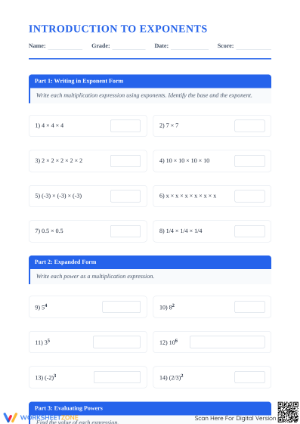
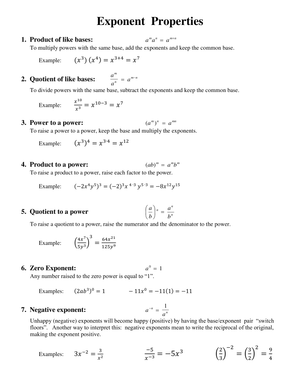
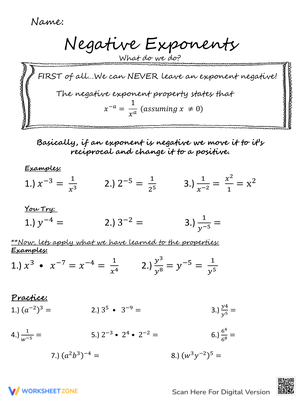
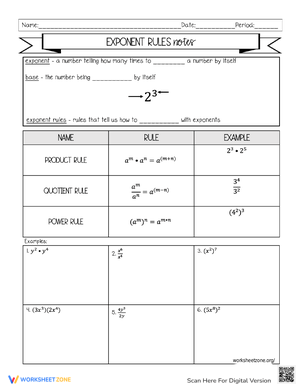
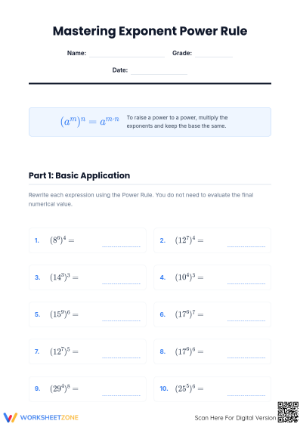
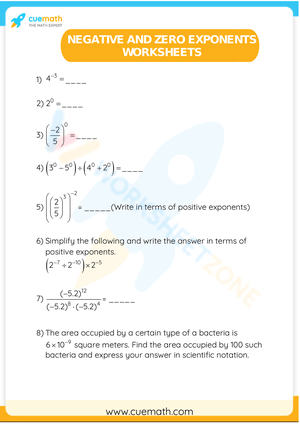
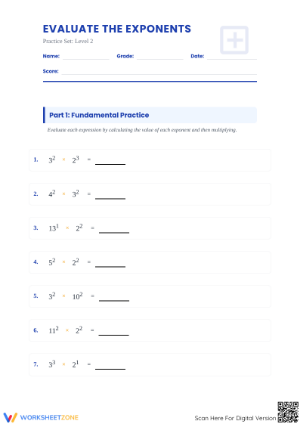
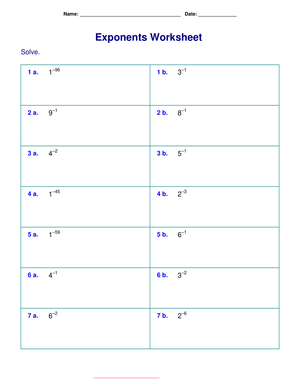
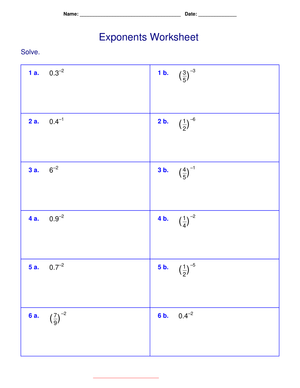
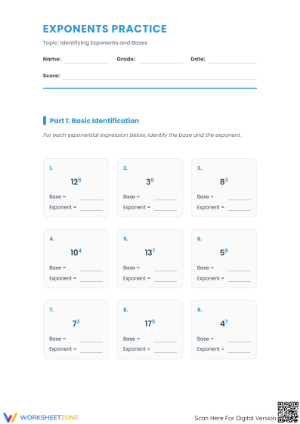
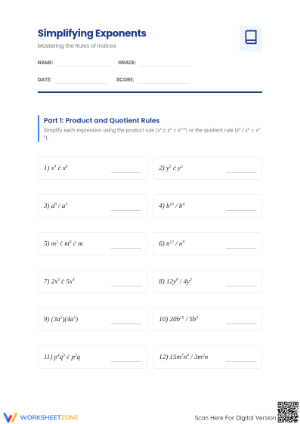
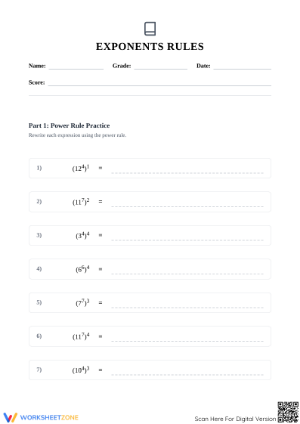
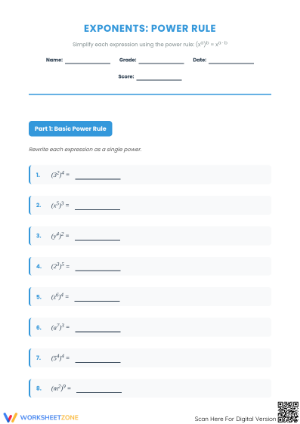
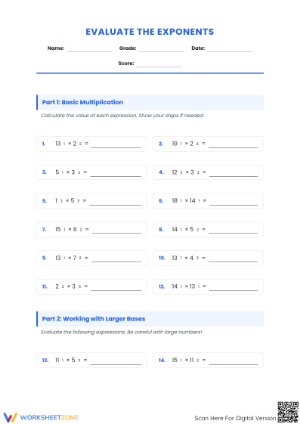
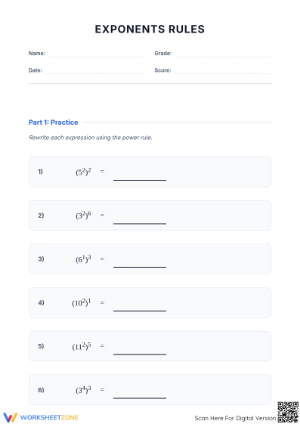
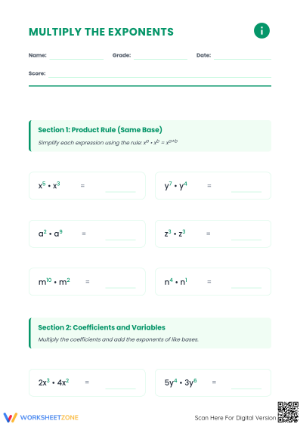
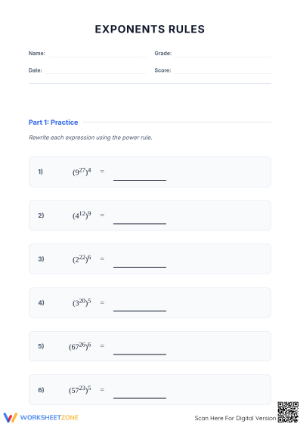
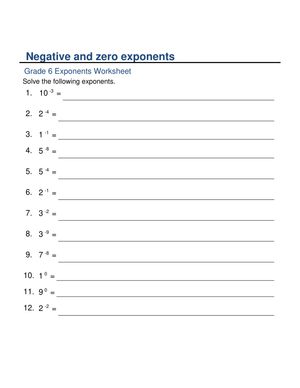
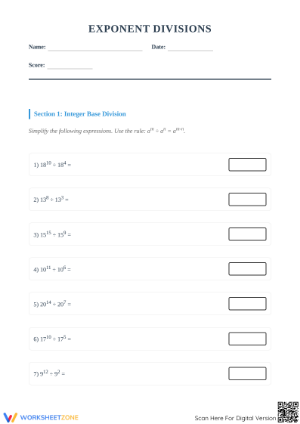
These 8th grade properties of exponents printable worksheets give teachers rule-specific practice for each of the seven exponent properties students are expected to master before high school algebra. The set includes focused worksheets for product of powers, quotient of powers, power of a power, power of a product, power of a quotient, zero exponent, and negative exponents — alongside mixed-review and error-analysis worksheets for when students need to choose the right rule without being told which one applies.
The Specific Skills Targeted in Each Worksheet
Students move through a sequence that builds from single-rule fluency toward multi-rule decision-making. On the rule-specific worksheets, students simplify expressions, rewrite equivalent forms, and match expressions to the property that justifies each step. On the mixed worksheets, they work without a built-in category cue — which is exactly where gaps tend to surface.
The skills covered include:
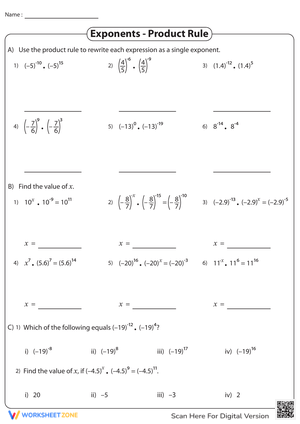
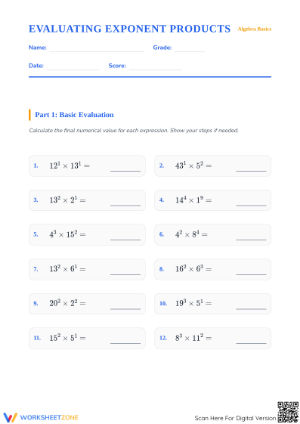
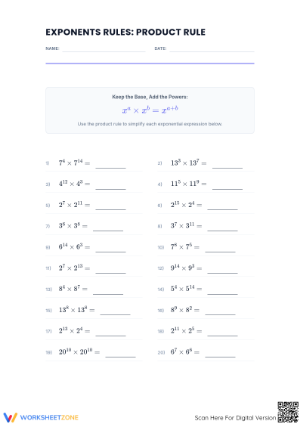
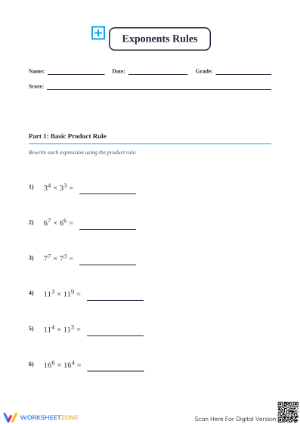
- Product of Powers: Simplifying expressions like x⁴ · x³ by adding exponents when the bases are identical.
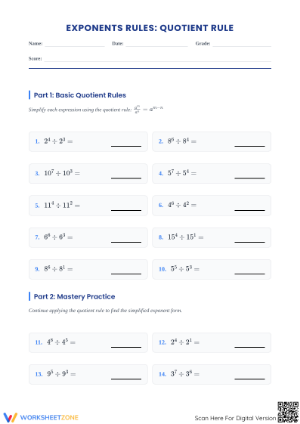
- Quotient of Powers: Dividing expressions with matching bases by subtracting exponents.
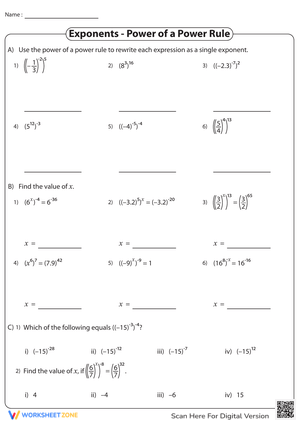
- Power of a Power: Multiplying exponents when an exponent is raised to another exponent, as in (x³)⁴.
- Power of a Product and Quotient: Distributing an outside exponent across factors inside parentheses.
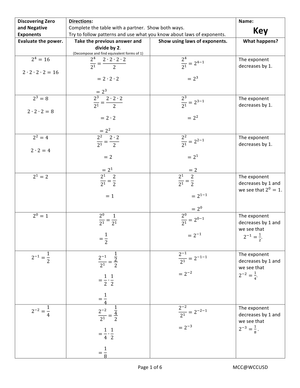
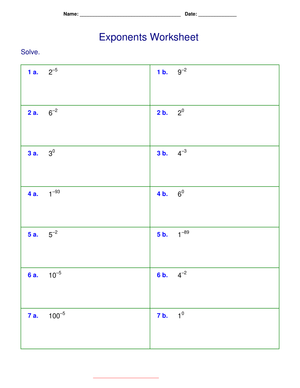
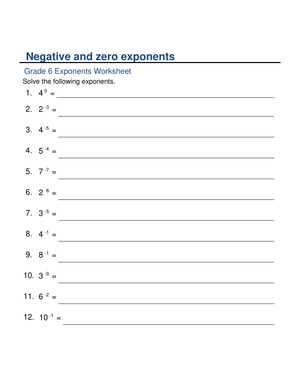
- Zero Exponent: Recognizing that any nonzero base raised to the zero power equals one.
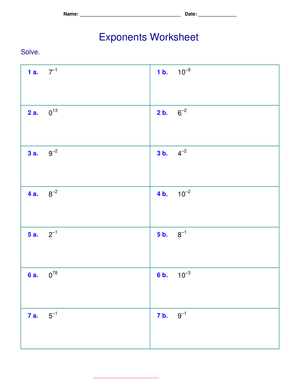
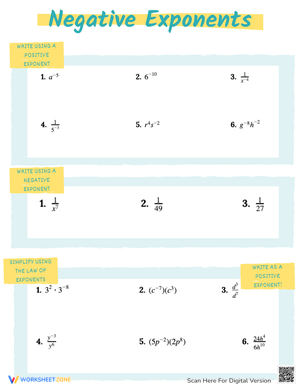
- Negative Exponents: Rewriting expressions with negative exponents as equivalent fractions.
The error-analysis worksheets add a layer the other formats don't: students read a worked solution, locate the mistake, and rewrite the correct simplification. This format works well as a class discussion starter because it forces students to articulate the rule rather than just apply it.
Where Student Thinking Breaks Down With Exponent Rules
The most consistent error across 8th grade classrooms is adding exponents when the bases are different. A student working with x² · y³ writes x⁵ because the combination of two exponents and one operation pattern-matches to the product of powers rule — even though the bases don't match. These worksheets address that directly by placing expressions with unlike bases alongside ones where the rule genuinely applies, so students have to check before calculating rather than reaching for a pattern by reflex.
The power of a power rule produces a distinct confusion. In (x²)³, students frequently add the exponents and get x⁵ instead of multiplying to get x⁶. They've seen "exponents and an operation means add exponents" often enough that it overrides the correct procedure. A worksheet that places (x²)³ next to x² · x³ and asks students to simplify both — then explain in writing why the results differ — addresses this more effectively than additional isolated practice of either type alone.
Zero exponents generate a specific misconception worth naming before you assign them: students commonly write 7⁰ = 0 because they're applying a rule from a different context — "multiplying by zero gives zero." The 8th grade properties of exponents printable worksheets that target this error most effectively include brief true/false sets where students mark whether a zero-exponent expression equals zero or one and write a one-sentence justification. That writing step is what makes the correction stick rather than fade by the following week.
Negative exponents tend to produce a stopping problem rather than a wrong-answer problem. Students simplify correctly until a negative exponent appears in the result, then leave x⁻³ in the answer rather than rewriting it as 1/x³. Each worksheet that requires the rewritten form as the final step trains that follow-through habit consistently — harder to build through verbal reminders alone.
How to Work These Worksheets Into Your Unit Sequence
The most effective sequence for 8th grade properties of exponents printable worksheets is to open each new property with three to five modeled examples, then immediately move students to a rule-specific worksheet while the worked examples are still visible. That structure keeps cognitive load manageable — students apply the rule in real time rather than trying to reconstruct it from memory later in the period. Reserve the mixed-rule worksheets for the second half of the unit, after students have had focused practice with at least three or four properties separately.
Bell ringers are one of the most consistent fits for these resources. Three problems reviewing the previous day's property take under eight minutes, and because the format is predictable, students start without needing additional instruction. On Fridays, swap the single-rule bell ringer for two or three items from a mixed-rule worksheet to push retrieval across the full week's content.
For intervention groups, the most useful pairing is product of powers next to power of a power — that pair produces the most persistent confusion — on a worksheet that puts both rule types side by side. Running that session while the rest of the class works on a mixed-review or extension worksheet keeps whole-class momentum intact without sacrificing time for students who need to go back to the beginning of the distinction.
Standard Alignment
These worksheets align to CCSS 8.EE.A.1: "Know and apply the properties of integer exponents to generate equivalent numerical expressions." In classroom terms, that standard requires more than rule recall — students need to produce an equivalent expression and show why the transformation is valid. The rule-specific worksheets in the set build toward that standard, while the error-analysis and mixed-rule worksheets assess it more directly by requiring students to identify and apply properties without category labels guiding the choice.
Serving Both Reteach and Extension Needs With the Same Resource Set
Students don't struggle with exponent rules in the same way, and a worksheet that challenges one student will frustrate another. For students who need more time with one rule before a second is introduced, assign rule-specific worksheets in order, ensure each worksheet includes a worked example at the top, and reduce the total problem count per sitting so students finish accurately rather than rushing. The ordering matters: product of powers before quotient of powers, zero exponent before negative exponents — that sequence reflects the typical readiness curve and limits cross-rule interference.
Students who have the core rules down but need to push further get the most from error-analysis worksheets and from multi-step expressions that combine two or three properties — something like simplifying (2x³y⁻²)⁴ without breaking it into labeled steps first. These 8th grade properties of exponents printable worksheets include both the focused-practice and the extension formats, so one resource set serves a classroom where students are at genuinely different points in their understanding.
A practical differentiation move that doesn't require two separate lesson plans: assign the same mixed-rule worksheet to the whole class, then direct students still building fluency to complete only the single-base expressions while students ready for more work through the multi-variable and multi-rule items. Grading stays manageable because the work comes off one worksheet, not two separate assignments.
Frequently Asked Questions
Which exponent properties are included across the set?
The set covers all seven properties specified in the 8th grade standard: product of powers, quotient of powers, power of a power, power of a product, power of a quotient, zero exponent, and negative exponents. Rule-specific worksheets, mixed-review worksheets, and error-analysis worksheets are all included.
Can individual worksheets be used for reteaching a single property mid-unit?
Yes. Because each rule-specific worksheet isolates one property, teachers can pull exactly the worksheet that matches the gap an exit ticket or quick check has revealed — without assigning a broader review. That precision makes the set practical for small-group reteaching the day after a formative assessment surfaces a specific breakdown.
Do the worksheets come with answer keys?
Each worksheet includes a complete answer key. For whole-class independent practice, teachers can verify work in a few minutes. For intervention groups, having the key during the session means errors get addressed immediately rather than a day later when corrected papers are returned.
When in the unit should mixed-rule worksheets be assigned?
Mixed-rule worksheets work best after students have had focused practice with at least three or four individual properties. Assigning them earlier — before enough repetition with each rule separately — tends to produce guessing rather than reasoned rule selection. Use them as a midpoint check and again as a unit-review tool in the days before the summative assessment.













 Interactive Worksheet Maker
 Quiz Maker
 Word Search Maker
 Crossword Puzzle Maker
 Word Scramble Generator
 Sentence Scramble Generator
 Handwriting Worksheet Generator
 Name Tracing Generator
 Fill In The Blank Generator