


























Views
Downloads

Printable Exponent Divisions Worksheet | Grade 8 Math
Paste this activity's link or code into your existing LMS (Google Classroom, Canvas, Teams, Schoology, Moodle, etc.).
Students can open and work on the activity right away, with no student login required.
You'll still be able to track student progress and results from your teacher account.
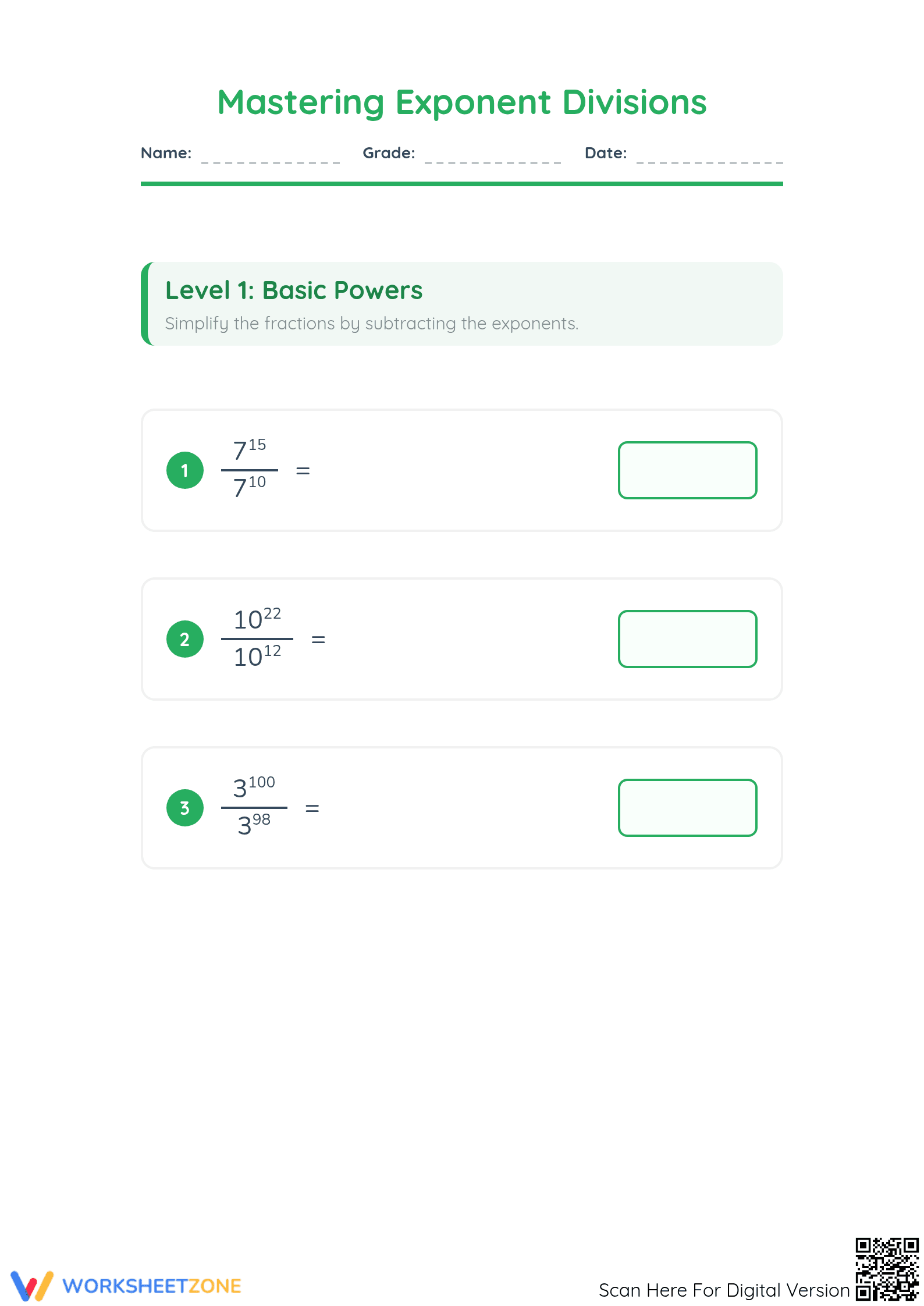
Evaluating exponents is a critical middle school skill that bridges arithmetic and algebra. This worksheet focuses on the quotient property of exponents, helping students simplify expressions by subtracting exponents. By the end of these 10 tasks, learners will confidently divide powers with both numerical and variable bases.
At a Glance
- Grade: 8 · Subject: Math
- Standard:
8.EE.A.1— Apply properties of integer exponents to generate equivalent numerical expressions- Skill Focus: Quotient Property of Exponents
- Format: 3 pages · 10 problems · Answer key included · PDF
- Best For: Algebra readiness and exponent rule mastery
- Time: 20–30 minutes
What's Inside
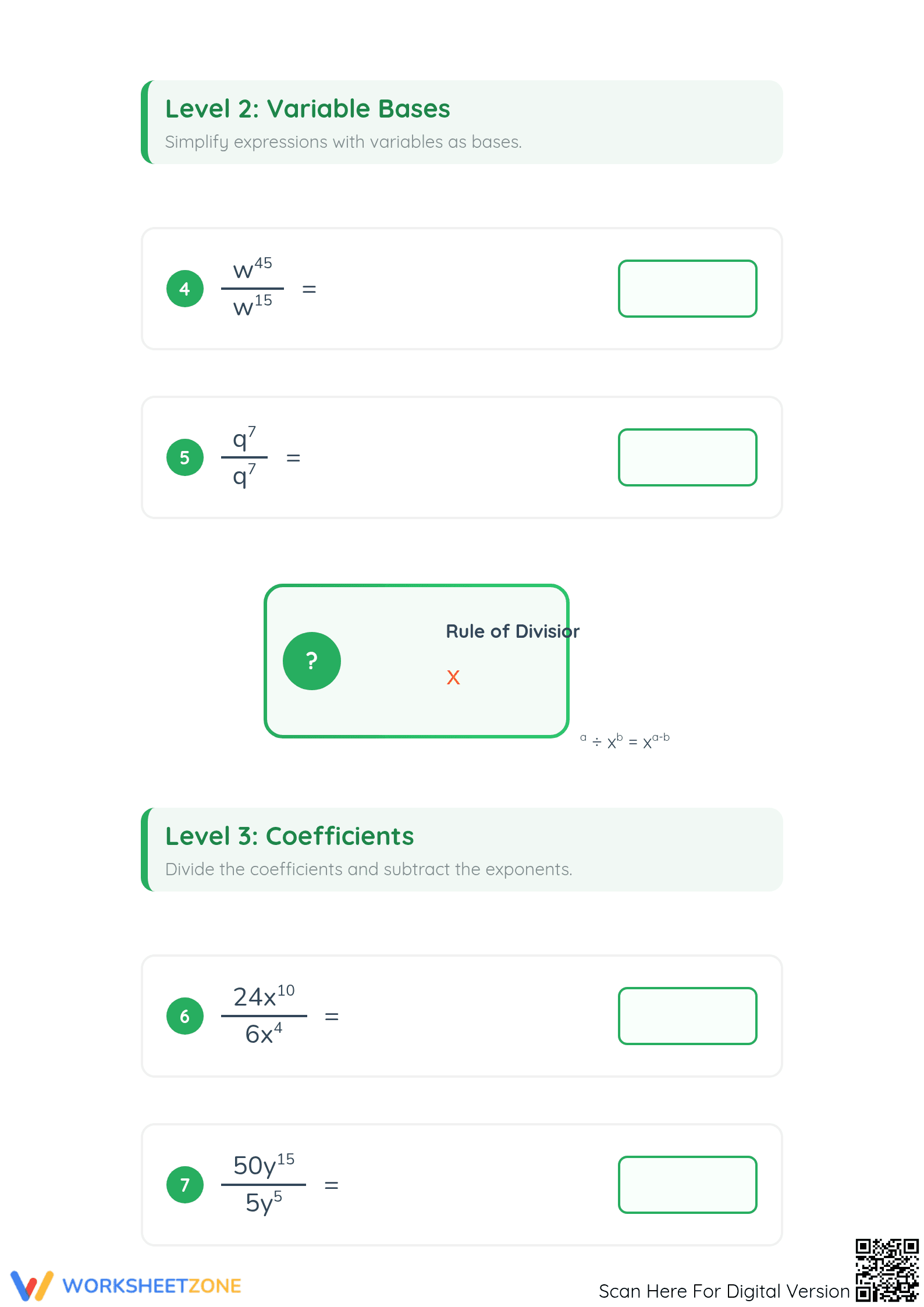
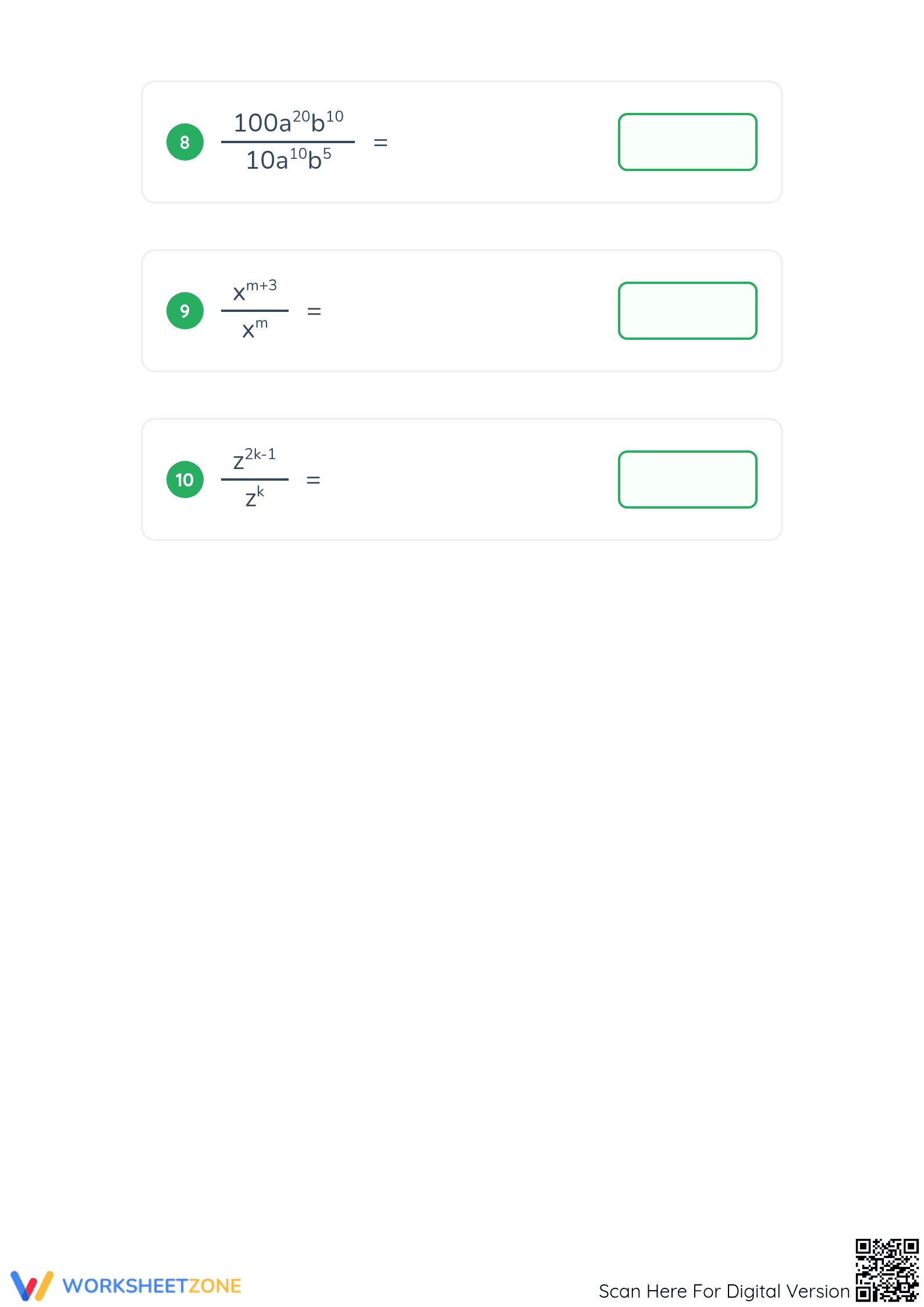
This 3-page PDF features a progression of 10 targeted problems. It starts with basic numerical powers, moves to variable bases, and concludes with more complex expressions involving coefficients. A dedicated "Rule of Division" box provides a visual anchor for students, and a complete answer key is included for immediate feedback.
Skill Progression
- Guided Practice: The first three problems use numerical bases (e.g., 7^15 / 7^10) to reinforce the core subtraction rule.
- Supported Practice: Tasks 4 through 7 introduce variable bases and coefficients, requiring students to handle multiple steps.
- Independent Practice: The final three problems involve multi-variable expressions and algebraic exponents (e.g., x^(m+3) / x^m) to ensure total mastery.
This sequence follows the gradual-release model, moving from scaffolded numerical examples to abstract algebraic reasoning.
Standards Alignment
This resource is directly aligned to 8.EE.A.1. This standard requires students to know and apply the properties of integer exponents to generate equivalent numerical expressions. This specific worksheet isolates the quotient property. Both standard codes can be copied directly into lesson plans, IEP goals, or district curriculum mapping tools.
How to Use It
Use this as a primary practice set during your exponents unit. It is ideal for independent seatwork following a direct instruction lesson on the quotient rule. Teachers can also use the variable-base section as a formative assessment to check for readiness before moving into scientific notation or negative exponents.
Who It's For
This is designed for Grade 8 students but is equally effective for Grade 7 accelerated learners or high schoolers needing a refresher. It pairs naturally with a lesson on the product rule of exponents to show the relationship between operations.
According to the NAEP (2024), mastery of exponential properties is a significant predictor of success in high school algebra and beyond. This worksheet employs the quotient property of exponents, a fundamental skill where students learn to simplify fractions by subtracting exponents of like bases. By providing 10 structured problems across three difficulty levels, the resource ensures that students move beyond rote memorization toward conceptual understanding. Fisher & Frey (2014) highlight that scaffolded practice sets, like the one provided here, support the gradual release of responsibility necessary for learners to internalize complex mathematical rules. This specific focus on the subtraction of powers directly supports the CCSS 8.EE.A.1 standard, ensuring students are prepared for more advanced topics such as negative exponents and scientific notation. The inclusion of a clear rule anchor and variable-based problems facilitates the transition from concrete arithmetic to abstract algebraic manipulation.


