


























Views
Downloads

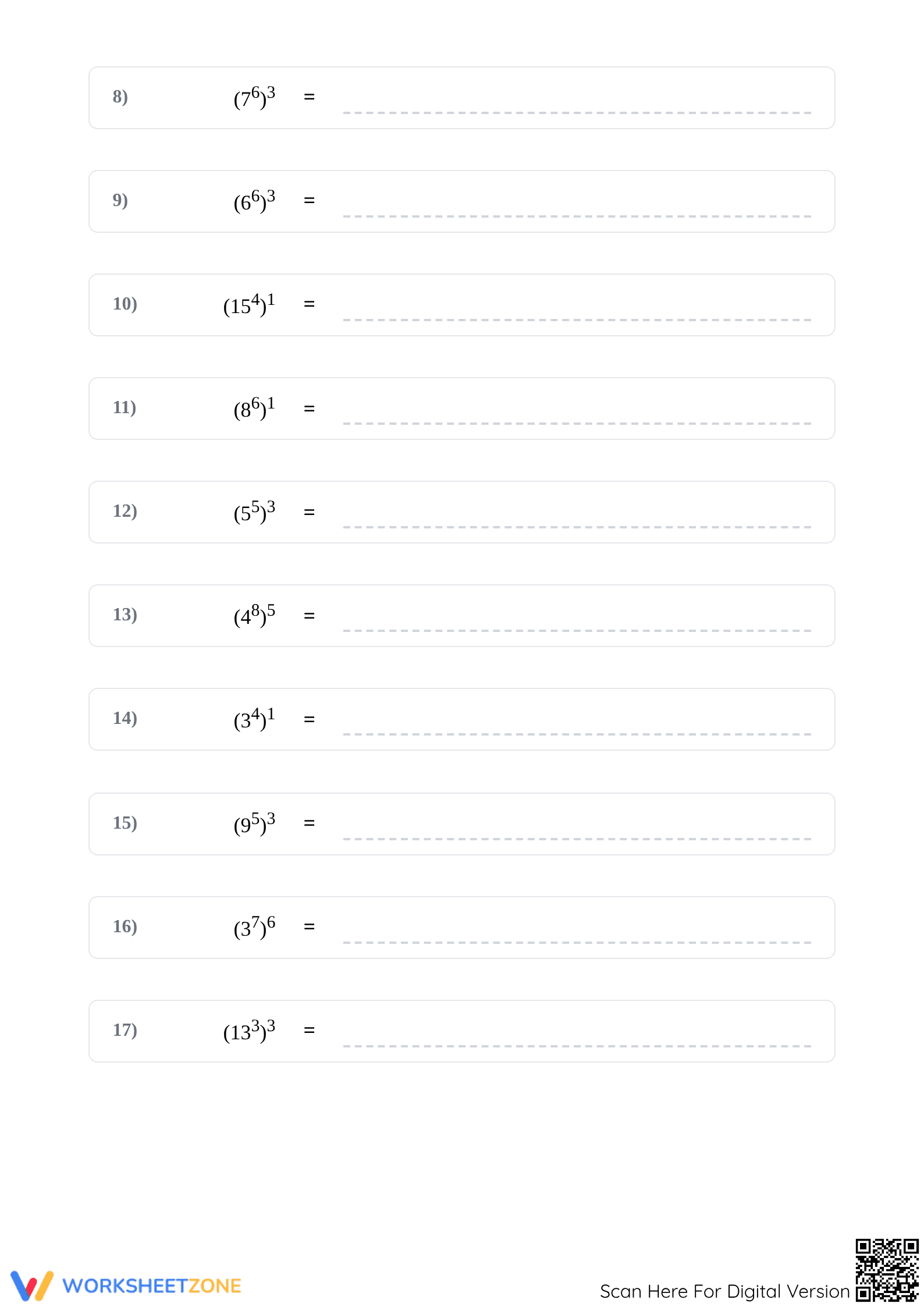


Printable Exponents Power Rule Practice | Grade 8 Math
Paste this activity's link or code into your existing LMS (Google Classroom, Canvas, Teams, Schoology, Moodle, etc.).
Students can open and work on the activity right away, with no student login required.
You'll still be able to track student progress and results from your teacher account.
Mastering exponent properties is essential for high school algebra. This printable Grade 8 Math worksheet offers targeted practice in applying the power rule of exponents to simplify numerical and algebraic expressions. By completing these exercises, learners build the procedural fluency needed to handle complex mathematical operations and equivalent expressions.
At a Glance
- Grade: 8 · Subject: Math
- Standard:
8.EE.A.1— Apply properties of integer exponents to generate equivalent numerical expressions- Skill Focus: Exponent Power Rule (Power of a Power)
- Format: 3 pages · 24 problems · Answer key included · PDF
- Best For: Independent practice and formative assessment
- Time: 20–30 minutes
What's Inside
This 3-page packet features 24 problems reinforcing the power rule (a^m)^n = a^(m*n). The first 18 problems use numerical bases to build a concrete foundation. The final six introduce variables, requiring application in an algebraic context. A complete answer key is provided for quick grading and self-correction.
Skill Progression
- Numerical Foundation: Students begin with 18 problems involving integer bases to solidify their understanding of the multiplication of exponents.
- Algebraic Transition: The worksheet shifts to variable-based expressions (e.g., (x^5)^2), ensuring students can generalize the rule beyond arithmetic.
- Independent Mastery: With 24 total tasks, the set moves from basic recall to consistent application, following a gradual-release instructional model that builds student confidence.
The layout ensures a steady increase in complexity, moving from basic exponents to multi-digit bases and algebraic variables.
Standards Alignment
This resource is directly aligned to 8.EE.A.1, which requires students to know and apply the properties of integer exponents to generate equivalent numerical expressions. By focusing specifically on the power rule, this worksheet targets a critical component of the Expressions and Equations domain. This standard code can be copied directly into lesson plans, IEP goals, or district curriculum mapping tools.
How to Use It
Assign this worksheet as a primary practice activity during your unit on exponent laws. It works exceptionally well as a "check for understanding" after a direct instruction lesson on the power rule. For a formative assessment observation, watch for students who mistakenly add the exponents instead of multiplying them; this common error provides a valuable moment for immediate corrective feedback.
Who It's For
This resource is designed for Grade 8 students but is also appropriate for Grade 7 advanced learners or high school students needing a refresher in Algebra 1. It pairs perfectly with an interactive notebook entry on exponent properties or a digital presentation showing the expanded form of power-of-a-power expressions.
The NAEP 2024 mathematics framework underscores the importance of procedural fluency with exponent properties for success in algebraic reasoning. The power rule of exponents represents a conceptual shift where students must understand that raising a power to another power involves a multiplicative relationship between indices. Studies from ScienceDirect TpT Analysis indicate that skill-specific practice sets lead to higher retention rates compared to mixed-review worksheets early in the learning cycle. This Grade 8 resource provides the necessary repetition of 24 tasks to ensure students move from rote memorization to automatic application of the standard 8.EE.A.1. By isolating the power rule before introducing other properties, educators can effectively identify and address misconceptions regarding the distinction between the product rule and the power rule in mathematical expressions. Such focused practice is critical for building the long-term mathematical proficiency required for collegiate-level STEM pathways.


