


























Views
Downloads

Grade 8 Multiplying Exponents — Printable No-Prep Worksheet
Paste this activity's link or code into your existing LMS (Google Classroom, Canvas, Teams, Schoology, Moodle, etc.).
Students can open and work on the activity right away, with no student login required.
You'll still be able to track student progress and results from your teacher account.
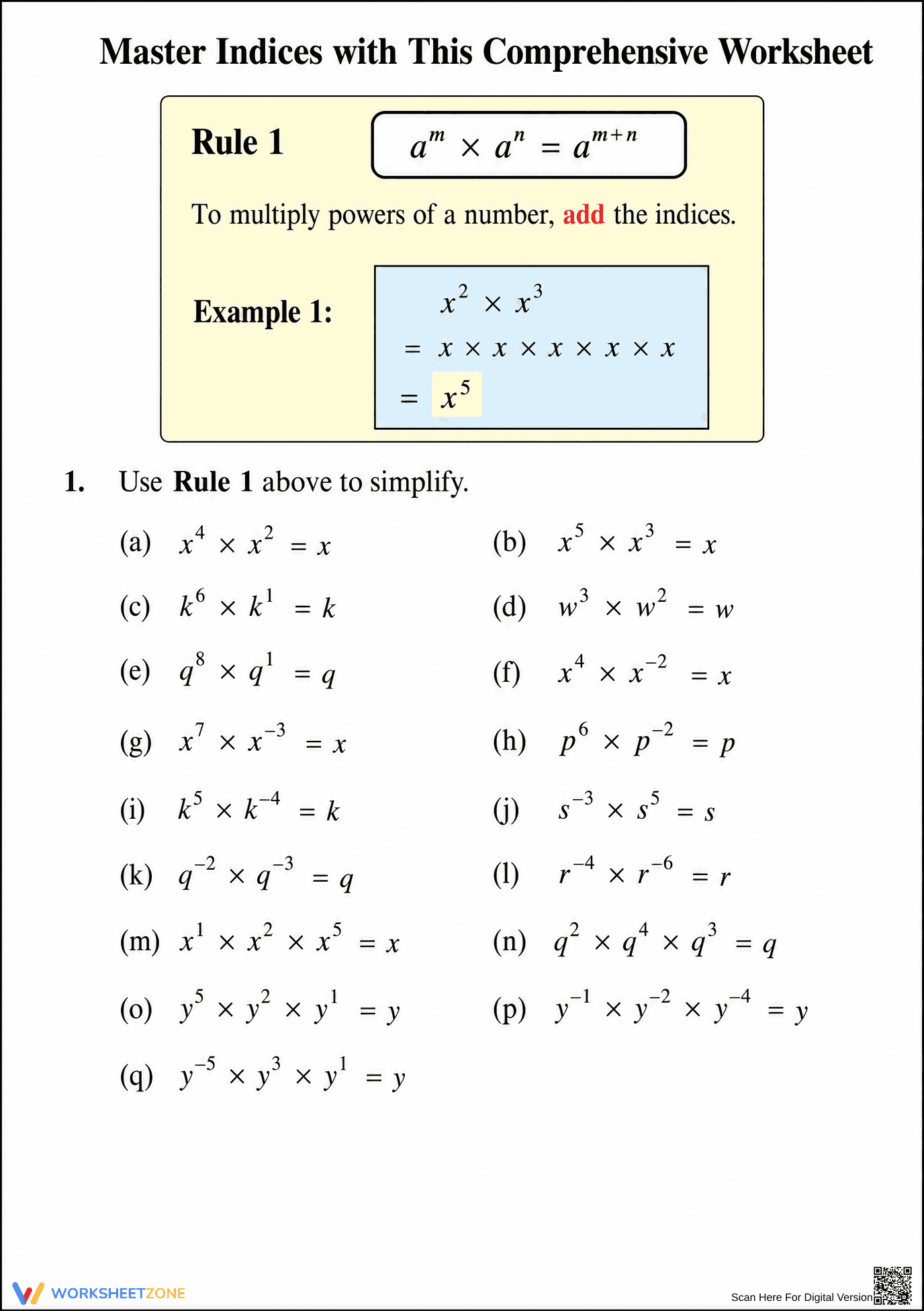
This Grade 8 algebra worksheet helps students master the product rule of exponents by multiplying powers with the same base. With a clear rule definition and worked example, this resource ensures learners independently simplify algebraic expressions with confidence.
At a Glance
- Grade: 8 · Subject: Math
- Standard:
8.EE.A.1— Apply properties of integer exponents to generate equivalent expressions- Skill Focus: Multiplying exponents with the same base
- Format: 1 page · 17 problems · Answer key included · PDF
- Best For: Independent practice and review
- Time: 15–20 minutes
This single-page resource opens with a straightforward instructional box detailing the mathematical rule for multiplying indices, complete with a visual example. Below the instructional header, students will find 17 targeted practice problems. The expressions gradually increase in complexity, starting with positive integer exponents and progressing to negative exponents and multi-variable multiplication. An answer key supports quick grading.
Zero-Prep Workflow
This worksheet is designed for immediate classroom implementation with absolutely no teacher setup required.
- Print (1 minute): Generate copies of the single-page PDF for your entire roster.
- Distribute (1 minute): Hand out the assignment as students enter the room or transition to independent work.
- Review (3 minutes): Read the top instructional box together before releasing students to work.
With a total teacher prep time of under two minutes, this self-explanatory activity is highly suitable for emergency sub plans or unexpected schedule changes.
Standards Alignment
This practice aligns directly with 8.EE.A.1: Know and apply the properties of integer exponents to generate equivalent numerical expressions. It specifically targets the product rule, ensuring students understand how to add indices when multiplying identical bases. Both standard codes can be copied directly into lesson plans, IEP goals, or district curriculum mapping tools.
How to Use It
Deploy this worksheet immediately following direct instruction on the product rule of exponents to solidify initial understanding. Alternatively, use it as a focused bell-ringer activity the day after introducing the concept to activate prior knowledge. As students work through the 17 problems, observe whether they correctly add negative exponents (such as in problem "g" or "h") as a quick formative assessment. Expected completion time ranges from 15 to 20 minutes depending on student fluency with basic addition and subtraction.
Who It's For
This resource is designed for eighth-grade math and early high school algebra learners. The built-in example makes it highly accessible for students who require visual scaffolds or frequent reminders of mathematical rules. For differentiation, teachers can assign only the positive exponent problems to struggling learners, while challenging advanced students to write their own expressions that simplify to a specific power. Pair this worksheet with an anchor chart displaying all exponent rules for maximum impact.
Mastering the product rule of exponents is a critical foundational step for higher-level algebra and calculus. Standard 8.EE.A.1 requires students to apply properties of integer exponents to generate equivalent expressions. When learners practice multiplying exponents with the same base, they develop the algebraic fluency necessary to manipulate complex polynomials and scientific notation. According to EdReports 2024, instructional materials that provide explicit rule definitions alongside immediate, targeted practice significantly improve long-term retention of algebraic properties. By isolating the product rule and providing a clear worked example before independent practice, this resource minimizes cognitive overload and reduces common calculation errors. This highly structured approach ensures students build the procedural confidence required to tackle multi-step equations, exponential growth models, and advanced mathematical reasoning in subsequent secondary coursework.


