


























Views
Downloads
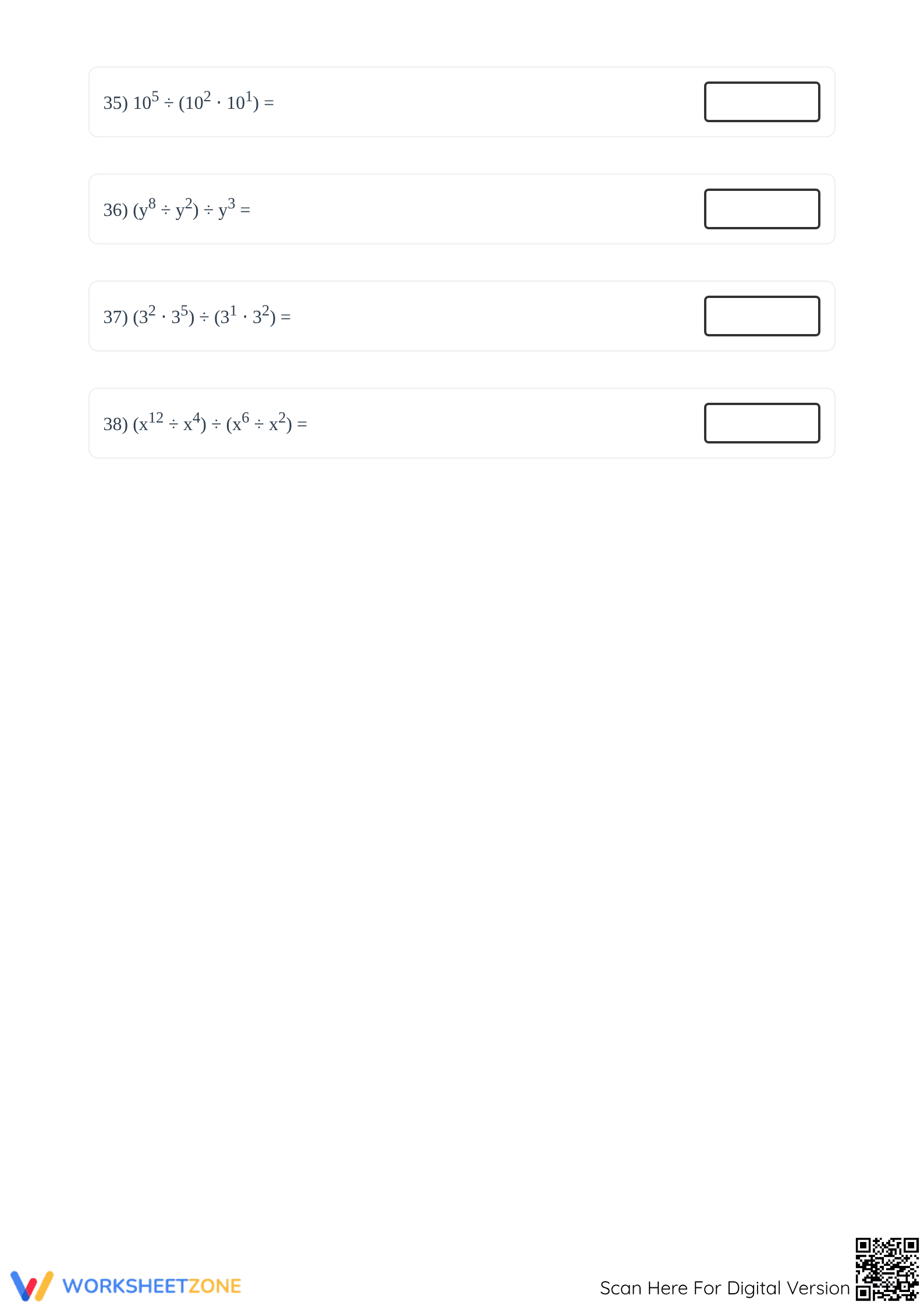

Printable Exponent Division Worksheet | Grades 6-8 Math
Paste this activity's link or code into your existing LMS (Google Classroom, Canvas, Teams, Schoology, Moodle, etc.).
Students can open and work on the activity right away, with no student login required.
You'll still be able to track student progress and results from your teacher account.
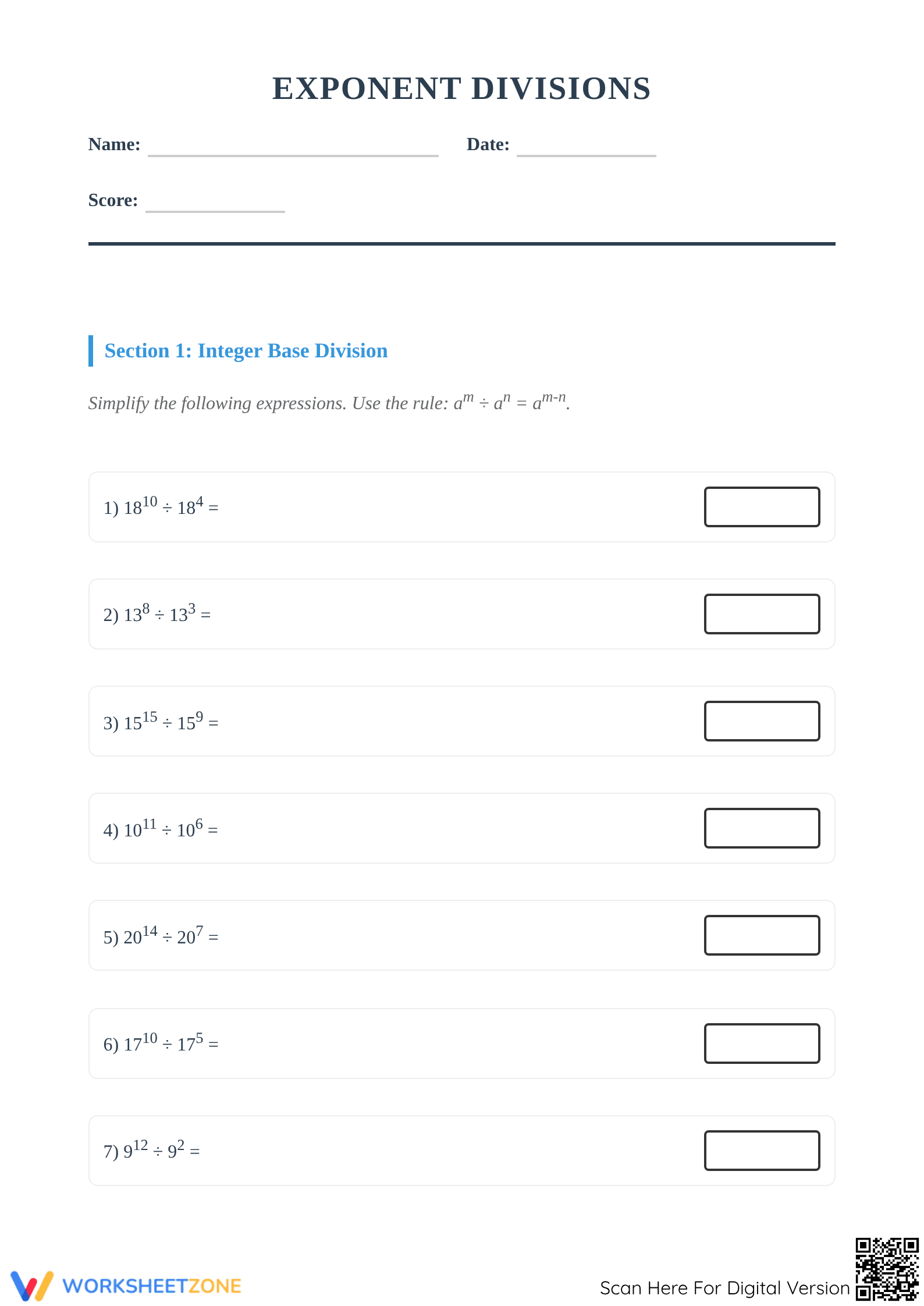
Mastering the quotient rule for exponents is a fundamental step toward algebraic fluency. This Grade 8 math worksheet provides students with targeted practice in dividing exponential expressions. By applying the rule a^m / a^n = a^(m-n), learners gain confidence in simplifying complex expressions involving both integer and variable bases across thirty-eight structured problems.
At a Glance
- Grade: 8 · Subject: Math
- Standard:
8.EE.A.1— Apply the properties of integer exponents to generate equivalent numerical expressions- Skill Focus: Quotient Rule for Exponents
- Format: 5 pages · 38 problems · Answer key included · PDF
- Best For: Independent practice or comprehensive sub plans
- Time: 40–50 minutes
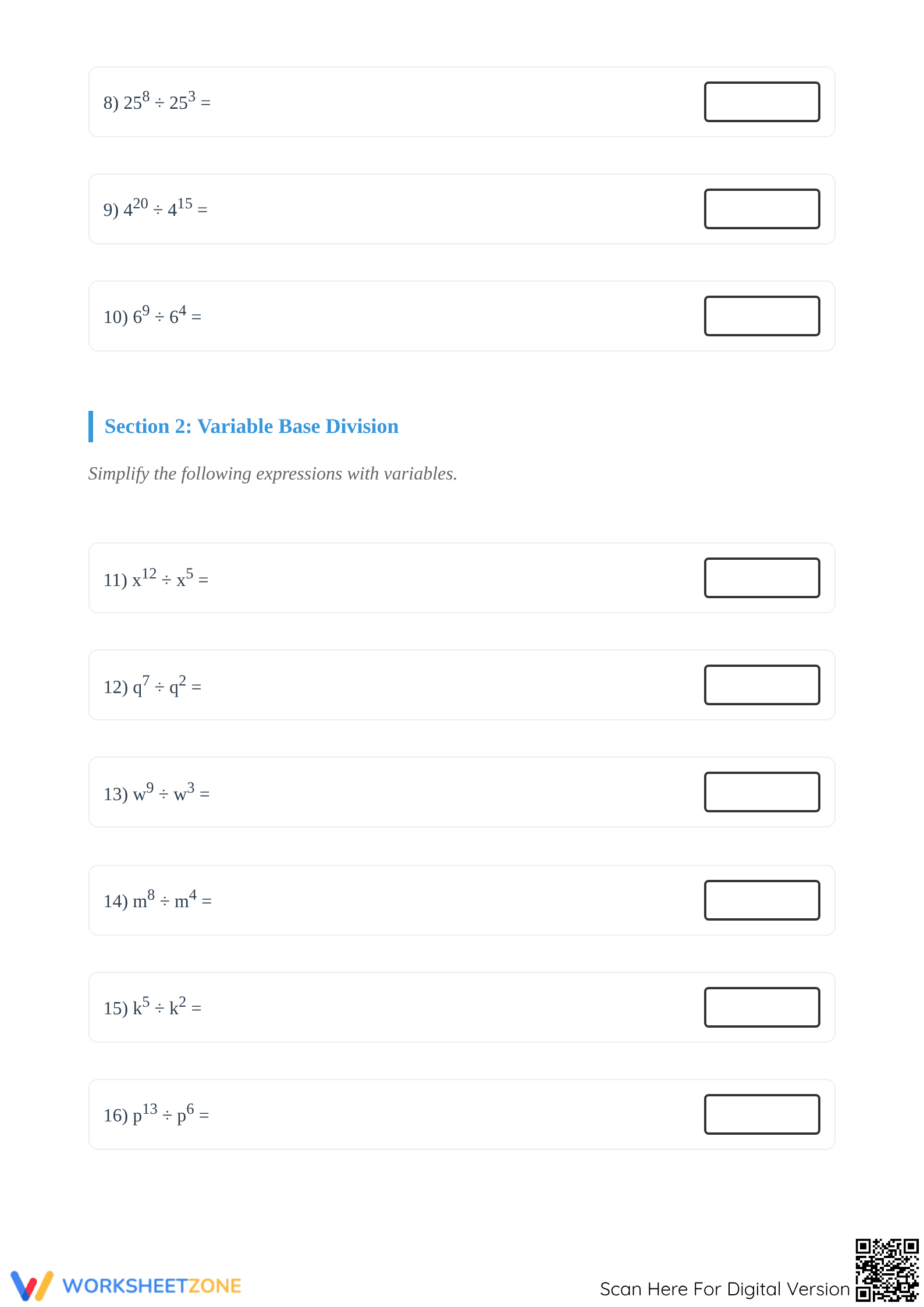
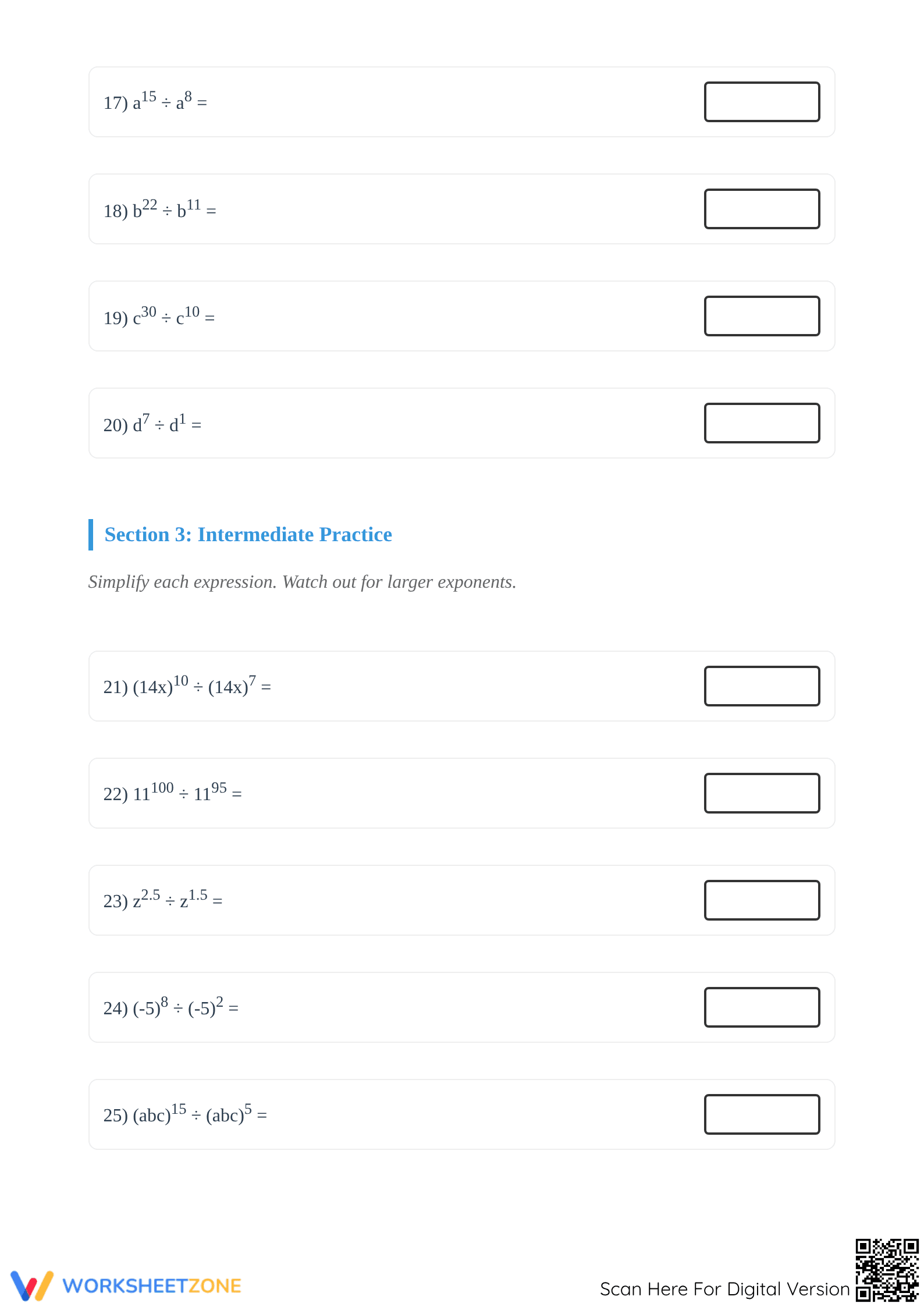
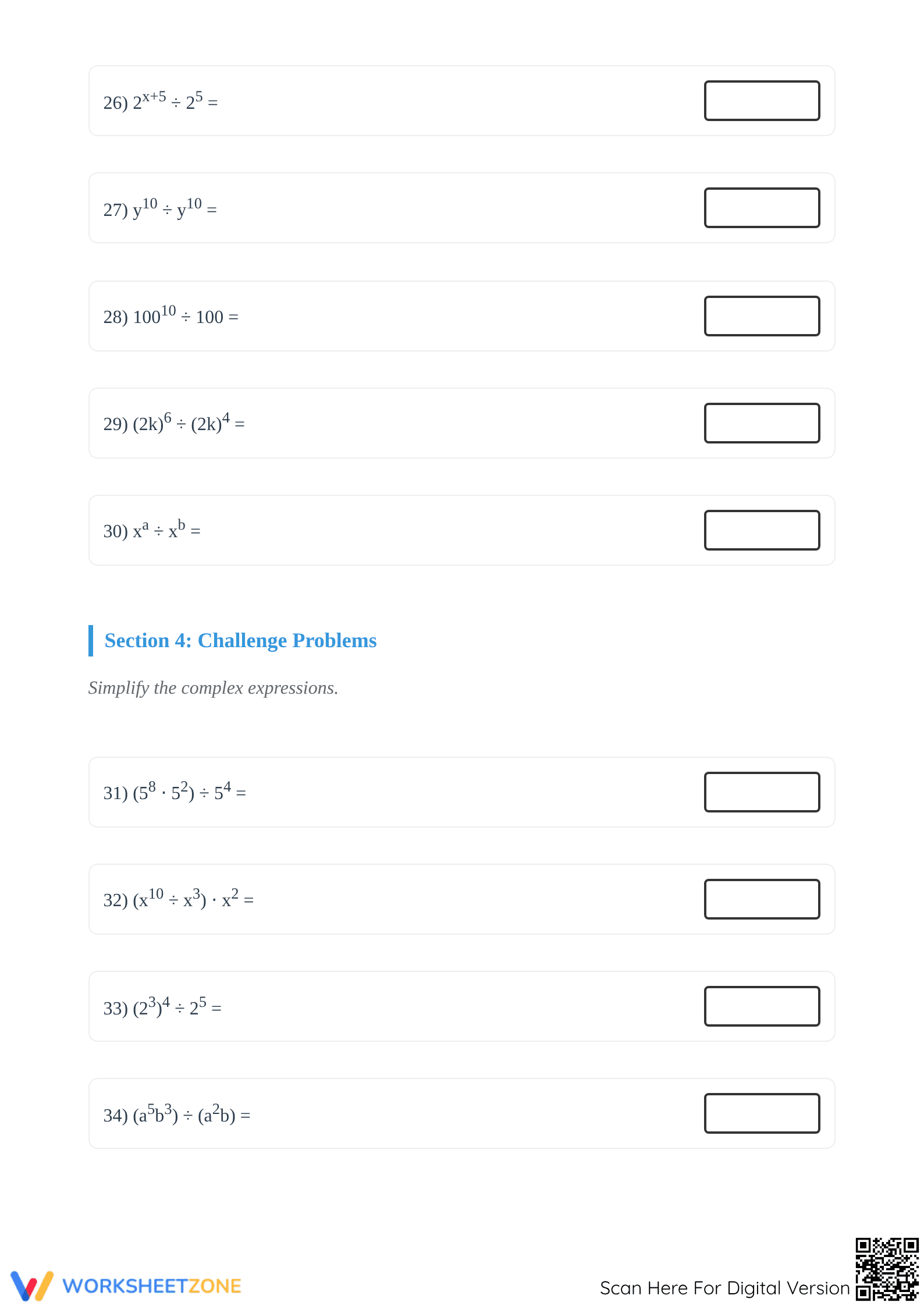
This extensive five-page PDF includes four distinct sections designed to build mastery through repetition and increasing complexity. It features ten integer base division problems, ten variable base problems, ten intermediate practice tasks involving larger exponents and coefficients, and eight multi-step challenge problems. A complete, step-by-step answer key is provided to ensure easy grading and immediate student feedback.
Skill Progression
- Guided Practice: The worksheet begins with numerical problems that explicitly state the quotient rule, providing a scaffolded entry point for learners to subtract exponents with identical integer bases.
- Supported Practice: Sections transition students into variable bases and intermediate expressions, requiring them to apply the rule independently while navigating coefficients and decimals.
- Independent Practice: The final section presents challenge problems where students must perform multiple operations to arrive at the simplest exponential form.
This "I Do, We Do, You Do" structure ensures students move from basic computation to high-level application.
Standards Alignment
This resource is directly aligned with 8.EE.A.1. Students will "know and apply the properties of integer exponents to generate equivalent numerical expressions." Specifically, the worksheet focuses on the Quotient of Powers property. This standard code can be copied directly into lesson plans, IEP goals, or district curriculum mapping tools to ensure instructional coherence and rigour.
How to Use It
Use this packet as a summative practice set after introducing the laws of exponents. The first two pages work well for in-class guided practice, while the remaining pages serve as an excellent homework assignment or sub plan. Teachers should observe students at problem 21 to ensure they are correctly handling coefficients before moving into the multi-step challenge problems.
Who It's For
This worksheet is designed for eighth-grade math students but is also suitable for sixth and seventh-graders who are ready for advanced algebraic concepts. It provides essential support for students needing remediation on exponent rules or an extension for those ready for complex multi-operation tasks. It pairs naturally with a laws of exponents anchor chart or a digital lesson on algebraic expressions.
The ability to manipulate exponential expressions using the quotient rule is a critical precursor to success in high school algebra. This worksheet facilitates this skill by providing high-volume deliberate practice, which is essential for procedural fluency. According to NAEP, proficiency in algebraic expressions at the eighth-grade level is a strong predictor of post-secondary STEM readiness. This resource addresses this need by aligning directly with standard 8.EE.A.1, ensuring students can accurately apply properties of integer exponents. By moving from simple numerical bases to complex variable expressions, the packet supports the cognitive load required for mastery. Fisher & Frey (2014) emphasize that scaffolded materials allow for the gradual release of responsibility, moving students from recall to complex problem-solving. This approach ensures that Grade 8 learners build a robust foundation in exponents.


